
Is your Facebook Page not getting a monetization invitation? Find out why it fails and learn how to get monetized on Facebook in 2026 with real requirements, timelines, and approval logic.
If your goal is simple—get your Facebook page monetized and keep it monetized—you need to think beyond checklists. Facebook does publish requirements, but approvals don’t happen just because you tick boxes. In real life, monetization follows patterns, not promises. Pages that understand those patterns move forward; pages that don’t usually stall without explanation.
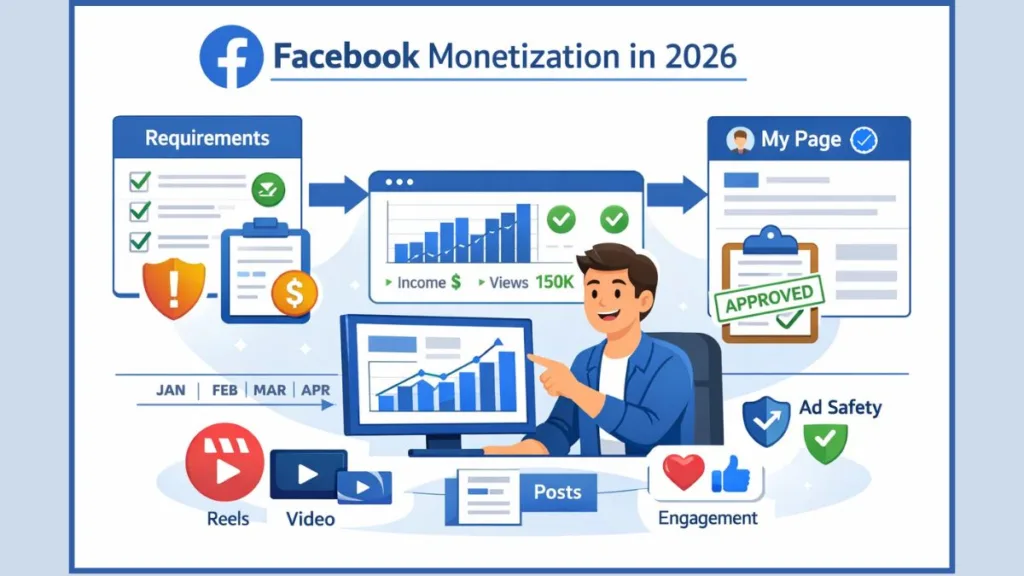
This guide goes deeper, using real-life examples and practical interpretation so you understand how Facebook monetization actually plays out over time in 2025–2026.
What Facebook Monetization Really Means in 2026
Facebook monetization is not about your personal profile. It is entirely page-based (or tied to a professional account). This single misunderstanding explains why many creators never get monetized—they focus on themselves instead of treating the Page as a business asset.
In 2025, Facebook consolidated older monetization programs into a single unified system often referred to as Content Monetization. This system allows earnings from multiple content formats, including Reels, long-form videos, photos, and text posts, all tracked in one dashboard.
Important reality: Facebook does not pay you for effort. It pays you for predictable, advertiser-safe performance.
In practice, Facebook evaluates your Page like a digital media outlet. It watches how consistently you publish, how stable your audience engagement is, and how safe your content feels for advertisers. If your Page looks unstable—random posting times, frequent topic changes, or trend-chasing behavior—monetization rarely moves forward, even if a few posts go viral.
Official Facebook Monetization Requirements and Eligibility Rules
These are the baseline Facebook monetization requirements. If you miss these, monetization does not happen—period.
To be eligible for review, your Page must meet the following:
- Good Standing: No repeated policy violations, copyright shortcuts, or borderline content that triggers limited reach.
- Location: You must live in a country where monetization is available.
- Age: You must be 18 years or older.
- Activity: Your Page must show consistent activity over time.
Real-world warning: If a Page posts daily for two weeks, disappears for a month, then suddenly starts posting aggressively again, monetization will likely stall. On paper, nothing is “wrong.” In reality, Facebook sees instability, not reliability.
Key clarification: Eligibility is only permission to be reviewed, not a guarantee of monetization. Facebook does not publish a universal follower or view threshold that guarantees approval. Instead, it evaluates behavior patterns, content quality, and policy history together.
Why Many Facebook Pages Never Get Monetized (Even When Eligible)
This is where most frustration begins.
Many creators wait endlessly for an “Apply for monetization” button instead of improving how their Page behaves. Others chase viral reach by posting trending memes, reused clips, or controversial takes—believing views equal progress.
They don’t.
Facebook does not reward spikes. It rewards patterns. Pages that look unpredictable, opportunistic, or risky are quietly deprioritized. There is usually no rejection email, no warning, and no explanation—just silence.
Hard truth: If your Page feels chaotic to Facebook, monetization quietly stops moving forward.
How Facebook Actually Decides Monetization Approval (Real-World Insight)
In real-world observation, mid-size Facebook Pages often monetize faster than very large ones. Pages in the 30K–60K follower range tend to show cleaner engagement signals. Their reach is easier to evaluate, and their audience behavior is more stable week after week.
Consistency beats virality every time. A Page posting similar content daily with steady reach often monetizes sooner than a Page that goes viral once a month. Facebook wants confidence that paying you won’t create advertiser risk.
There is also a silent evaluation phase. Facebook rarely announces it, but Pages are monitored over time. This is why monetization sometimes appears to activate “suddenly.”
It wasn’t sudden—you were being evaluated for weeks or months.
The Facebook Page Model That Works for Monetization
Pages that succeed rarely rely on a single Page. Instead, they build focused, niche-specific Pages that each serve one clear purpose.
For example, instead of one broad entertainment Page, creators separate topics into different Pages—one focused on facts, another on light news, another on evergreen visuals. If one Page slows down, the others continue performing.
This approach spreads risk, stabilizes earnings, and makes each Page easier for Facebook to understand.
Facebook monetization favors structured publishing assets, not personality-driven chaos.

Content Strategy That Passes Facebook Monetization Review
Content that passes monetization review often looks boring on purpose.
Pages using original visuals and videos, even simple ones, outperform Pages that repost viral content. A basic fact graphic created in-house frequently performs better long-term than a scraped meme because it is safer, cleaner, and easier to verify.
Pages that rely on trending clips or reused content may grow fast but usually hit a ceiling. Monetization either never activates or gets removed later.
Facebook prioritizes advertiser safety over creativity.
How Long It Takes to Get Monetized on Facebook
Monetization is not instant.
Most Pages that succeed show three to six months of consistent posting before monetization changes appear. If you post daily for a month and then stop, the clock does not keep running. If you receive policy warnings, the clock often resets.
Think of monetization like credit history. Time and consistency matter more than short bursts of activity.
Patience is not optional—it is part of the system.
Can Paid Growth Help You Get Monetized on Facebook?
Paid growth can help you move faster, but it cannot skip fundamentals.
Using ads to grow a Page can make it look established sooner, which may accelerate review. However, ads do not fix weak content, low engagement, or policy violations.
In practice, paid growth works best when content already performs organically and ads are used only to scale visibility—not to fake legitimacy.
Paid growth accelerates progress; it does not replace trust.
How Much Money Can You Earn from Facebook Monetization?
There is no fixed payout.
Earnings depend on stable reach, audience behavior, content niche, advertiser demand, and seasonality. Some Pages earn a few hundred per month. Others consistently cross four figures.
The difference is rarely follower count. It is predictability and compliance over time.
Facebook pays reliability, not potential.
Common Mistakes That Block Facebook Monetization
Most failures come from impatience and shortcuts. Pages copy what went viral yesterday instead of building a repeatable content system. Others ignore small warnings, assuming they don’t matter. Over time, those warnings accumulate.
Another common issue is frequent niche switching. Facebook struggles to evaluate Pages that constantly change direction, and confusion slows approval.
Monetization rewards clarity, discipline, and consistency.
Step-by-Step Focus to Get Monetized on Facebook
- Start with a safe, evergreen niche advertisers won’t avoid.
- Build one clean Facebook Page with a clear purpose.
- Post original content on a predictable schedule.
- Protect your policy record aggressively.
- Track Page health, not vanity metrics like likes or shares.
When your Page behaves like a reliable publisher, monetization becomes a byproduct.
FAQ: Facebook Monetization
Can you get monetized on Facebook without followers?
In real practice, very small Pages rarely receive monetization invites because Facebook lacks enough performance data.
How do you check Facebook monetization eligibility?
You can view your Page’s status and alerts inside the Monetization section of your Meta Business Suite dashboard.
Why was Facebook monetization removed from my Page?
The most common reasons are reused content (unoriginal content), policy violations, or engagement manipulation.
Is Facebook monetization guaranteed?
No. Eligibility improves your chances, but approval is always discretionary and monitored over time.
Final Thought
Getting monetized on Facebook is not about discovering a hidden trick. It is about behaving like a Page Facebook can confidently pay—consistently, compliantly, and predictably for months.
Do that long enough, and monetization stops being a mystery and becomes the natural outcome of trust.
Useful Resources to Get Monetized on Facebook: Official & Practical
Facebook Monetization Eligibility Checker: Use this first. It shows exactly why your Page is eligible or blocked, including policy issues and monetization status.
Facebook Content Monetization Overview: Explains how Facebook’s unified Content Monetization system works across Reels, videos, photos, and text posts.
Partner & Content Monetization Policies: These policies decide whether you get paid or quietly blocked. Read them once, bookmark them forever.
Payout Setup Guide: Required after approval. If payouts aren’t configured correctly, earnings get delayed or frozen.
Check Facebook Page Status: Shows hidden violations, restrictions, or reduced distribution—even when no notification appears.
Visit Our Post Page: Blog Page