
Frozen app? Learn how to end task in Windows 11 with 4 fast ways to force quit unresponsive programs and fix high CPU issues in 2025—no restart needed.
Frozen app holding your screen hostage?
You don’t need to restart your PC. You don’t even need Task Manager—at least not anymore.
Windows 11 gives you several reliable ways to end a task, including a new, faster method that skips Task Manager entirely. This matters because restarting your system interrupts work, closes every open app, and can worsen data loss if something is already unstable.
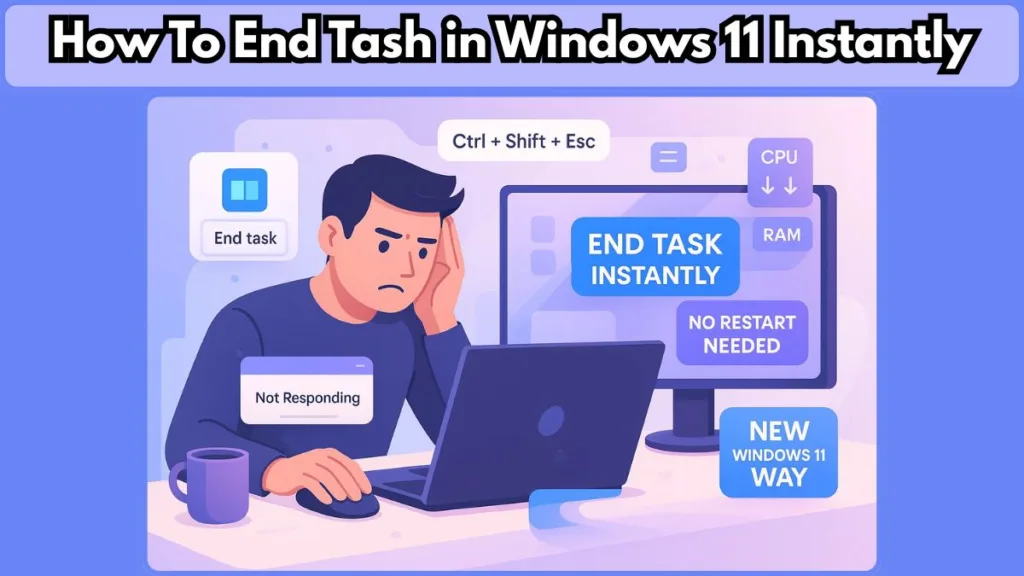
Whether your app is not responding, stuck on a frozen screen, running endlessly in the background, or consuming high CPU usage, this guide shows you exactly how to force close programs in Windows 11, starting with the quickest fix available and moving toward deeper recovery options.
Why Ending Tasks in Windows 11 Feels Different After Recent Updates
If apps feel more fragile lately, that’s not your imagination. Recent Windows 11 updates, especially 23H2 and later (including 24H2 builds), quietly changed how app termination works. Microsoft added a new taskbar “End Task” feature, but left it disabled by default and hid it inside Developer Settings, where most users never look.
At the same time, some users experienced Task Manager stability issues, including situations where Task Manager would not fully close and instead linger in the background. In real usage, this meant multiple Task Manager instances running invisibly, slowly consuming memory.
Combined with heavier modern apps, more background services, browser-based software, and increased memory pressure, this led to more frequent “Not Responding” states, frozen close buttons, and apps that simply refused to exit using normal methods.
This combination of new features + hidden settings + bugs is why task-ending behavior suddenly feels unfamiliar.
What “End Task” Means in Windows 11 and What Happens When You Use It
Before you kill an app instantly, it’s important to understand what Windows does behind the scenes. Closing an app normally using the X button sends a polite request asking the app to shut down, save state, and release resources properly.
End Task immediately terminates the app’s process at the system level.
When you force close a program in Windows 11, any unsaved data is lost instantly. However, the benefit is immediate relief: the app is removed from active memory, all background threads associated with it are stopped, and system resources such as CPU, RAM, and GPU usage are freed.
This is especially important when:
- An app is locked in an infinite loop
- A game freezes during loading
- A background app causes fan noise or overheating
- Windows becomes sluggish due to memory leaks
End Task is a recovery tool, not a daily closing method.
Fastest Way to End a Task in Windows 11 Using the New Taskbar Feature
This is where Windows 11 truly feels modern. Starting with Windows 11 version 23H2, Microsoft introduced a taskbar-based End Task option designed specifically to reduce friction during freezes.
Once enabled, this method removes the need to open Task Manager, wait for it to load, and manually find the process—steps that can feel painfully slow when your system is already struggling.
Right-click the app icon on the taskbar > Click End Task > App closes instantly.
This approach exists to help you kill stuck apps in seconds, especially when:
- Games crash mid-session
- Browsers hang with many tabs
- Creative apps stop responding
- UI clicks lag but the taskbar still responds
It is now the fastest way to close a frozen app in Windows 11 for everyday scenarios.
Method 1: How to End a Task in Windows 11 Using Task Manager
Even with newer features, Task Manager remains the most comprehensive and dependable tool for managing processes in Windows 11. It’s still the best choice when you need visibility, diagnostics, and control beyond a single app.
How to Open Task Manager in Windows 11 Quickly
You can open Task Manager instantly by pressing Ctrl + Shift + Esc, which bypasses menus and security screens. Alternatively, Ctrl + Alt + Delete provides access when the system UI is partially frozen, while right-clicking Start works during normal operation.
If Explorer is frozen, Ctrl + Shift + Esc is usually your best bet.
How to End an Unresponsive App from Task Manager
Once Task Manager is open, stay on the Processes tab. Locate the unresponsive application, select it, and click End Task. Windows immediately terminates the process and attempts to recover system stability.
Task Manager also shows CPU usage, memory consumption, disk activity, and GPU load, which helps you identify apps causing slowdowns, runaway background processes, or performance bottlenecks affecting the entire system.
Method 2: How to Enable and Use the Hidden Taskbar End Task Option
This is the feature most users miss—even though it’s the fastest.
What the Taskbar End Task Feature Does in Windows 11
The taskbar End Task feature adds an End Task option directly to the right-click menu of running apps on the taskbar. It works on Windows 11 23H2 and newer, but it is disabled by default and hidden under System > For Developers.
Microsoft hides it because it bypasses all app-level safety checks.
This feature performs immediate process termination without warnings, save prompts, or confirmations.
How to Enable End Task in the Windows 11 Taskbar
To enable it, open Settings, click System, go to For Developers, and toggle End Task to ON. The change applies instantly and does not require restarting your PC or Explorer.
How to Force Close an App from the Taskbar
After enabling it, simply right-click any running app icon on the taskbar and click End Task. This works even when the app window itself is completely frozen or visually stuck.
Limitations of the Taskbar End Task Feature
This method only works for apps that expose a taskbar icon. It cannot terminate protected system services or background-only processes, and it does not give you a chance to save work before closing the app.
Method 3: Keyboard Shortcuts to Force Close Programs in Windows 11
Keyboard shortcuts remain useful when the system is slow but still partially responsive.
Common End Task and Force Quit Shortcuts
Pressing Alt + F4 attempts a graceful close and may still trigger save prompts if the app responds. Ctrl + Shift + Esc opens Task Manager instantly, while Ctrl + Alt + Delete provides access when the desktop UI becomes unstable.
If Alt + F4 fails repeatedly, the app is likely stuck at the process level.
At that point, forced termination methods are required.
Method 4: How to Kill a Process in Windows 11 Using CMD or PowerShell
When graphical tools fail entirely, the command line gives you absolute control.
Force Quit Apps with the Taskkill Command
Open Command Prompt or PowerShell as administrator, then type:
taskkill /im appname.exe /f
If you know the Process ID (PID), you can target it precisely using:
taskkill /pid 1234 /f
This method is especially effective when:
- Explorer crashes
- Task Manager refuses to open
- Malware or broken services block UI access
What to Do If Task Manager Is Not Closing in Windows 11
Some Windows 11 builds introduced a bug where Task Manager hides instead of closing, leaving multiple instances running silently in the background. Over time, this can cause unnecessary memory usage and slow system response.
This issue directly influenced Microsoft’s decision to add the taskbar End Task feature.
You can resolve it by ending Task Manager from itself, using the taskkill command, or restarting Windows Explorer to reset the shell environment.
Common End Task Problems in Windows 11 and How to Fix Them
If the End Task option is missing, confirm your system is running Windows 11 23H2 or newer and that it’s enabled in Developer Settings. However, if Windows 11 End Task is not working, the app may be running as a protected or elevated process.
If an app still refuses to close, terminating related background processes, restarting Explorer, or performing a Windows 11 reboot usually restores normal behavior.
Best Practices to Prevent Frozen Apps and High CPU Usage in Windows 11
Keeping Windows and drivers updated ensures compatibility with newer apps. Limiting startup programs reduces background load, while monitoring system resources helps catch runaway processes early.
Regular restarts clear RAM, reset background services, and improve long-term stability.
Avoid force-closing system processes unless absolutely necessary.
FAQ: How to End Task and Force Quit Apps in Windows 11
What is the shortcut key to end a task in Windows 11?
Ctrl + Shift + Esc opens Task Manager instantly.
How do I force quit a program in Windows 11?
Use the taskbar End Task feature, Task Manager, or the taskkill command.
How do I enable End Task on the taskbar?
Settings → System → For Developers → Toggle End Task ON.
Why can’t I end some tasks in Windows 11?
Some system processes are protected to keep Windows stable.
How do I kill a task using CMD in Windows 11?
Use taskkill /im app.exe /f in an elevated Command Prompt.
End Task in Windows 11: The New Way vs the Old Way
Old way: Ctrl + Alt + Delete > Task Manager > Find app > End Task
New way: Right-click app on taskbar > End Task
If an app freezes, it’s not your fault—Windows changed how things work.
Now you know how to end task in Windows 11 in the fastest, safest, and smartest way possible.
Visit Our Post Page: Blog Page