
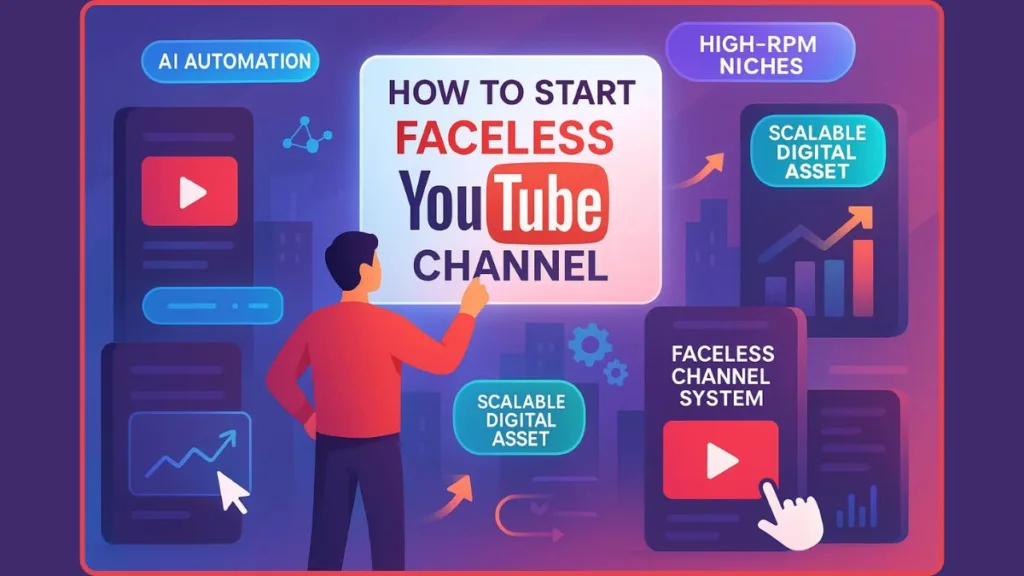
Build a scalable digital asset in 2026. Learn how to start a faceless YouTube channel using AI automation, high-RPM niches, and systems that actually monetize.
Faceless YouTube Automation in 2026 and the Scale of the Opportunity
Let’s start with a simple comparison.
Creator A runs a vlog. He spends 8–10 hours filming, editing, and uploading a single video. Eventually, one upload reaches 100,000 views. The engagement feels rewarding, the numbers look impressive, and the momentum feels real. But the moment he stops uploading, the income stops too. His success is directly tied to his time and presence, keeping him trapped on the hamster wheel.
Creator B takes a different path. She doesn’t vlog or show her face. Instead, she manages a faceless YouTube automation channel built inside a high-RPM niche like cybersecurity explainers. Her role is not manual creation but system oversight. She spends roughly 2 hours managing a workflow, coordinating scripts, voiceovers, and visuals. Her video reaches 10,000 views, yet it earns more than Creator A’s viral vlog because advertisers in certain niches pay significantly higher rates.
This outcome is possible because YouTube in 2025 has 2.53 BILLION monthly active users. The platform is not saturated—it is still expanding. You do not need everyone. You only need a fraction. Reaching just 0.001% of users is enough to build a full-time income.
Think of a YouTube channel in 2026 as owning a billboard in a city of 2.5 billion people. You are not targeting the crowd—you are targeting value.
Creator A is trading time for views.
Creator B is building digital real estate.
This guide is not about becoming famous. It is about shifting from content creation to asset management, using faceless YouTube automation, AI-powered workflows, and high-value niches that still work in 2025 and so for 2026.
What Is a Faceless YouTube Automation Channel in 2026?
In 2026, YouTube automation does not mean bots, spam, or recycled clips uploaded at scale. That model is dead.
Modern faceless YouTube automation operates like a high-tech factory, not a sweatshop. The channel owner is no longer the laborer. They are the Digital Architect designing a system where scripting, narration, visuals, and publishing run through repeatable processes.
A properly built faceless automation channel relies on AI tools to assist with scripting, voiceovers, and video assembly. It may include outsourced editors or thumbnail designers, supported by stock footage or AI-generated visuals. Most importantly, it is built on scalable infrastructure that allows consistent output without daily involvement.
The goal is not to remove effort entirely. The real objective is to remove dependency on your face, your voice, and your constant presence.
In this model, the protagonist is not the creator.
It is the system.
Why Faceless YouTube Channels Work in 2026 (Mobile-First Viewing Behavior)
A critical reason faceless automation works so well today is viewer behavior. Over 70% of all YouTube watch time now happens on mobile devices. Most viewers are watching on phones—while commuting, relaxing, or multitasking.
They are not analyzing lighting, camera gear, or cinematic framing. They respond to clear visuals, bold on-screen text, strong narration, and simple storytelling that works on a small screen.
This is why faceless videos—with large subtitles, clean visuals, and direct explanations—often outperform highly produced vlogs. They are optimized for how people actually consume YouTube in 2025.
Faceless is not a limitation.
It is a mobile-first advantage.
Is Faceless YouTube Automation Legit in 2026? (YouTube Monetization Rules Explained)
YouTube’s monetization rules function like zoning laws in real estate. If you build something cheap that adds no value, it is rejected. If you build a structured, valuable asset, it is approved and rewarded.
To monetize through the YouTube Partner Program (YPP), a channel must reach 1,000 subscribers and 4,000 watch hours from long-form content, or 10 million Shorts views within 90 days. This requirement acts as a barrier to entry, filtering out low-effort and spam-driven channels.
Poor automation—repetitive templates, unedited AI scripts, or reused footage—fails. This is slumlord behavior in digital real estate. Channels that invest in original scripting, clear narration, and meaningful editing continue to be monetized.
AI is allowed.
Automation is allowed.
Low value is not.
The rule remains simple: don’t be a slumlord—be a developer.
Understanding YouTube RPM in 2026: Why Niche Choice Beats Views
RPM (Revenue Per Mille) measures earnings per 1,000 views after YouTube’s cut. This metric matters far more than raw view count.
In 2025, finance RPM ranges from $15 to $50, while gaming RPM typically sits between $1 and $4. This difference reshapes the entire business model.
A gaming channel may need 1 million views to earn roughly $2,500. A finance or tech channel can generate around $35,000 from the same view count. This is the difference between owning property in a low-value area and owning property in a high-value neighborhood.
This is why 10,000 views in the right niche can outperform 100,000 views in the wrong one. Views are vanity. RPM is reality.
YouTube Shorts vs Long-Form Content: Growth vs Income Strategy
YouTube Shorts receives approximately 70 BILLION views per day, making them one of the largest discovery engines in the world. However, Shorts RPM ranges from just $0.01 to $0.06.
This means Shorts excel at reach, not revenue. Generating 1 million Shorts views may earn $10–$60, while just 2,000 long-form views in a finance niche can produce the same income.
The correct strategy is clear. Shorts are your marketing department. Long-form videos are your sales department. Growth comes from Shorts. Profit comes from long-form content.
High-RPM Faceless YouTube Niches That Actually Work in 2026
Certain niches consistently outperform others because of advertiser demand and viewer intent. Personal finance and money explainers lead due to aggressive advertiser competition and premium RPMs. Make-money-online and business education attract audiences with strong buying intent.
Legal and compliance content benefits from advertisers willing to pay higher rates. Technology and AI explainers attract SaaS advertisers with high CPMs. Documentary and educational storytelling generates strong watch time, while relaxation and ambient sound content benefits from long viewing sessions that allow multiple ad placements.
All of these niches are faceless-friendly, automation-ready, and proven to monetize in 2026.
Faceless YouTube Automation Workflow (Step-by-Step Blueprint)
A successful faceless channel follows a repeatable system. It begins with keyword and topic research driven by search demand rather than trends. Scripts are produced using AI assistance, then refined with human logic to ensure originality and clarity.
Voiceovers are generated through AI or human narration. Visuals come from stock libraries or AI-generated assets. Thumbnails are designed with mobile-first principles, using bold text and clear contrast. Metadata is optimized, and performance is measured through watch time, retention, CTR, and RPM.
The algorithm does not reward effort.
The algorithm loves systems.
Best AI Tools for Faceless YouTube Automation in 2026 (Complete Stack)
In 2026, running a faceless YouTube automation channel means deploying a full stack of AI tools, each handling a specific phase of production to reduce manual work and increase consistency. These tools form the backbone of a scalable system that allows faster turnaround without sacrificing quality.
A complete AI stack starts with script and content generators that transform ideas into structured scripts, then moves to voice synthesis and automated editing, and finishes with thumbnail and SEO tools that maximize discoverability. These tools replace repetitive manual tasks and allow you to focus on strategy and optimization.
Scriptwriting and research tools like ChatGPT (using custom personas and structured prompts) or Claude can generate well-paced, logically sound video scripts with strong hooks and clear explanations. These tools dramatically reduce writing time while still allowing room for human refinement and originality.
Voiceover generators like ElevenLabs or Murf.ai produce natural narration with realistic tone, pacing, and emphasis. High-quality voice synthesis is critical for retention, especially in faceless formats where narration carries the entire video experience.
AI video production and editing tools such as InVideo AI, Pictory, Runway, or Capsule can automatically assemble visuals, sync audio, insert transitions, and format videos for long-form or Shorts. These platforms significantly reduce editing complexity and production time.
Automated clip repackaging tools like Vidyo.ai analyze long-form videos to identify highlights and convert them into Shorts, making it easier to build discovery funnels without additional filming or scripting.
SEO and optimization tools like TubeBuddy and VidIQ help identify keywords, optimize titles and descriptions, test thumbnails, and analyze competitors, ensuring each upload has the highest possible chance of ranking.
Thumbnail and caption automation tools such as Descript generate readable subtitles and on-screen text at scale, supporting accessibility and improving performance on mobile devices.
Together, these tools create a fully automated production pipeline that supports script > voice > visuals > optimization. This is what scalable faceless YouTube automation looks like in 2026.
How Much Does It Cost to Start a Faceless YouTube Automation Channel?
Starting a faceless YouTube automation channel in 2026 can be cost-efficient, with expenses scaling based on how fast and how professionally you want to move.
At the lowest level, you can start with a $0 setup, using free AI tools, free trials, and royalty-free media. This approach works but usually comes with slower output and limited customization.
A more practical and scalable setup typically falls in the $50–$150 per month range. This budget allows access to higher-quality AI video editors, better voice synthesis, SEO tools, thumbnail software, and analytics. These tools significantly reduce production time and often lower the cost per video compared to manual workflows.
If you add outsourced editors, voice talent, or specialized freelancers, costs increase further. However, even with outsourcing, many automation channels keep initial production costs around $100 per video, often reaching break-even after producing 12–35 videos, depending on niche, RPM, and audience engagement.
How to Scale a Faceless YouTube Channel Without Burnout
Burnout happens when automation channels are run like one-person jobs. True growth requires treating your channel as business infrastructure, supported by systems rather than constant effort.
Scaling starts with batch production, where scripts, voiceovers, and visuals are created in groups rather than one video at a time. This reduces context switching and dramatically improves efficiency.
Delegation and automation follow. Tasks such as voiceovers, editing, uploads, and metadata can be automated or outsourced, allowing you to separate content execution from system management.
Data-driven iteration is essential. Tracking watch time, engagement, CTR, and RPM allows you to double down on what works and eliminate what doesn’t. Scaling is built on feedback loops, not guesswork.
Common Mistakes That Kill Faceless YouTube Automation Channels
One of the most damaging mistakes is publishing low-effort AI content without meaningful human refinement. AI can assist, but it cannot replace logic, structure, and value.
Ignoring watch time and retention signals stalls growth even with frequent uploads. Relying solely on Shorts for income is another critical error due to their extremely low RPM.
Treating YouTube as social media instead of a search-driven digital asset leads to poor SEO and inconsistent traffic. Finally, failing to analyze analytics results in repeated mistakes and stalled channels.
FAQ: Faceless YouTube Automation in 2026
Is faceless YouTube automation dead?
No. Low-effort automation is dead, not system-driven, high-value channels.
Can AI-generated videos be monetized?
Yes, when they provide original value and meet YouTube’s monetization standards.
Which niches have the highest RPM in 2026?
Finance, business, and technology remain the highest-paying niches.
How soon can earnings start?
With consistency and proper niche selection, many channels earn within a few months.
Conclusion: Building Digital Real Estate with Faceless YouTube Automation
You can build a job where income stops when you stop filming, or you can build a machine that continues working without you.
A faceless YouTube automation channel is not a shortcut.
It is a build-once, optimize-forever digital asset.
Stop trading time for views.
Build assets, not just videos.
High-value neighborhoods win.
In 2026, digital real estate beats the hamster wheel every time.
Visit Our Post Page: Blog Page