
Looking for the best meditation app for beginners in 2026? We compare Headspace, Calm, Insight Timer, Medito, Balance, and more—features, pricing, free plans, and beginner experience explained.
Looking for the best meditation app for beginners in 2026? You already know the frustration — dozens of apps all promising calm, clarity, and better sleep, but half of them throw up a paywall after three sessions and the other half leave you staring at a library of 300,000 meditations with no clue where to begin.
Here’s something that’s worth knowing upfront: the meditation app market has grown enormously, and not all of that growth has benefited the beginner. The global market is now valued at over $6.65 billion, and with that much money involved, the marketing has gotten louder while the actual beginner meditation experience hasn’t always gotten better.
The good news? A handful of apps genuinely nail the guided meditation for beginners experience — and a few of them won’t cost you a single rupee or dollar.
What follows is a plain-English breakdown of the best meditation apps for beginners right now, so you can stop reading comparison articles and actually start meditating.
Best Meditation Apps for Beginners 2026: Quick Verdicts
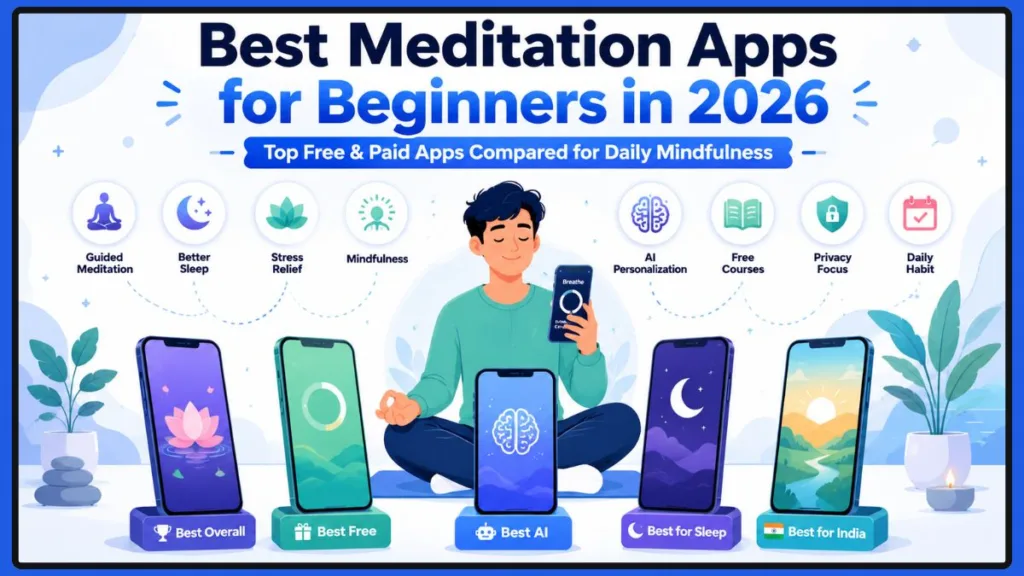
- Best overall for beginners: Headspace — structured “Basics” course, AI companion, science-backed curriculum
- Best completely free option: Insight Timer — 300,000+ free sessions, strong community, and surprisingly good retention
- Best for budget-conscious users: Medito — 100% free, nonprofit, no ads, curated beginner courses
- Best AI-personalized experience: Balance — first year free, daily mood check-ins, adaptive sessions
- Best for sleep: Calm — celebrity sleep stories, cinematic interface, deeply relaxing
- Best for Indian users: Idanim / Heartfulness — free Hindi content, live trainers, no paywall
- Best warm and humorous tone: Breethe — feels like a supportive friend, not a wellness robot
What’s Actually Happening in the 2026 Meditation App Market
Before diving into the picks, it helps to understand why the market looks the way it does — because the context genuinely changes how you should approach choosing a mindfulness app for beginners.
The global meditation app market sits at $6.65 billion in 2026 and is projected to hit $14.17 billion by 2031. That’s a 16.3% compound annual growth rate, driven by rising stress and anxiety levels, increasing smartphone access, and employers integrating digital wellness apps into their benefits packages.
The result? Every app is fighting for your attention, and many of them use the same strategy: offer a taste for free, then push you toward a $69.99/year subscription before you’ve built any real habit. The industry-wide 30-day retention rate tells the story honestly — most apps lose 95% of their users within a month.
The exception? Apps that actually solve the beginner problem instead of just marketing to it.
The best meditation app isn’t the one with the biggest library. It’s the one you’ll still be using in week three.
How We Evaluate Meditation Apps for Beginners
In 2026, every app claims to “reduce anxiety” and “improve sleep.” Those claims alone mean almost nothing. Here’s what actually matters when you’re choosing your first meditation app:
Onboarding experience: If the app doesn’t guide you to your first session within two minutes of downloading, most beginners never come back. The quality of that first-click experience is everything.
Session length options: Research consistently shows beginners benefit most from 3–10 minute sessions. Apps that front-load long sessions or hide the short ones create unnecessary friction.
Free content access: A 7-day trial isn’t enough to build a habit. Apps with genuine free tiers give you time to actually evaluate whether the daily meditation practice is working for you.
Software and privacy practices: Some apps collect mood data, sleep patterns, and journaling content. Before you share anything personal, it’s worth knowing who has access to it and how it’s used.
Long-term habit support: The best apps use structured courses, gentle reminders, and progress tracking — not guilt-driven streak notifications — to help you build a sustainable meditation routine.
The Best Meditation Apps for Beginners in 2026: Detailed Picks
Best Overall for Beginners: Headspace (~$69.99/year, 14-day free trial)
If you want the clearest, most beginner-friendly meditation app, Headspace is still it — and it’s not particularly close.
The “Basics” course is the gold standard in beginner onboarding: 10 sessions, each between 3 and 10 minutes, delivered with animated explainers and a tone that’s friendly without being patronizing. It demystifies meditation in a way that makes you feel competent rather than confused, which is exactly what a beginner needs in the first week.
Beyond the course, Headspace’s “Ebb” AI companion now adapts sessions based on how you’re feeling on a given day, which removes a lot of decision fatigue. Clinical research backs the app’s effectiveness — users report a 37% reduction in anxiety after eight weeks and meaningful improvements in sleep quality through the dedicated Sleep Program.
The main limitation worth knowing upfront is the paywall. Headspace’s free tier is genuinely limited, and if you’re not ready to commit financially after the trial, you’ll hit a wall quickly. That said, if budget isn’t a concern, it’s the most coherent structured meditation for beginners available.
Download Headspace:
Recommended for: Anyone who wants a structured, science-backed starting point and doesn’t mind paying for a polished experience.
Best Completely Free Option: Insight Timer (Free / $59.99/year for premium)
If you hear “free meditation app” and assume it means “watered-down,” Insight Timer is the app that challenges that assumption directly.
The free library contains over 300,000 guided sessions from teachers around the world, covering everything from basic breath awareness to sleep meditations, anxiety relief, and movement practices. That breadth is both its greatest strength and its most common beginner pitfall — the sheer volume can feel overwhelming if you don’t know where to start.
The fix? Head straight to the “Courses” tab and choose a structured beginner program rather than browsing the open library. That single decision dramatically improves the first-week experience.
What’s genuinely remarkable about Insight Timer is the retention data. While most apps lose 95% of users by day 30, Insight Timer achieves a 16% Day 30 retention rate — nearly double the industry average — largely due to its community features, group meditations, and the sense of practicing alongside other people.
Download Insight Timer:
Recommended for: Anyone who wants real free access, enjoys variety, and is willing to use the Courses section rather than browsing at random.
Best for Budget-Conscious Users: Medito (100% Free)
Medito is a nonprofit meditation app, and it shows — in the best possible way.
There are no ads, no paywalls, no premium tier, and no data-selling. The beginner course is curated, clear, and genuinely useful. The interface is simpler than the paid apps, but it gets out of the way and lets the meditation do the work.
If you’ve been put off by apps that offer three free sessions and then ask for your credit card details, Medito is a direct antidote. It won’t have the production polish of Calm or the AI features of Balance, but it provides everything a beginner actually needs to build a daily meditation habit — without any of the commercial pressure.
Download Medito:
Recommended for: Anyone who wants the purest, most pressure-free starting point for meditation.
Best AI-Personalized Experience: Balance (Free for the first year, then $69.99/year)
The Balance app takes a different approach to the beginner problem: instead of asking you to choose from a library, it builds a daily meditation session specifically for you based on your goals, experience level, and how you’re feeling each morning.
Daily mood check-ins feed into an adaptive algorithm that selects session length, focus area, and guidance style. Over time, the app genuinely learns what works for you — which is a meaningful advantage for beginners who aren’t yet sure what kind of mindfulness practice they’re looking for.
The first-year-free offer makes this an easy recommendation to try. You get the full premium experience without any financial commitment, which gives you enough time to actually evaluate whether AI personalization makes a difference for your practice.
Download Balance:
Recommended for: Anyone who wants a guided, personalized experience and doesn’t want to spend time choosing between options.
Best for Sleep: Calm (~$69.99/year, 7-day free trial)
If the primary reason you want to meditate is to sleep better, Calm has built its entire identity around that goal.
The Sleep Stories are the standout feature — long-form, narrated bedtime stories designed to ease your mind into rest, with some narrated by recognizable names. The soundscapes and ambient audio libraries are genuinely high quality, and the visual design of the app itself has a cinematic, relaxing quality that other apps haven’t quite matched.
Clinical data supports the sleep meditation angle: 90% of users report better sleep quality after consistent use, and the app’s “7 Days of Calm” starter series gives you a clear path into the practice without overwhelming you.
The main trade-off is similar to Headspace — the free content is limited, and the annual subscription adds up. But if sleep is your specific pain point, the investment is easier to justify.
Download Calm:
Recommended for: Anyone whose primary goal is improving sleep quality and who wants a beautifully produced experience.
Best for Indian Users: Idanim / Heartfulness (Free)
If you’re in India, or if Hindi is your primary language, these two apps deserve special mention because they solve a problem that most Western meditation apps completely ignore.
Both Idanim and Heartfulness are completely free, offer content in Hindi and other regional Indian languages, and provide access to live trainers — a feature that’s genuinely rare and valuable for beginners who benefit from human guidance rather than recorded audio alone. There are no paywalls and no data being sold to advertisers.
The research backs the importance of this: apps that offer regional language support see 21% higher usage and 15% lower churn than English-only alternatives in the Indian market. When meditation is explained in your mother tongue, the practice is simply more accessible.
Download Idanim:
Download Heartfulness:
Recommended for: Indian users, Hindi speakers, and anyone who prefers regional language content and live teacher access.
Best Warm and Humorous Tone: Breethe (~$89.99/year, 14-day free trial)
Breethe fills a specific gap in the meditation app for beginners market: it’s designed for people who find wellness apps a little too serious.
The “Learn to Meditate” series uses humor, relatable language, and a tone that genuinely feels like a supportive friend rather than a clinical wellness program. The app also includes hypnotherapy sessions and AI coaching, which rounds out the offering for users who want more than just guided breathing.
If you’ve tried other guided meditation apps and felt put off by the overly earnest, jargon-heavy approach, Breethe is the app most likely to change your mind.
Download Breethe:
Recommended for: Anyone who wants a warm, humorous, and judgment-free introduction to meditation.
Quick Comparison: Best Meditation Apps for Beginners 2026
| App | Price | Best Strength | Free Tier | Beginner Course | Regional Support |
|---|---|---|---|---|---|
| Headspace | $69.99/yr | Structured onboarding | Limited | Yes (Basics) | 5+ languages |
| Insight Timer | Free / $59.99/yr | Massive free library | Yes | Yes (Courses tab) | 30+ languages |
| Medito | Free | No paywall, nonprofit | Yes | Yes | English |
| Balance | Free yr 1, then $69.99/yr | AI personalization | Yes | Yes | English |
| Calm | $69.99/yr | Sleep content | Limited | Yes (7 Days) | 5+ languages |
| Idanim / Heartfulness | Free | Hindi, live trainers | Yes | Yes | Hindi, 10+ langs |
| Breethe | $89.99/yr | Warm, humorous tone | Limited | Yes | English |
What Actually Matters When Choosing a Beginner Meditation App
The Paywall Problem Is Real
Here’s a question worth asking before you download anything: how much free content does this app actually give you? Most apps offer 7 to 14 days of free access — which sounds generous until you realize that research consistently shows it takes longer than two weeks to build a meaningful meditation habit.
Apps like Insight Timer, Medito, and Heartfulness solve this by offering substantive free tiers that don’t disappear after a trial period. If budget or commitment uncertainty is a factor for you, starting with one of these removes the financial pressure that often causes people to abandon the practice before it takes hold.
Short Sessions Beat Long Sessions for Beginners
When you’re just starting, five minutes of daily meditation is more valuable than one forty-five-minute session per week. The research supports this clearly — short, consistent practice yields measurable reductions in stress and anxiety within thirty days.
Apps that front-load longer sessions, or that bury their short sessions behind multiple taps, create unnecessary friction. Look for apps that make a 3–5 minute session the obvious first choice, not something you have to dig for.
The Overwhelm Problem Is More Common Than You Think
The industry-wide 30-day retention data tells an honest story: most beginner meditators give up within the first month. The three biggest reasons are decision fatigue (too many choices with no guidance), paywalls appearing before a habit is formed, and a lack of visible progress.
If you find yourself staring at a library of hundreds of sessions and feeling paralyzed rather than motivated, that’s not a you problem — it’s a design problem. Structured beginner courses, like Headspace’s “Basics” or Balance’s daily personalized session, exist specifically to solve this. Using them from day one dramatically improves your chances of still meditating in week four.
Privacy Is Worth Checking Before You Share
Meditation apps often collect mood data, journaling content, sleep patterns, and usage behavior. How that data is used varies significantly between apps.
Headspace collects minimal personal data and is GDPR compliant. Calm collects more, including mood check-ins and usage analytics, and shares some data with analytics partners. Medito, Heartfulness, and Idanim collect very little and sell nothing to advertisers — which is a meaningful advantage if you’re sharing anything personal.
Before you start journaling your anxiety or logging your sleep patterns, it’s worth spending two minutes reading the privacy section of any app you’re considering.
Your mental health data deserves the same protection as your financial data. Check the privacy policy before sharing anything personal with a wellness app.
The Free vs. Paid Math
There’s a simple way to think about this. If you’re new to guided meditation and genuinely unsure whether it’ll stick, start with a free app — Medito, Insight Timer, or Heartfulness — and give it thirty days. If you’re still practicing at day thirty, that’s the time to evaluate whether upgrading to a paid experience makes sense for you.
If you already know you prefer structure and are willing to invest upfront, Headspace or Balance are the easiest recommendations. Balance’s first-year-free offer particularly removes the financial friction entirely.
Common Questions Answered
Which meditation app is actually best for complete beginners?
For structured guidance and the clearest possible starting point, Headspace’s “Basics” course is the most beginner-friendly experience available. If you want to start for free without any trial expiry, Medito or the Insight Timer Courses tab are excellent alternatives.
How long should I meditate as a beginner?
Five to ten minutes daily is enough to see real benefits — reduced anxiety, better focus, and improved sleep quality. The key is consistency over duration. One five-minute session every day is more effective than an hour-long session once a week.
Are free meditation apps actually any good?
Yes. Insight Timer’s free library is genuinely world-class. Medito’s beginner meditation course rivals the paid apps in quality. And for Indian users, Heartfulness and Idanim offer live trainer access at no cost — something most paid apps don’t provide at all.
Is Headspace or Calm better for beginners?
For pure beginner meditation structure, Headspace has the edge — the “Basics” course is more clearly designed for someone with zero meditation experience. Calm is better if sleep improvement is your specific goal, as that’s where its content genuinely excels.
What should I do if I tried a meditation app before and gave up?
That’s more common than you’d think — the industry’s own data shows it. The most common reasons are paywalls appearing too early, sessions that feel too long, and no clear starting point. Try Medito or Balance (first year free) with a single, firm commitment: one five-minute session per day for thirty days, using a structured beginner course rather than the open library. That combination addresses all three of the most common failure points.
Final Verdict: Which Meditation App Should You Download First?
The honest answer is that the right app depends on what’s most likely to help you actually start — and keep going.
- If you want the most structured, science-backed beginner experience: try Headspace’s free trial and work through the Basics course from day one.
- If budget is a concern and you want genuine free access: Medito has no paywall, no ads, and a curated beginner course. Start there.
- If you want AI personalization without upfront cost: Balance’s first year is free, and the daily adaptive sessions remove decision fatigue almost entirely.
- If your primary goal is better sleep: Calm’s sleep content is best-in-class.
- If you’re in India or prefer Hindi content: Idanim and Heartfulness give you live trainers and regional language support at no cost.
One thing that consistently matters more than any individual feature: actually starting. The best meditation app is the one with the lowest barrier between downloading it and your first five-minute session.
Five minutes a day. A structured beginner course. Thirty days. That’s the entire playbook — and any of the apps above will get you there.
Have you tried any of these apps? Which one clicked for you? Drop your experience in the comments — it helps other beginners figure out where to start.
Visit Our Post Page: Blog Page
Discover more from Izoate
Subscribe to get the latest posts sent to your email.