
Wondering if you can get monetized for a Facebook Group you created? Learn how Facebook group monetization works, whether Facebook pays group admins directly.
If you’ve spent months growing a Facebook Group, you may be wondering whether you can actually make money from it. Perhaps your group has hundreds or even thousands of members actively commenting, sharing, and engaging every day. At that point, it’s natural to ask whether Facebook offers a way to monetize your community.
The short answer is that Facebook does not automatically pay people just for creating Groups. However, many group owners earn a sustainable income by leveraging the audience they’ve built through memberships, affiliate marketing, digital products, coaching, and sponsorships. The opportunity is real, but it requires understanding how community value actually works.
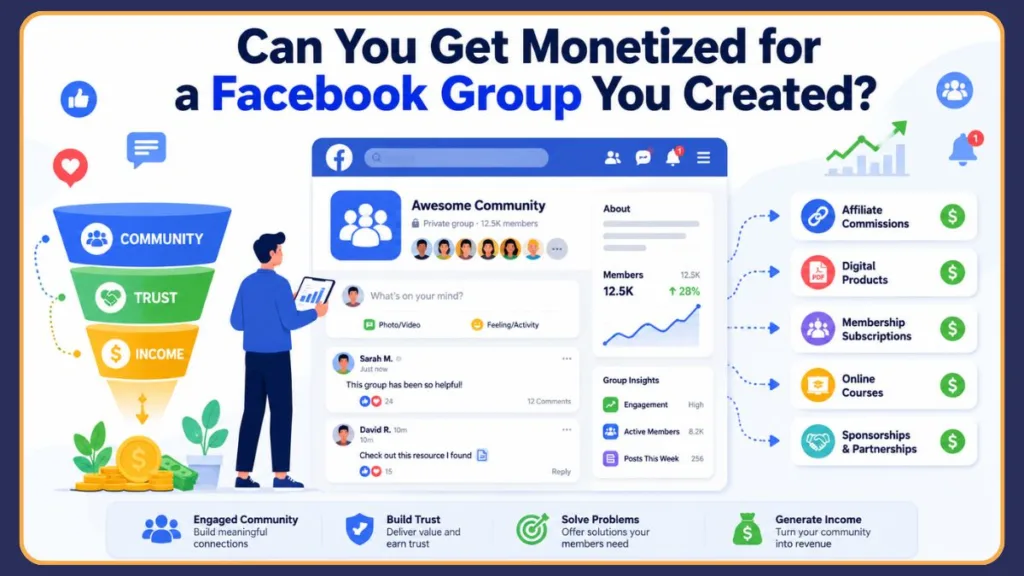
In an era where algorithmic feeds dominate, your Facebook group acts as a sanctuary for like-minded individuals. Highly active group members are often far more likely to invest in recommendations compared to passive page followers. The challenge is no longer just building the audience; it’s learning how to strategically guide that audience toward helpful solutions without making your community feel like they are constantly being sold to.
As of mid-2026, Meta has begun rolling out its “Meta One” subscription ladder, including plans like Facebook Plus and Instagram Plus for $3.99 per month. This shift proves that even the world’s largest ad-based platforms recognize the immense value of recurring subscription revenue and premium community features. Group admins who adopt this mindset—treating their community as a premium asset rather than just a free forum—are positioned to thrive in the current creator economy.
What Is Facebook Group Monetization and How Does It Work?
Facebook group monetization is the process of extracting financial value from a highly engaged online community. At its core, it is about identifying the unique needs, pain points, and desires of your group members and offering them tailored solutions.
Instead of relying on passive ad revenue, group admins monetize their influence through direct product sales, third-party partnerships, or by transitioning members to off-platform paid ecosystems. This means stepping away from traditional “pay-per-click” mindsets and stepping into a community-first entrepreneurial model. Whether you are running a local gardening group, a software developers’ network, or a fitness accountability club, the fundamental principle remains the same: value drives revenue.
Industry data from 2026 shows that community-led businesses are experiencing unprecedented growth. Because consumer trust in traditional advertising is declining, peer-to-peer recommendations inside private Facebook groups carry incredible weight. Today’s most successful admins operate as digital community managers, curating experiences and products that save their members time and money.
Is Facebook Group Monetization Actually Available in 2026?
Yes, but the strategy has fundamentally shifted. Rather than looking for native platform payouts, successful admins in 2026 use their groups as high-trust marketing funnels to drive their own independent revenue streams.
With Meta constantly updating its algorithms to prioritize meaningful interactions, groups currently enjoy some of the highest organic reach on the platform. However, because the tools to earn directly from Facebook are evolving, modern creators are adopting hybrid approaches. They combine digital product launches, exclusive coaching, and subscription models. The secret to success in 2026 is seeing your Facebook group not as the final destination, but as the top of your business funnel.
A major shift occurred early in 2026 when Meta transitioned its beta monetization features into the fully public Content Monetization Program (CMP). While this unified dashboard (which merges In-Stream Ads, Reels bonuses, and Performance bonuses) is strictly for Pages and Profiles, savvy group admins use their groups as the ultimate distribution channel. By driving their highly engaged group members to interact with their monetized Page content, admins are indirectly leveraging 2026’s newest platform tools to generate substantial revenue.
Does Facebook Monetize Facebook Groups Directly?
If you’re hoping Facebook will automatically pay you simply for creating a Facebook Group, the answer is usually no. Many users assume Facebook Groups work exactly like YouTube channels, TikTok accounts, or public Pages where ad revenue splits kick in automatically. However, that doesn’t mean your group can’t become a valuable source of income.
Does Facebook Pay Group Creators Directly for Their Communities?
No. As of 2026, Facebook does not cut a direct check to group admins simply for running a group, nor do they share ad revenue generated from the feed inside the group. The platform provides the infrastructure, but the monetization strategy is entirely up to you.
Think of Facebook as a provider of a bustling, free community hall. They give you the space and the structural tools to bring people together, but they aren’t going to hire you as an employee. Admins who succeed financially are those who take full responsibility for their revenue, viewing their group as a free relationship-building tool rather than a payroll platform.
Warning: In April 2026, Meta announced a massive shift toward AI-handled content moderation across its platforms. This means admins must be more vigilant than ever about Meta’s Community Standards. Relying on Facebook to pay you directly is not just impossible; relying on them as your sole business platform is risky without a diversified off-platform strategy.
Understanding the Difference: Facebook Page Monetization vs. Group Monetization
Pages broadcast to audiences and can natively run in-stream ads or earn from Stars. Groups are interactive hubs built for deep, peer-to-peer community engagement. Because of this, groups require direct-to-consumer monetization strategies rather than relying on automated ad placements.
To break it down further:
- Pages (The Stage): Designed for one-to-many communication. Meta allows eligible Pages to run in-stream video ads, earn bonuses, and collect tips (Stars). It’s perfect for viral video creators.
- Groups (The Round Table): Designed for many-to-many communication. Facebook limits native ad insertions here because it disrupts the flow of conversation. Therefore, monetization must happen through relationships, recommendations, and direct sales.
The newly public 2026 CMP operates on a “Performance-Based Payout Model” for Pages, decoupling revenue from specific ad impressions and instead rewarding creators for “Qualified Views” and overall engagement across Reels, long-form videos, photo posts, and text updates. Groups, by contrast, cannot enroll in this performance dashboard. Group monetization remains an active, entrepreneurial pursuit rather than a passive, algorithmic one.
Can a Facebook Group Qualify for Facebook Content Monetization?
Not directly. The unified Facebook Content Monetization program applies to Profiles and Pages, paying out for Reels, videos, and posts. However, clever admins share their monetized Page content directly into their Groups to drive highly qualified, engaged views that boost their Page earnings.
This cross-pollination strategy is incredibly powerful in 2026. If you are enrolled in the Facebook Content Monetization program on your Page, the views you generate dictate your performance-based payout. By dropping your monetized Reels or long-form videos into a group of 10,000 hyper-engaged members, you guarantee a massive spike in watch time, essentially using your group to amplify your Page’s direct platform earnings.
Furthermore, Meta’s new “Creator Fast Track” program, expanded in 2026, offers guaranteed monthly payouts (ranging from $100 up to $3,000 depending on follower counts) for creators who consistently post original Reels. Group owners who maintain an eligible Page can create targeted Reels answering their group’s most common questions, share them to the group for guaranteed high retention rates, and easily hit the Fast Track engagement metrics.
Can You Earn From Facebook Groups Without Professional Mode Enabled?
Absolutely. Because group monetization relies on third-party links, digital products, and external platforms, you do not need to turn your personal profile into Professional Mode to make money from your community.
Many admins prefer to keep their personal profiles private while running highly profitable groups. Your earning potential is tied to the authority you command within the group and the quality of the solutions you offer, not to the specific status of your personal Facebook account.
This separation allows creators to maintain a boundary between their personal lives and their business operations. You can run a 50,000-member group using your standard private profile and still route all business inquiries, affiliate sales, and coaching sign-ups through a dedicated business email or external website.
Can Facebook Group Admins Make Money? Realities and Expectations
Before discussing monetization methods, it’s important to understand that Facebook Groups generate value differently from Facebook Pages. The community itself is the asset. Once you’ve built trust and engagement, you can begin introducing revenue streams. The most successful Facebook Groups make money because members trust the recommendations, products, and expertise being shared.
The rise of specialized subscription platforms in 2026 underscores this reality. Creators are learning that a small, highly engaged audience that trusts the admin’s expertise will gladly pay for premium access, resulting in much higher and more stable earnings than algorithmic ad revenue could ever provide.
How Many Members Do You Need to Monetize a Facebook Group Effectively?
Engagement drastically outweighs sheer volume. While advertising directly to corporate brands usually requires 25,000+ members, hyper-niched groups can easily monetize with just 1,000 to 3,000 active, trusting members.
For example, a generic “Funny Memes” group with 100,000 members might struggle to make $100 a month because the audience is too broad to sell a specific product to. Conversely, a highly targeted group of 1,500 “First-Time Golden Retriever Owners in Texas” could generate thousands of dollars monthly through specialized dog training courses, premium pet food affiliate links, and local grooming sponsorships.
In fact, micro-communities have become the gold standard for high-ticket coaching and specialized digital products. When a group is highly specific, the conversion rates for relevant affiliate offers can soar past 10%, whereas generic pages often see conversion rates well below 1%. This means a smaller group owner can out-earn a massive influencer simply by knowing exactly what their members need.
Can a Private Facebook Group Be Monetized? Strategies for Success
Yes. In fact, privacy often increases exclusivity and trust. Members in a closed, safe environment are highly receptive to an admin’s recommendations, making them much more likely to convert into paying customers compared to a public audience.
Private groups also act as a natural filter against spammers and bots. When members have to answer vetting questions to join, they enter the space already invested in the topic. This psychological commitment translates directly to higher open rates on your links and higher conversion rates on your product offers.
Additionally, maintaining a private group shields your proprietary content and strategies from competitors. When you offer premium advice, beta test new courses, or share exclusive affiliate discounts, the “walled garden” effect makes members feel like they are receiving VIP treatment, which inherently boosts their willingness to spend money on your recommendations.
What Are the Best Ways to Monetize a Facebook Community in 2026?
To generate revenue without sacrificing the community trust you have built, you need to provide genuine value. If your members feel like they are constantly being pitched to without receiving any benefit, they will quickly leave or report your group.
The rule of thumb for 2026 is the “80/20 approach“: 80% of your posts should strictly offer free value, education, community support, or entertainment, while only 20% should include a monetization angle. Striking this balance keeps engagement metrics high and prevents audience fatigue.
How Do Facebook Group Owners Earn Money? Proven Revenue Models
The core pillars of earning money include selling digital assets, leveraging affiliate marketing, securing B2B sponsorships, and building paid communities. By combining a few of these methods, you create multiple streams of income that protect you if one strategy underperforms.
Incorporating AI into this workflow has become a major trend. Admins are increasingly using tools like Meta AI (which was heavily integrated into Facebook’s ecosystem in 2026) or ChatGPT to rapidly outline digital assets, brainstorm merchandise ideas, and generate localized lists of potential B2B sponsors, drastically reducing the time it takes to launch a new revenue stream.
Can I Use Affiliate Links in a Facebook Group Successfully?
Yes. You can drop affiliate links (like Amazon, ClickBank, or specialized software) natively into daily discussions or pinned posts. The key is context — only recommend products that genuinely solve a problem for your members.
Best Practices for Affiliate Marketing in Groups:
- Always Disclose: Clearly state when a link is an affiliate link to maintain transparency and comply with FTC guidelines.
- Create “Resource Pages”: Instead of spamming links daily, create a single pinned post or group guide titled “My Top Recommended Tools/Products” containing your affiliate links.
- Focus on High-Ticket Software: If your group is B2B (business-to-business), recommending software with recurring affiliate payouts (like email marketing tools or hosting services) is much more lucrative than low-percentage Amazon physical goods.
With recent updates to Facebook’s post formats, utilizing high-quality image posts alongside your affiliate links in the first comment or share message has proven highly effective. Data from publisher analytics in 2026 shows that image-link shares generate some of the highest engagement and click-through rates on the platform, making them ideal vehicles for your affiliate promotions.
Are Facebook Groups Good for Affiliate Marketing? Expert Insights
They are highly effective. A targeted niche group converts much higher than a public page because the recommendations feel like peer-to-peer advice rather than corporate advertising.
When a member posts a question like, “What camera should I buy for my upcoming safari?”, your response as the trusted admin carries massive weight. Providing a detailed, helpful answer followed by your affiliate link is the purest form of value-exchange marketing.
Because Facebook groups organize content chronologically and topically, your well-crafted affiliate responses can continue to generate passive income months later as new members use the search bar to find answers to those exact same questions.
Can I Sell Products Through a Facebook Group to My Members?
Selling products directly to your members is one of the most profitable routes. The best performers are high-margin digital products (like PDFs, templates, meal plans, or itineraries) and community-specific branded merchandise that leverages group “inside jokes.”
Top Products to Sell to Your Group:
- Online Courses: Package your group’s most frequently asked questions into a structured video course.
- Paid Workshops/Webinars: Charge a small fee ($15-$30) for a live deep-dive training session hosted off-platform.
- Physical Merchandise: Use print-on-demand services to create apparel. Remember, don’t just paste your logo on a shirt. Create designs based on the culture and humor of your specific community.
Furthermore, utilizing the Facebook Shops integration offers a seamless way to showcase physical products. By setting up an online storefront linked to a Page, admins can easily direct group members to browse and purchase branded merchandise or related physical goods without ever leaving the Meta ecosystem, reducing friction and increasing conversion rates.
Can You Run Ads Inside a Facebook Group? Navigating Sponsored Content
While Facebook’s native ad network does not let you place banner ads inside the group UI, admins can independently negotiate B2B sponsorships. You can charge a relevant brand a flat monthly fee to feature them in a pinned post or as your group’s cover photo.
This is essentially renting out your digital real estate. If you manage a group for local real estate investors, local contractors or mortgage brokers will happily pay you $500 to $1,000 a month to be the “Exclusive Sponsored Partner” prominently displayed in your group’s banner and featured in a weekly dedicated post.
This direct sponsorship model is becoming even more critical in 2026. As Meta rolls out premium, ad-free subscription tiers (like Facebook Plus), a portion of your audience will no longer see traditional network ads. However, your natively integrated, admin-endorsed B2B sponsorships remain fully visible to all members, providing immense guaranteed value to your brand partners.
How Do I Turn My Facebook Group Into a Business? Scaling for Growth
If you rely entirely on Facebook, you face severe Platform Risk. You do not truly own your Facebook group — the platform could change its algorithm or ban your group without warning. The real business is built by moving the audience off rented land.
Experienced community builders know that Facebook is incredible for discovery but terrible for security. To build an asset that has real valuation, you must capture member data (like email addresses) and create an ecosystem that you control 100%.
The rapid deployment of Meta’s AI moderation tools in 2026 has resulted in faster, but sometimes unpredictable, content decisions. A single algorithmic misunderstanding could temporarily suspend your group’s visibility. This underscores why savvy admins view their Facebook group merely as the top of their marketing funnel, treating data ownership as their top priority.
Can I Charge Membership Fees in a Facebook Group? Transitioning to Paid Models
You cannot charge a mandatory entrance fee through Facebook directly. Instead, admins use the free Facebook group as a lead generator, funneling their most dedicated members into a premium, paid community hosted on external platforms like Uscreen, Skool, Patreon, or Mighty Networks. This gives you total control over pricing, analytics, and access.
The “Freemium” Community Funnel:
- Top of Funnel (Free Facebook Group): Members join to network, ask basic questions, and consume free content.
- Middle of Funnel (Email Capture): You offer a free high-value digital asset (a “lead magnet”) in the group in exchange for their email address.
- Bottom of Funnel (The Paid Platform): You pitch your email list and top group contributors on joining your VIP inner circle hosted on a platform like Skool, Patreon, or Mighty Networks, charging $49/month for direct access to you, premium resources, and exclusive live calls.
This off-platform migration strategy has birthed a massive sub-economy in 2026, with community platforms offering advanced gamification and course hosting features. By transitioning your top 1% to 5% of Facebook group members to a $49/month recurring subscription, you can establish a predictable, reliable baseline income that scales as your free Facebook group continues to organically acquire new leads.
How Much Money Can a Facebook Group Make? Real-World Data
To see how these concepts function outside of theory, let’s look at a real-world community builder’s experience: a private group focused entirely on inbound tourism to Thailand that grew to 80,000 members.
The owner built this community out of a passion for travel, but quickly realized that helping people solve practical travel problems created an incredible business asset.
- Traffic Power: A single relevant resource link shared by the admin inside the group drove 30,000 views in one week.
- The Pivot to Ownership: Instead of relying on unpredictable algorithmic reach or low-paying public ad networks, the admin focused on capturing 3,000 email addresses in 3 months. They achieved this simply by requiring an email to download a free “Thailand Packing Checklist” upon entry.
- The Revenue: By focusing on solving real problems, the admin created an in-depth, $25 proprietary PDF travel guide to sell to that email list. Combined with charging local Thai hotels and tour operators a fee for pinned promotional spots, the group became a highly lucrative digital business. It succeeded because it was built on mutual value and specific expertise, not on gimmicks.
If we map out the math for a group of this caliber in 2026: Assuming just a 2% conversion rate on the 3,000-person email list for the $25 guide, the digital product alone yields $1,500 in upfront revenue with virtually zero overhead. Add in three local hotel sponsors paying $300 a month for pinned posts, and the admin has established a baseline revenue of nearly $1,000 a month in recurring B2B income, all while utilizing the newly unified Content Monetization Program on their linked Facebook Page to double-dip on the group’s video engagement.
Frequently Asked Questions: Facebook Group Monetization
Can You Get Paid for Owning a Facebook Group?
Yes. While Facebook does not pay you directly, you can generate substantial income through external monetization strategies like selling digital products, utilizing affiliate marketing, and moving members to paid off-platform subscriptions. The key is acting as an entrepreneur rather than just a moderator. The 2026 landscape proves that community ownership is highly valuable; combining free Facebook discovery with paid off-platform features is the optimal route to getting paid.
Does Facebook Pay Group Creators Directly?
No, Facebook does not pay group admins a salary or share ad revenue for group activity. Instead, it provides the ecosystem and tools for you to build a highly engaged, monetizeable audience. You must build your own revenue streams on top of this free traffic source. However, if you also run a Facebook Page, you can enroll in the Content Monetization Program and use your group to boost your performance-based payouts by sharing your Page’s eligible content directly to your members.
What Is Facebook Group Monetization?
It is the strategy of turning group attention and engagement into revenue through off-platform sales, brand partnerships, and independent business ventures. Ultimately, it is about solving problems for your community at scale and getting compensated for the immense value you provide.
What Is the Facebook Content Monetization Program (CMP) in 2026?
Fully rolled out in early 2026, the CMP is a unified dashboard that replaced fragmented programs like the Reels Play Bonus and In-Stream Ads. It allows eligible Pages and Profiles to earn revenue from Reels, long-form videos, photos, and text posts based on a performance payout model. Group admins leverage this by sharing their monetized Page content into their groups for highly qualified views.
Should I Upgrade My Personal Profile to Professional Mode to Monetize My Group?
It is not required. Group monetization is fundamentally driven by direct sales, sponsorships, and external links. You can keep your personal profile entirely private while operating a highly profitable community, reserving Professional Mode only if you want to monetize your public personal feed.
Visit Our Post Page: Blog Page
Discover more from Izoate
Subscribe to get the latest posts sent to your email.