
Listen up, if you’ve been grinding Sanctuary since the early days, Season 15: Season of Hell’s Legacy is exactly the homecoming we’ve been asking for. Dropping officially on September 15, 2026, at 9:30 a.m. PT with Patch 3.2.1, this update isn’t just celebrating the franchise’s massive 30th anniversary—it’s also launching the game on the Nintendo Switch 2 inside the Age of Hatred Collection. Between the lore-heavy return of Deckard Cain and the resurgence of the big three—Diablo, Mephisto, and Baal—Blizzard has absolutely packed this cycle with deep mechanical overhauls, deterministic crafting, and some heavy nostalgia trips.
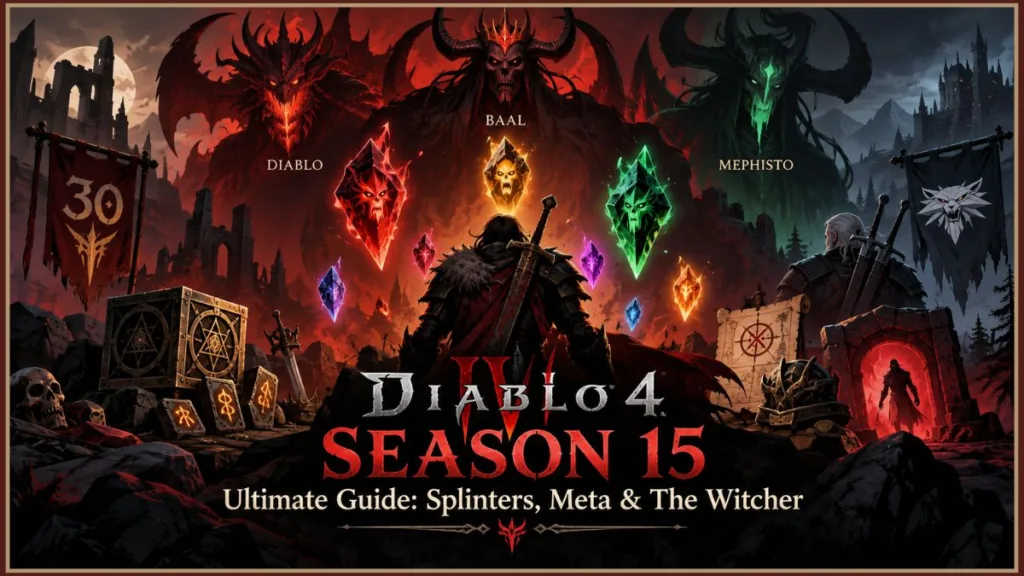
Whether you’re trying to theorycraft your endgame loop around the dual-splinter systems, looking to target-farm legacy drops, or just mapping out your seasonal checklist ahead of the CD Projekt Red crossover, here is the absolute breakdown of how Season 15 actually plays out on the ground.
Right from the character select screen, you’re going to immediately notice a vibe shift. Blizzard fully embraced a darker, grittier visual aesthetic this time around, complete with remastered acoustic guitar tracks heavily inspired by the original Tristram theme. The hub cities feel way more oppressive, the lighting has been specifically tweaked to emphasize shadows, and the overarching narrative structure featuring Cain grounds you in a story that feels intensely personal for veteran Nephalem.
What Is the Difference Between Splinters of Evil and Soul Splinters?
Blizzard’s naming convention here has already tripped up half the community on day one, but mechanically, these two systems handle completely different parts of your progression loop. One is going to reshape your endgame map activities, while the other dramatically alters your jewelry slots and stat distributions.
How Do Splinters of Evil, Dark Wanderer Buffs, and War Plans Work?
Splinters of Evil drop directly from slaying the Prime Evils, functioning as your dedicated progression track and activity overhaul. You can carry only one Splinter of Evil at any given time, which temporarily transforms your character into a Dark Wanderer. While you’re carrying one, your baseline endgame modes completely transform:
- Diablo’s Splinter of Terror: Modifies your Helltides and Infernal Hordes, injecting distinct environmental threats, extreme mob density, and specific loot tables.
- Baal’s Splinter of Destruction: Alters the flow of your Kurast Undercity runs and Lair Boss encounters, scaling mob ferocity and target rewards.
- Mephisto’s Splinter of Hatred: Restructures The Pit runs and Nightmare Dungeons into brutal, hostile gauntlets.
- Tree of Whispers Integration: Carrying any of the three splinters systematically modifies your Tree of Whispers turn-ins and objective profiles across the board.
Visually, slotting one of these Splinters adds a sick dark aura to your character model, complete with a specialized town-portal animation that reflects exactly which of the three Prime Evils you are currently channeling.
Each Splinter is attached to its own standalone reputation track featuring eight distinct activity modifiers and six progressive upgrades for your Iconic Power. You unlock these milestones by knocking out seasonal War Plans. Crucially for those of us leveling alts, from Season 15 onward, this War Plan reputation is entirely account-wide across your shared progression partition—meaning you are totally saved from grinding duplicate tracks on secondary characters.
You can track your War Plans seamlessly via a new dedicated sub-tab in the seasonal journey menu, allowing you to pin specific upgrade requirements directly to your on-screen quest tracker so you never lose focus.
What Are Soul Splinters and How Do You Upgrade Them in the Horadric Cube?
In contrast, Soul Splinters do not alter world states; they are hyper-specialized, socketable gems crafted exclusively for your jewelry slots, harvested from the Lesser and Minor Evils. You can slot up to three Soul Splinters simultaneously across your rings and amulet. Each one delivers an absurd, build-defining damage multiplier or defensive pivot, but they are counterbalanced by brutal drawbacks—think amplified incoming elemental damage or severe internal resource drains.
There are eight unique Soul Splinters you can build around:
- Splinter of Anguish (Andariel)
- Splinter of Sin (Azmodan)
- Splinter of Lies (Belial)
- Splinter of the Black Soulstone
- Splinter of Pain (Duriel)
- Splinter of the Mother (Lilith)
- Splinter of Hellfire (Na-Krul)
- Splinter of Damnation (Skarn)
To counteract those nasty drawbacks, optimizing your armor affixes to stack specific elemental resistances is absolutely mandatory if you want to push this season.
If your initial drops roll low tiers, do not scrap them. You can feed your lower-quality variants straight into the Horadric Cube via Amalgamation, upgrading them step-by-step into their highest-rarity iterations. Just know this crafting process isn’t free; Amalgamation demands a steep tax of Forgotten Souls, thousands of Gem Fragments, and a hefty gold fee per tier, making Helltide farming absolutely essential to fund your jewelry upgrades.
What Are Waking Nightmares and Where Do You Find the Prime Evils?
To commemorate 30 years of Sanctuary’s history, the dev team rolled out Waking Nightmares—instanced legacy encounters that pull historic arena layouts, music cues, and encounter designs straight out of the archives. These are partitioned into three distinct formats you need to know about:
- Capstone-Style Dungeons: These serve as extensive, multi-tier gauntlets leading straight into full recreations of historic Prime Evil encounters. You will push up the frozen crags of Mount Arreat to confront Baal, fight down through the corrupted blood pools of the Durance of Hate to face Mephisto, and descend into the foundational catacombs of Tristram Cathedral to battle Diablo himself. You first encounter them during the seasonal narrative, but their true value emerges later: you can run them across Torment tiers, eventually pushing into pinnacle Capstones at Torment 10+ for apex-tier loot tables.
To unlock these T10+ variants, you will need to farm specific Prime Keys that drop exclusively from high-tier Nightmare Dungeon bosses and the Blood Maiden.
- Overworld Dungeons: Structured as standard-length static dungeon tiles placed at fixed locations across the world map. These pull iconic layouts and narrative encounters spanning Diablo I, Hellfire, Diablo II, Diablo III, and Diablo Immortal, restoring nearly 20 classic franchise bosses to active combat rotation.
When you step into these dungeons, the game applies a subtle, retro-style visual filter and shifts the UI font to mimic the classic releases, making the nostalgia trip incredibly immersive.
- Ambush Rooms: As you clear world objectives and dungeons, stay alert for sudden phase shifts. Ambush Rooms are single-chamber legacy flashpoints that drag past horrors—such as the corpse-exploding Nihlathak or the poison-choked Maggot Queen—directly into your path, occasionally backed by the manifestation of tragic legacy figures like Leah.
You can usually tell an Ambush Room is about to trigger if you hear a distinct, reversed audio cue just before opening a standard dungeon door, giving you a few precious seconds to pop your defensive elixirs.
How Do the New Rebirth System, Horadric Post, and Twitch Drops Work?
Longtime players finally have real solutions to two of the game’s biggest friction points: character slot stagnation and missed dungeon floor drops.
- The Rebirth Feature: You no longer need to delete characters or create brand-new ones just to play the season. Rebirth allows you to take any pre-existing Eternal Realm hero and reset them straight to Level 1 on the Seasonal Realm. It completely preserves your character’s recorded playtime, operational name, visual identity, and cosmetic loadout without wasting valuable roster slots or sacrificing your sentimental attachments.
If you are wondering what happens to the high-level gear that character was wearing, don’t sweat it: the Rebirth process safely strips all equipped items and stash inventory, mailing it directly to your Eternal Realm stash tabs so absolutely nothing is ever lost.
- The Horadric Post: Inventory overflow during speed-farming is no longer an issue. The Horadric Post functions as an automated courier hub, piping your missed floor drops, seasonal milestone turn-ins, and critical community rewards directly into an account mailbox.
You can access the Post from any major city hub, positioned right next to the Stash chest, and it features a handy “Claim All to Inventory” button for rapid loot sorting.
- Twitch Drops Window: Keep in mind that seasonal Twitch Drops are running concurrently from September 15 through September 29, delivering account-bound cosmetics that feed directly into these delivery pathways once your accounts are linked. This season’s drops are particularly high-value, featuring a set of spectral Prime Evil weapon transmogs and an exclusive back-trophy featuring Deckard Cain’s legendary satchel.
How Do You Get Legacy Uniques and Upgrade Mythics in the Horadric Cube?
Itemization in Season 15 brings back classic equipment identities while finally introducing deterministic systems to protect your masterworked investments.
- Returning Legacy Gear: Blizzard has permanently restored ten familiar Uniques from earlier Diablo games directly into both the Seasonal and Eternal item pools. Among these, nine serve as core equipment drops—including heavy-hitters like Messerschmidt’s Reaver, Leoric’s Crown, and the legendary resource-anchor Stone of Jordan. Furthermore, several of these legacy artifacts have been repurposed into Unique Charms engineered specifically for your Talisman slot.
The Stone of Jordan, in particular, is highly sought after because it restores the classic “+1 to All Core Skills” affix, making it an absolute powerhouse for hybrid builds looking to hit crucial breakpoint thresholds.
- Horadric Cube Mythic Upgrades: Instead of just gambling raw sparks and praying for random baseline rolls, the Horadric Cube now features a premium deterministic conversion recipe. You can take an existing high-tier item and elevate it directly into its Mythic counterpart. The monumental upside here: the item completely retains its established affix spread, applied Tempering rolls, and existing Masterworking ranks.
This targeted upgrade recipe requires three Resplendent Sparks combined with a new, ultra-rare material called “Primeval Ash,” which drops exclusively from the Torment 10 Waking Nightmare bosses.
- Mythic Charms & Blacksmith Caches: Mythic Charms have officially entered the world drop pool. At the forge, the Blacksmith now separates endgame caches into distinct procurement pools: you can gamble specifically for class-usable Mythic Uniques or target universal Iconic Mythics.
What Is the Season 15 Class Meta and Best Build Synergies in Patch 3.2.1?
Balancing an eight-class ecosystem—now featuring the base roster alongside the expansion additions of the Spiritborn, Paladin, and Warlock—means Patch 3.2.1 had to bring heavy tunings. While every archetype received numerical pass-overs, PTR adjustments zeroed in heavily on six core classes: Barbarian, Druid, Necromancer, Paladin, Sorcerer, and Warlock.
Druids in particular walked away with sweeping item-level buffs: both the Greatstaff of the Crone and Fleshrender received massive numerical updates, pushing basic-attack and shapeshifting synergies back into serious endgame viability.
Meanwhile, the introduction of Soul Splinters has ignited entirely new meta builds that you should definitely look into:
- Warlocks are using the Splinter of Anguish to convert their damage-over-time poison mechanics into screen-clearing, explosive area-of-effect detonations.
- Paladins are slotting Mephisto-themed splinters to drive high-stakes aura setups, stripping away foundational survivability in exchange for astronomical holy-damage burst profiles.
- Barbarians are leveraging the Splinter of Pain to completely bypass standard fury generation, enabling permanent Whirlwind uptime as long as they can out-leech the gem’s aggressive health-drain penalty.
- Necromancers have found massive synergy with the Splinter of the Black Soulstone, which allows their Golem and Skeletal Mages to temporarily absorb fatal blows meant for the player, redefining high-tier Torment survivability.
What Is Coming in the Diablo 4 and The Witcher Crossover Event?
Keep your silver swords sharp for later in the rotation: Sanctuary is slated to collide with CD Projekt Red’s The Witcher in a dedicated mid-season crossover. While developer updates remain tight-lipped on the exact narrative beats, datamining points to some massive additions:
- Witcher-themed cosmetic armor sets, weapon transmogs, and stylistic mount gear.
- A standalone dimensional-rift questline threading the two dark-fantasy universes together.
- Bespoke crossover monster encounters engineered to test specific combat mechanics, demanding tactical preparation reminiscent of classic witcher hunts.
Rumors strongly suggest that iconic beasts like Leshens and Fiends will be dynamically invading the forests of Scosglen and the swamps of Hawezar. You will want to start stockpiling high-tier Incense and specific beast-slaying Elixirs right now, as these encounters are expected to enforce strict DPS checks and require precise dodging against wide-sweeping, telegraphed root mechanics.
When Does Diablo 4 Season 15 End, and What Are the Battle Pass Rewards?
Operating on Blizzard’s standard ~80-day seasonal timetable, expect the Season of Hell’s Legacy to conclude around late November or early December 2026.
If you are planning your seasonal route, the Season Journey is laid out across nine tiers housing 125 individual objectives. Maxing out the Battle Pass and season progression delivers massive power spikes and collection items that you definitely do not want to miss:
- Power Progression: Up to 14 Skill Points and 42 Paragon Points.
- Crafting & Gear: 10 Resplendent Sparks alongside 5 Mythic Unique Caches.
- Cosmetics: The exclusive Dark Wanderbear pet and the Banner of the Three mount trophy.
When progressing through the free track, remember to immediately allocate your earned Smoldering Ashes into the Urn of Aggression for that vital baseline XP boost. Once you hit level 60, respec those ashes into the brand-new seasonal Urn of the Prime Evils to significantly increase your drop rates for high-tier Soul Splinters.
Hit the Rebirth button, lock in your War Plans early to automate your alt progression, and prioritize pushing those Torment-tier Waking Nightmares to secure your legacy setup before the gates close on the season!
Visit Our Post Page: Blog Page
Discover more from Izoate
Subscribe to get the latest posts sent to your email.