
Want to become an Amazon Flex driver in 2026? Learn how to apply for Amazon Flex with simple step-by-step instructions. Discover the requirements, app setup, approval process, waitlist details, earnings, and tips to start delivering and earning on your own schedule today.
If you’re looking for a flexible way to earn money on your own schedule, you may be wondering how to apply for Amazon Flex and whether you qualify to become a delivery driver.
Amazon Flex is Amazon’s delivery partner program that allows independent contractors to deliver packages using their own vehicles. Unlike traditional delivery jobs, you choose when to work by accepting available delivery blocks through the Amazon Flex app.
According to Amazon’s official website, drivers can earn $18–$25 per scheduled hour, although actual earnings vary based on location, tips (where applicable), route demand, delivery block availability, and how efficiently deliveries are completed.
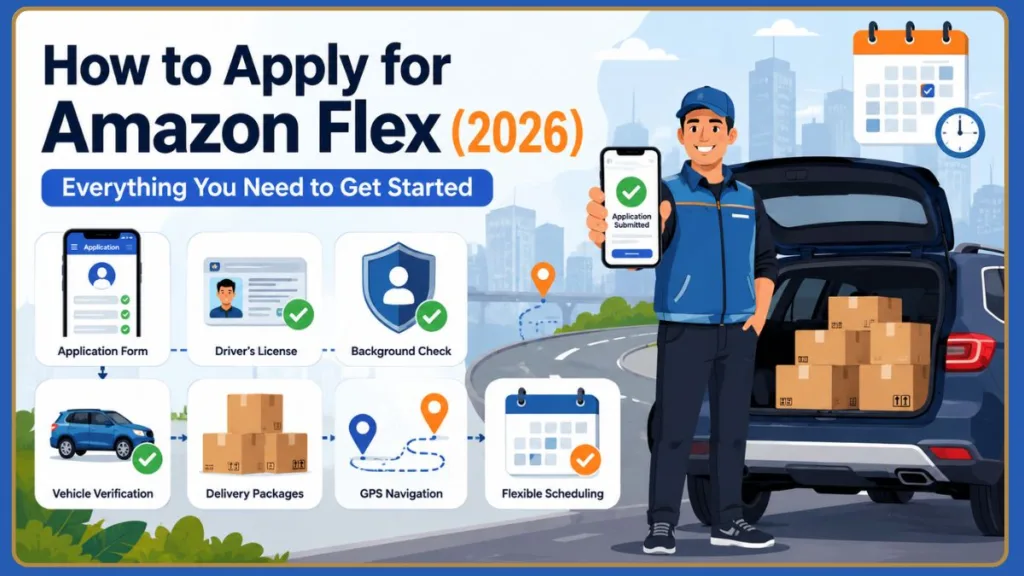
The application process is relatively straightforward. You’ll need to download the Amazon Flex app, create an account, submit personal information, upload required documents, pass a background check, and complete onboarding before you can begin accepting delivery offers.
However, one important detail many applicants overlook is that approval depends not only on meeting the requirements but also on whether Amazon Flex is actively onboarding drivers in your area.
In this guide, you’ll learn everything you need to know before starting your Amazon Flex driver application online, including eligibility requirements, vehicle rules, insurance requirements, and how local availability can affect your approval timeline.
What Is Amazon Flex?
Amazon Flex is a gig economy delivery platform that allows individuals to deliver Amazon packages, Amazon Fresh grocery orders, Prime Now deliveries (where available), and retail orders using their personal vehicles. Instead of working fixed shifts like traditional employees, Amazon Flex drivers operate as independent contractors, giving them flexibility over when and how often they work.
When you become an Amazon Flex driver, you use the mobile app to reserve delivery blocks. Each block displays the estimated duration, pickup location, and expected earnings before you accept it. Most delivery blocks range from 2 to 5 hours, depending on the market and delivery type.
This flexibility has made Amazon Flex one of the most popular delivery driver jobs for people seeking part-time income, side hustles, or supplemental earnings.
It’s important to understand that Amazon Flex differs from other Amazon jobs. For example, Amazon Flex drivers are not Amazon employees.
They are separate from Amazon Delivery Service Partner (DSP) drivers, who work for third-party delivery companies and typically drive Amazon-branded vans. Flex drivers also differ from workers employed in Amazon fulfillment centers, sortation centers, or warehouse facilities.
Because you operate as an independent contractor, you’re responsible for managing your own schedule, maintaining your vehicle, tracking expenses, and understanding any tax obligations that may apply in your country or state.
As a Flex driver, you’re also automatically enrolled in the Amazon Flex Rewards program from your very first delivery, which is a tiered points system with four levels. You earn at least one point per delivery and ten points per scheduled block at baseline, though drivers with stronger customer-service standing earn more: drivers in “great” standing earn two points per delivery and twenty per block, and those in “fantastic” standing earn three points per delivery and thirty per block.
As your point total climbs across the four tiers, you unlock additional perks like fuel discounts, cashback on the Amazon Flex Debit Card, and preferred scheduling, which gives you earlier access to newly posted blocks before other drivers see them.
Fact: Amazon Flex drivers choose their own delivery blocks through the app rather than being assigned mandatory shifts by Amazon.
Before You Apply: Check Whether Amazon Flex Is Available in Your Area
One of the biggest misconceptions about becoming an Amazon Flex driver is that meeting the requirements automatically guarantees approval.
In reality, local demand plays a major role in whether you can start delivering immediately.
Amazon Flex continuously adjusts onboarding based on package volume, customer demand, and the number of active drivers in a region. Some cities actively recruit new drivers, while others maintain waiting lists because they already have enough delivery partners.
This is one of the most common concerns among applicants. Many people complete the onboarding process only to discover they’re placed on the Amazon Flex Interest List, commonly referred to as the waitlist.
If your market is full, Amazon may keep your application on file until additional drivers are needed. Wait times can range from a few days to several months depending on local demand.
You can check availability by downloading the Amazon Flex app and entering your preferred delivery area during registration.
How to Apply for Amazon Flex in California
If you’re researching how to apply for Amazon Flex in California, the application process is the same as in other participating states. California has some of the largest Amazon delivery markets in the United States, including Los Angeles, San Diego, Sacramento, San Jose, and the San Francisco Bay Area.
Because demand fluctuates throughout the year, approval timelines can vary significantly depending on your city and the number of active drivers already serving the area.
How to Apply for Amazon Flex in Texas
Applicants searching for how to apply for Amazon Flex in Texas follow the same onboarding process through the Amazon Flex app. Major Texas markets include Dallas-Fort Worth, Houston, Austin, and San Antonio.
Availability often changes based on seasonal demand, local package volume, and driver supply.
How to Apply for Amazon Flex in Florida
Those interested in how to apply for Amazon Flex in Florida will complete the same registration and verification process. Popular delivery markets include Miami, Orlando, Tampa, Jacksonville, and Fort Lauderdale.
Florida often experiences increased delivery demand during holiday shopping seasons and peak tourism periods.
How to Apply for Amazon Flex in Canada
Many people search for how to apply for Amazon Flex in Canada. Amazon Flex currently operates in select Canadian cities, including markets in Ontario, British Columbia, and Alberta, although availability changes over time.
Applicants must meet local eligibility requirements and may be placed on a waiting list if onboarding is temporarily paused in their region. Across major US metro areas, driver-reported wait times in many of the largest cities, including New York, Los Angeles, Chicago, and Miami, can stretch from several months to multiple years when those markets are at capacity, while smaller or fast-growing delivery markets tend to onboard new applicants much more quickly.
Tip: If Amazon Flex isn’t currently accepting drivers in your area, joining the Interest List is usually the fastest way to receive notifications when new onboarding opportunities become available.
Amazon Flex Requirements
Before starting your Amazon Flex driver application, it’s important to verify that you meet the program’s eligibility requirements.
Amazon uses these requirements to ensure drivers can safely complete deliveries while meeting customer expectations.
Age Requirement
You must be at least 21 years old to qualify for Amazon Flex.
This requirement applies throughout the United States and Canada and is one of the first eligibility checks completed during onboarding.
Driver’s License Requirement
Amazon requires all delivery partners to have a valid driver’s license.
The license must be current and legally valid in the state, province, or region where you intend to deliver. During onboarding, you’ll be asked to provide license information and verify your identity.
Social Security Number Requirement
Applicants in the United States must provide a valid Social Security Number (SSN) during the application process.
Amazon uses this information for identity verification, background screening, and tax reporting purposes. Canadian applicants may be asked to provide equivalent identification information based on local requirements. If you don’t have an SSN, Amazon Flex can generally still work with an Individual Taxpayer Identification Number (ITIN), but only when it’s paired with valid US work authorization, most commonly an Employment Authorization Document (EAD, Form I-766). An ITIN on its own, without an accompanying EAD or green card, typically won’t clear the work-authorization stage of the background check.
Smartphone Requirements
Since the entire platform operates through the Amazon Flex app, having a compatible smartphone is essential.
The app manages route navigation, package scanning, delivery confirmations, earnings tracking, customer communication, and scheduling.
According to Amazon’s current requirements, supported devices generally include the following.
Android Devices
- Android 7.0 or later
- Minimum 2 GB RAM
- Camera with flash
- GPS capability
iPhone Devices
- iPhone running iOS 15 or later (requirements may change as Amazon updates the app)
- Functional camera and GPS
If you’re trying to get set up on your phone, you’ve probably already searched for the Amazon Flex app download, the Amazon Flex app for Android, the Amazon Flex app download APK, or the Amazon Flex app for iPhone, since these are some of the most common starting points for new applicants.
You can find the official listings directly on the App Store and Google Play. Because the Android version is not always available through Google Play, Amazon often provides a direct APK download through its official Flex website.
Beyond the baseline OS version, you’ll also want a reliable cellular data plan rather than a Wi-Fi-only device, since the app doesn’t function offline once you’re out delivering, along with at least 2 to 3 GB of free storage for app updates and cached route data.
Because Amazon periodically tightens its supported OS versions as it updates the app, it’s worth double-checking the current minimum requirement listed in the app store before you apply, since the exact version can shift from what’s published elsewhere.
Vehicle Requirements
Your vehicle plays a major role in determining whether you qualify.
Amazon generally accepts four-door mid-size sedans, large sedans, SUVs, minivans, cargo vans, and pickup trucks with covered beds. Vehicle requirements may vary slightly depending on the delivery type and market.
Vehicles that typically do not qualify include motorcycles, scooters, mopeds, most two-door vehicles, and pickup trucks with uncovered beds.
The reason is simple: delivery routes often require enough cargo space to safely transport dozens of packages.
In practice, most stations accept a four-door sedan, SUV, van, or truck with a model year of 2005 or newer as long as it’s registered in your name and in safe, roadworthy condition, though some stations quietly enforce stricter age caps.
Common examples of midsize sedans that typically clear the bar include the Honda Accord, Toyota Camry, Nissan Altima, and Hyundai Sonata, while popular SUV and crossover choices include the Honda CR-V, Toyota RAV4, Ford Escape, and Hyundai Tucson.
Fact: Drivers using larger vehicles such as SUVs and vans may qualify for routes involving higher package volumes.
Insurance Requirements
You must maintain valid auto insurance that meets local legal requirements.
Amazon also provides commercial auto insurance coverage for eligible delivery partners while actively delivering through Amazon Flex in many regions. According to Amazon, this coverage may include auto liability coverage, uninsured motorist coverage, underinsured motorist coverage, and contingent comprehensive and collision coverage (subject to deductibles and conditions).
Coverage details vary by country and region, so drivers should review Amazon’s current insurance policy information and maintain their own personal auto insurance at all times.
Because insurance requirements can vary by location, it’s important to understand exactly what coverage applies while performing deliveries.
In most states, you’ll also need a commercial or rideshare insurance rider on top of your standard personal policy, which typically runs an additional $10 to $18 per month, and you’ll need to be listed as a covered driver on that policy even if the vehicle itself is registered to someone else, such as a spouse.
Background Check Requirement
All applicants must pass a background screening before being approved.
Amazon typically partners with third-party screening providers to review driving history, criminal records, and identity verification information.
Most background checks are completed within a few days, although processing times can occasionally take longer depending on local regulations and verification requirements.
The review generally covers your driving record going back 3 to 7 years and any criminal history within the past 7 years, in line with Fair Credit Reporting Act limits. The most common automatic disqualifiers include a DUI or reckless driving conviction within the past three years, a suspended or invalid license, and any violent or theft-related felony within the past seven years. Minor issues, like a single old speeding ticket, generally won’t disqualify you on their own.
Do You Need Delivery Experience?
No.
One of the reasons Amazon Flex jobs attract so many applicants is that prior delivery experience is generally not required.
You don’t need a commercial driver’s license (CDL), professional driving background, or previous experience with courier services such as UPS, FedEx, DoorDash, Uber Eats, or Instacart.
As long as you meet the eligibility requirements and successfully complete onboarding, you can apply to become an Amazon Flex delivery driver.
Tip: While delivery experience isn’t required, strong navigation skills, time management, customer service awareness, and familiarity with your local area can help improve delivery efficiency and maximize earnings.
How To Sign Up For Amazon Flex In 2026
Now that you understand the eligibility requirements, the next step is completing the Amazon Flex driver application online.
The good news is that Amazon has simplified the onboarding process significantly. Unlike many traditional delivery jobs, there is usually no in-person interview, no lengthy hiring process, and no requirement to visit an office before applying.
Most applicants can complete the initial onboarding steps directly from their smartphone.
However, accuracy matters. Incorrect information, blurry document uploads, or mismatched personal details can delay your approval and sometimes require additional verification.
Based on Amazon Flex’s official onboarding process and discussions from Amazon Flex drivers on Reddit, many applicants report that the application itself is straightforward, but delays often occur because of document verification issues, background check processing, or local market waitlists rather than problems with the application form itself.
Let’s walk through the process step by step.
Step 1: Download the Amazon Flex App
The entire application process takes place through the Amazon Flex app. Unlike some delivery platforms that allow desktop registration, Amazon Flex primarily relies on its mobile application for account creation, onboarding, scheduling, route management, and earnings tracking.
If you’re searching for the Amazon Flex app download, you’ll need to install the official app on a compatible smartphone before proceeding.
The app is also where you’ll submit your application, upload documents, complete onboarding, accept delivery blocks, navigate routes, track earnings, and contact support.
Many experienced Flex drivers recommend becoming familiar with the app interface before accepting your first delivery block because nearly every aspect of the job is managed through the application.
Amazon Flex App Download for Android
Many applicants search for the Amazon Flex app for Android or the Amazon Flex app download APK because the Android version is not always distributed through the Google Play Store.
Amazon currently provides the Android app directly through the official Amazon Flex website in many regions. During installation, Android users may need to allow app installations from trusted sources. You can also find the standard listing on Google Play if it’s available in your region.
According to Amazon’s published requirements, Android devices generally need Android 7.0 or later, at least 2 GB of RAM, a working camera, and GPS/location services enabled.
Once installed, the app manages everything from registration and document submission to package scanning and delivery navigation.
Some Android users report occasional issues with battery optimization settings interfering with GPS tracking. To avoid navigation problems during deliveries, many drivers recommend disabling aggressive battery-saving features for the Amazon Flex app.
Amazon Flex App Download for iPhone
iPhone users can typically download the application through the Apple App Store if Amazon Flex is available in their region.
Amazon’s current requirements generally include an iPhone 6s or newer, iOS 15 or later (requirements may change over time), GPS functionality, camera access, and cellular data connectivity.
Drivers frequently recommend enabling location services, background app refresh, camera permissions, and push notifications.
These settings help ensure smooth route navigation and timely delivery updates.
Can You Download Amazon Flex App to Your Computer?
One common question is whether you can download Amazon Flex app to your computer or complete the application through a website.
For most applicants, the answer is no.
While you can find information about the program online, the actual onboarding process, account setup, identity verification, delivery scheduling, and route management are designed to be completed through the mobile application.
Some applicants attempt to use Android emulators on computers, but Amazon generally expects drivers to use a supported mobile device for onboarding and deliveries.
It’s also worth choosing your device carefully before you start, since Amazon links your account to your phone’s device fingerprint once you’re activated, which can make swapping to a different phone afterward more complicated than it would be for a typical app.
Tip: Before installing the app, update your phone’s operating system and ensure GPS, camera permissions, and notifications are enabled. This can help prevent onboarding issues later.
Step 2: Create an Amazon Flex Account
Once you’ve downloaded the app, you’ll need to create an Amazon Flex account.
If you already have an Amazon customer account, you can typically use those credentials to begin registration. New users can create an account directly through the onboarding process.
During registration, Amazon will ask for basic information such as your full legal name, email address, mobile phone number, residential address, and delivery region preferences.
You’ll also be asked to select your preferred delivery area based on available markets.
This step is important because availability can vary significantly by location. Some regions immediately allow new applications, while others place applicants on an interest list until additional drivers are needed.
According to numerous Reddit discussions, applicants in major metropolitan areas often encounter waitlists because Amazon already has enough active drivers. In contrast, smaller cities and rapidly growing delivery markets may onboard new drivers much faster.
Understanding Amazon Flex Waitlists
One of the most common questions online is: “Why can’t I start immediately after applying?”
The answer is usually market demand.
Amazon Flex adjusts driver availability based on delivery volume. If your area already has enough drivers, your application may remain on a waitlist until additional capacity is needed.
Drivers report waitlist experiences ranging from a few days to several weeks, multiple months, or occasionally longer than six months in highly saturated markets.
Unfortunately, there is usually no way to skip the waitlist.
Amazon generally sends an email notification when a position becomes available in your selected delivery region.
Fact: Many applicants believe approval depends solely on qualifications. In reality, local driver demand often plays a major role in determining how quickly onboarding moves forward.
Step 3: Complete the Amazon Flex Driver Application
After creating your account, you’ll move on to the actual Amazon Flex driver application.
This section collects information Amazon needs to verify your eligibility and prepare your account for delivery work.
You’ll typically be asked to provide your driver’s license information, Social Security Number (or applicable tax identification), vehicle information, insurance details, and contact information.
Because Amazon uses this information during identity verification and background screening, accuracy is extremely important.
Even small discrepancies between your driver’s license, insurance policy, and application details can trigger additional reviews.
Many applicants searching for how to apply for Amazon Flex delivery, the Amazon Flex driver job application, or how to apply as a driver for Amazon Flex are surprised by how quickly this section can be completed when documents are prepared in advance.
Most applicants can finish the paperwork portion of onboarding in less than an hour.
Vehicle Information Requirements
Amazon typically asks for details about the vehicle you’ll use for deliveries.
Depending on your region, this may include your vehicle make and model, year of manufacture, license plate information, and insurance coverage details.
Amazon officially states that drivers generally need a midsize sedan or larger vehicle for standard package deliveries, although vehicle requirements can vary by market and delivery type.
Many experienced drivers recommend using a vehicle with good fuel efficiency, reliable air conditioning, adequate cargo space, and low maintenance costs.
Although compact cars can often complete standard package routes, larger vehicles may qualify for additional route opportunities in some markets.
Double-Check Before Submitting
Before moving to the next step, verify that your name matches your driver’s license exactly, your address is current, your insurance information is accurate, your phone number is active, and your email address is accessible.
Several drivers report delays caused by simple data-entry mistakes that required manual review.
Step 4: Upload Required Documents and Verify Your Identity
After submitting your information, you’ll be asked to upload supporting documents.
These typically include a valid driver’s license, proof of auto insurance, and identity verification materials required in your region.
You’ll also need to complete a selfie verification process.
This isn’t simply a profile picture. Amazon uses identity verification technology to confirm that the person creating the account matches the identification documents submitted during onboarding.
For the best results, use a well-lit environment, remove sunglasses, hats, and face coverings, ensure your face is clearly visible, and upload clear, readable documents.
Poor image quality remains one of the most common causes of verification delays.
It’s also worth noting that an out-of-state driver’s license can slow the background check by a few extra days, since the motor vehicle record pull has to cross state lines, and your license generally needs at least 90 days remaining before its expiration date at the time you submit your application.
Tip: Take document photos on a flat surface with good lighting rather than holding them in your hand. This makes text easier to read and reduces the chance of rejection.
Common Verification Mistakes That Delay Approval
Many onboarding delays occur because applicants unintentionally submit incomplete information.
Some of the most common issues include expired driver’s licenses, blurry document images, mismatched names across documents, outdated insurance information, incorrect account details, cropped document photos, poor selfie image quality, and documents uploaded in unsupported formats.
Double-checking every submission before proceeding can save several days of processing time.
What Happens After Identity Verification?
Once your documents are accepted, Amazon typically begins the next stage of onboarding automatically.
Applicants commonly receive status updates through email notifications, in-app messages, and application dashboard updates.
If your application appears stuck for several days, checking both your email inbox and spam folder is recommended.
Step 5: Complete the Amazon Flex Background Check
Every Amazon Flex applicant must successfully pass a background screening before becoming eligible to deliver.
This step helps Amazon maintain customer safety and delivery quality standards.
The screening process generally reviews driving history, criminal history, and identity verification information.
In the United States, Amazon commonly uses Checkr, a well-known background screening provider, to conduct these checks, although depending on your region, Amazon may instead route your application through Accurate Background or Sterling.
Regardless of which provider handles your file, the screening typically runs four checks in parallel: an identity and SSN or ITIN match against federal records, a Motor Vehicle Record (MVR) pull covering several years of driving history, a county-level criminal record search for every address you’ve lived at over the past several years, and a work authorization verification.
How Long Does the Amazon Flex Background Check Take?
According to Amazon and applicant reports, many background checks are completed within 2 to 5 business days.
However, processing times can occasionally extend to 10 business days or longer depending on local reporting systems, court record availability, identity verification requirements, application volume, and multi-state record searches.
If additional review is required, Amazon may contact you through email for clarification or additional documentation.
Many drivers report that background checks often move quickly when records are easily accessible, while applicants with recent address changes or records from multiple states sometimes experience longer processing times.
Real-world driver reports posted across forums in 2026 show a noticeably wider range than Amazon’s official window suggests. Some applicants with clean, single-state records clear in as little as a day or two, and plenty land in the typical 2-to-5-business-day range. A meaningful share, though, describe waits stretching to 2 to 3 weeks, and a smaller number report being stuck in pending status for 4 to 8 weeks.
Reasons a Background Check May Take Longer
Several factors can extend review times, including high application volume, court record verification delays, multiple previous addresses, identity verification issues, and public record reporting delays.
Waiting longer than expected does not necessarily indicate a problem with your application.
Fact: Having a background check take longer than expected does not automatically mean your application has been denied. Verification timelines can vary significantly between regions.
Step 6: Complete Amazon Flex Training and Onboarding
After passing the background screening, you’ll move into the final onboarding phase.
In the past, some delivery programs relied heavily on in-person orientation sessions. Today, Amazon Flex onboarding is largely completed through the app.
You’ll gain access to educational materials that explain package pickup procedures, delivery workflows, route navigation, package scanning, customer interactions, and safety expectations.
These training resources help new drivers understand how deliveries work before accepting their first block.
Most applicants can complete the required onboarding materials in less than a day.
What You’ll Learn During Amazon Flex Training
The onboarding materials introduce several important concepts you’ll use regularly as a delivery partner.
You’ll learn how delivery blocks work, how to check in at pickup stations, how to scan packages, how to mark deliveries as completed, and how to troubleshoot common delivery issues through the app.
You’ll also become familiar with terms such as:
- Delivery Blocks – Scheduled work periods that typically range from 2 to 5 hours.
- Instant Offers – Real-time delivery opportunities sent directly through the app.
- Amazon Fresh Deliveries – Grocery deliveries that may include customer tips.
- Retail Delivery Routes – Deliveries from participating retail partners.
- Pickup Stations – Amazon facilities where drivers collect packages.
- Route Optimization – The app-generated delivery sequence designed to improve efficiency.
Understanding these concepts early can make your first delivery experience much smoother.
Additional Tips Shared by Experienced Amazon Flex Drivers
Many long-time Flex drivers recommend learning a few practical habits before accepting your first route. Arrive at pickup stations 10–15 minutes early, bring a phone charger or power bank, keep your vehicle organized for faster deliveries, carry a flashlight for evening routes, use insulated bags for grocery deliveries, check package labels before leaving the station, and monitor traffic conditions before accepting blocks.
Drivers frequently mention that organization can significantly reduce delivery times and stress during busy routes.
Preparing for Your First Delivery Block
Before accepting your first block, make sure you have a fully charged phone, reliable mobile data service, vehicle fuel or charging capacity, working GPS navigation, and required identification.
Many new drivers report feeling overwhelmed during their first route, but most become comfortable after completing a few delivery blocks.
Amazon recommends arriving at the pickup location on time because late arrivals can result in missed blocks and may affect your standing within the program.
Tip: Even if you’re eager to start earning immediately, take time to review all onboarding materials carefully. Drivers who understand the app before accepting their first route often experience fewer delivery issues, complete blocks more efficiently, and avoid common mistakes that can affect delivery ratings.
What Happens After You Apply for Amazon Flex?
Submitting your application is only the first step in becoming an Amazon Flex driver. One of the most common questions applicants ask isn’t just how to apply for Amazon Flex, but rather what happens after the application is submitted.
Many first-time applicants assume they can start delivering packages immediately after uploading their driver’s license and completing onboarding. However, the reality is more complex.
Approval timelines depend on several factors, including background check processing, document verification, local driver demand, and whether Amazon is actively recruiting drivers in your area.
According to Amazon Flex’s official onboarding information, applicants must complete identity verification, pass a background check conducted by Amazon’s screening partner, and meet local market requirements before becoming eligible to deliver. Driver experiences shared across forums such as Reddit indicate that approval times can vary significantly by city and region.
While some drivers report being approved within a few days, others remain on the Amazon Flex Interest List for weeks or even months.
Understanding the process after applying can help you set realistic expectations and avoid unnecessary frustration.
Understanding Your Amazon Flex Application Status
After completing onboarding, your application typically moves through several stages before you can begin accepting delivery blocks.
The process generally includes account creation, identity verification, driver’s license review, background screening, insurance verification (where applicable), market availability review, and activation or placement on the Interest List.
Once Amazon verifies your information and your background check clears, your account may be activated if there is immediate demand for drivers in your area.
However, many applicants discover that passing the background check does not automatically mean they can start delivering.
In some regions, applicants are placed on the Amazon Flex waitlist even after successfully completing every onboarding requirement.
Real Driver Experiences From Reddit
Reddit discussions in communities such as r/AmazonFlex reveal significant differences in approval timelines. Some drivers reported approval within 2–7 days. Others waited 1–3 months before receiving activation emails. Several applicants in highly populated cities reported remaining on the Interest List for over 6 months.
One Reddit user explained:
“My background check cleared in less than a week, but I stayed on the waitlist for almost four months because my area already had enough drivers.”
Another driver shared:
“I applied during the holiday season and got activated within days because Amazon needed more drivers.”
These experiences highlight an important reality: local demand often matters more than application timing.
Data Insight #1: Amazon states that onboarding availability depends on delivery demand in each region. Driver activation is generally influenced by local package volume and staffing needs rather than the order applications are submitted.
Amazon Flex Waitlist Explained
The Amazon Flex Interest List is one of the most misunderstood parts of the onboarding process.
When Amazon already has enough active drivers in a market, new applicants are temporarily placed on a waiting list.
Being waitlisted does not mean your application has been rejected.
Instead, it means Amazon currently has sufficient delivery capacity and does not need additional drivers in your area.
Many applicants who wonder how do you get selected for Amazon Flex, ask why is my Amazon Flex application stuck, or search for how long is the Amazon Flex waitlist eventually discover that market demand is the primary factor affecting activation.
Why Amazon Uses a Waitlist
Amazon adjusts driver supply based on package volume and operational needs.
Periods that often trigger new driver activations include Prime Day sales events, holiday shopping seasons, back-to-school periods, warehouse expansions, driver shortages, and increased grocery delivery demand.
How Long Does the Amazon Flex Waitlist Last?
There is no universal timeline.
Amazon does not publish official waitlist durations, and activation times vary by market.
Based on Reddit discussions and driver reports, the following table breaks down typical waitlist durations.
| Waitlist Duration | Driver Reports |
|---|---|
| Less than 1 week | Common during peak seasons |
| 2–8 weeks | Frequently reported |
| 2–6 months | Common in saturated markets |
| 6+ months | Occasionally reported in major cities |
Can You Skip the Amazon Flex Waitlist?
Unfortunately, there is usually no legitimate way to bypass the waitlist.
Many Reddit users have reported trying to contact support repeatedly, create multiple accounts, or reapply with different emails.
None of these methods consistently resulted in faster activation.
The best strategy is simply to monitor your email regularly, complete onboarding requests immediately, and keep your documents current.
Tip: If Amazon sends an activation invitation after you’ve been waitlisted, complete every remaining onboarding step as quickly as possible. Available spots may be limited.
How to Get Approved Faster for Amazon Flex
Although there is no guaranteed method to accelerate approval, several best practices can help prevent unnecessary delays.
Applicants who submit accurate information and respond quickly to requests generally experience smoother onboarding.
Best Practices for Faster Approval
Upload clear, high-quality document photos, ensure your driver’s license is valid and unexpired, use the same legal name across all documents, check your email daily, complete onboarding tasks immediately, and respond quickly to verification requests.
Common Reasons Applications Get Delayed
According to Amazon Flex support documentation and driver reports, delays often occur because of blurry license photos, expired identification, name mismatches, incorrect addresses, background check verification issues, and high onboarding volume.
Many Reddit users noted that correcting document issues resolved their pending status within days.
Understanding Amazon Flex Delivery Blocks
Once approved, you’ll begin working through delivery blocks, which are scheduled delivery periods reserved through the Amazon Flex app.
Unlike traditional employment shifts, Flex drivers choose blocks based on their availability.
Each block displays the pickup location, start time, estimated duration, and expected earnings.
According to Amazon Flex, most delivery blocks typically range from 2 to 5 hours, although availability varies by market.
Types of Amazon Flex Delivery Blocks
Drivers may encounter several delivery categories.
Amazon.com Deliveries are traditional package deliveries from Amazon delivery stations and fulfillment centers.
Amazon Fresh Deliveries are grocery deliveries that may include customer tips.
Whole Foods Market Deliveries come from Whole Foods Market stores. These routes are often popular because customer tips can increase total earnings.
Retail Deliveries come from participating retail partners available in select markets.
How Many Packages Are in a 3-Hour Block?
One of the most searched Amazon Flex questions is how many packages are in a 3-hour block.
There is no fixed answer.
Package counts depend on route density, delivery distance, package size, number of stops, and local traffic conditions.
Based on driver reports from Reddit, light routes may contain 15–25 packages, average routes often contain 25–45 packages, and dense urban routes may exceed 50 packages.
Several drivers reported completing 3-hour routes in less than 2.5 hours, while others needed the full scheduled time depending on traffic and route complexity.
One Reddit driver explained:
“I’ve had 3-hour routes with 18 packages and others with over 40. It depends entirely on the station and route density.”
What Are Instant Offers?
In addition to scheduled blocks, Amazon Flex offers Instant Offers in select markets.
These are short-notice delivery opportunities sent directly through the app when drivers are near eligible pickup locations.
Instant Offers typically display estimated earnings, delivery distance, pickup location, and delivery timeframe.
Drivers can choose whether to accept or decline the offer.
Many drivers use Instant Offers to fill gaps between scheduled blocks.
Fact: Amazon notes that Instant Offers are available only in certain areas and are commonly associated with grocery deliveries, where customer tips may increase total earnings.
How Much Can You Make With Amazon Flex?
For many applicants, earnings are the deciding factor when evaluating whether becoming an Amazon Flex driver is worthwhile.
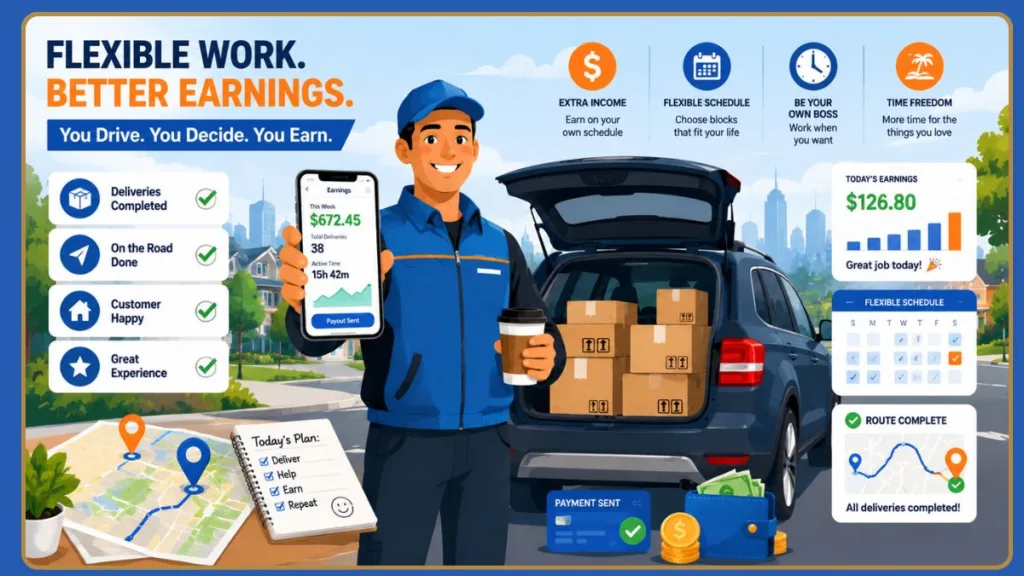
Amazon states that drivers can earn approximately $18–$25 per hour, depending on location, demand, and delivery type, as detailed on the official Amazon Flex earnings page.
However, actual earnings vary significantly.
Data on Amazon Flex Earnings
Based on Amazon’s published earning estimates, the table below shows typical gross earnings by block length.
| Block Length | Typical Gross Earnings |
|---|---|
| 2 Hours | $36–$50 |
| 3 Hours | $54–$75 |
| 4 Hours | $72–$100 |
| 5 Hours | $90–$125 |
These figures represent gross earnings before expenses and taxes.
Data Insight #2: A driver completing twenty 4-hour blocks per month could potentially earn between $1,440 and $2,000 in gross pay before accounting for fuel, maintenance, insurance, and self-employment taxes.
How Much Can You Make in 4 Hours With Amazon Flex?
A common question among new applicants is how much can I make in 4 hours with Amazon Flex.
Using Amazon’s estimated hourly range, $18 an hour comes to approximately $72, while $25 an hour comes to approximately $100.
Some drivers report earning more during surge pricing periods.
What Is Surge Pricing?
When Amazon experiences increased package demand or driver shortages, delivery blocks may appear with higher payouts.
Drivers often refer to these increased rates as “surge blocks.”
Reddit drivers frequently discuss holiday surge rates, Prime Day bonuses, and last-minute block increases.
One driver reported:
“A block that normally paid $84 increased to $132 because Amazon needed drivers urgently.”
Factors That Affect Amazon Flex Earnings
Several variables influence earnings, including delivery block availability, route density, fuel costs, vehicle maintenance, traffic conditions, customer tips, and seasonal demand.
Real Driver Feedback on Earnings
Reddit discussions reveal mixed experiences.
Some drivers appreciate the flexibility and report strong earnings during peak periods.
Others note that fuel costs, depreciation, tire wear, and maintenance expenses can significantly reduce profits.
One commonly repeated recommendation is to track expenses carefully.
Data Insight #3: The IRS standard mileage rate is commonly used by independent contractors to estimate vehicle operating costs and tax deductions, and it currently sits at 72.5 cents per mile for the 2026 tax year. Tracking mileage can help drivers better understand their actual net earnings.
Amazon Flex Payments and Debit Card
After completing deliveries, earnings are deposited according to the payment method selected during onboarding.
Most drivers choose direct deposit.
Amazon also offers the Amazon Flex Debit Card, issued through Amazon’s financial partners in eligible regions. The card becomes available once you reach Level 2 in the Amazon Flex Rewards program, and it can earn you cashback on gas and EV charging, plus smaller cashback percentages on Amazon.com and Whole Foods purchases.
Many applicants who want to apply for the Amazon Flex debit card also search for the Amazon Flex payment schedule, and many simply want to understand how Amazon Flex drivers get paid in the first place.
How Amazon Flex Drivers Get Paid
Amazon allows drivers to view estimated earnings before accepting a block.
Drivers can typically see estimated earnings, delivery duration, and pickup location.
This transparency allows drivers to evaluate opportunities before committing.
Amazon has expanded payment options in recent years, including more flexible payout schedules in eligible markets.
Benefits of the Amazon Flex Debit Card
Depending on eligibility and region, benefits may include faster access to earnings, cashback opportunities, fuel-related rewards, and no monthly maintenance fees.
Specific benefits may change over time, so drivers should review current terms directly through Amazon Flex.
Common Amazon Flex Application Problems
Even qualified applicants occasionally encounter onboarding issues.
Understanding common problems can help resolve them faster.
Background Check Taking Too Long
Most background checks are completed within several business days.
However, delays may occur because of court record verification, identity confirmation, high application volume, or manual review requirements.
Driver reports indicate timelines ranging from a few days to several weeks.
Application Stuck on Pending
Pending applications often indicate ongoing document review, identity verification, background screening, or market onboarding delays.
No Openings Available
If Amazon Flex is not actively recruiting in your area, you’ll likely remain on the Interest List until demand increases.
Verification Problems
Common verification issues include blurry photos, expired licenses, incorrect information, and incomplete uploads.
Tip: Before contacting Amazon Flex support, carefully review every submitted document. Many onboarding delays are caused by simple errors that can be corrected quickly.
Frequently Asked Questions
How do I apply for Amazon Flex?
Download the Amazon Flex app, create an account, submit your information, upload required documents, complete identity verification, pass a background check, and finish onboarding.
How do I get started with Amazon Flex?
Check whether Amazon Flex is available in your area. If openings exist, download the app and begin registration.
How do I become an Amazon Flex driver?
You must meet eligibility requirements, submit an application, pass a background check, and complete onboarding through the Amazon Flex app.
How do you qualify for Amazon Flex?
Applicants generally must be at least 21 years old, have a valid driver’s license, maintain qualifying auto insurance, possess an eligible vehicle, and pass a background screening.
Requirements may vary slightly by country and market.
Is Amazon Flex accepting new drivers?
Availability varies by location. Some regions actively recruit drivers, while others maintain waiting lists.
You can check availability through the Amazon Flex app or official website.
Can I apply for Amazon Flex through a website?
Most applicants complete onboarding through the Amazon Flex mobile app, although Amazon also provides information and market availability updates through its official website.
Is Amazon Flex Worth It?
For many drivers, Amazon Flex offers flexible scheduling, independent contractor freedom, and supplemental income opportunities.
However, profitability depends on fuel costs, vehicle expenses, route availability, and local demand.
Drivers who carefully manage expenses and track mileage often report better long-term results.
Final Thoughts
Learning how to apply for Amazon Flex is relatively straightforward, but understanding what happens after applying is equally important.
The onboarding process involves document verification, identity checks, background screening, and market availability reviews. Even after approval, some applicants may spend time on the Amazon Flex Interest List before receiving activation.
Information from Amazon Flex resources, publicly available earnings estimates, and real-world driver experiences consistently shows that approval timelines and earnings vary significantly by location.
If you’re interested in Amazon Flex jobs, the best strategy is to prepare your documents carefully, complete onboarding promptly, and remain patient if your market currently has a waitlist.
Once activated, you’ll gain access to a flexible delivery platform that allows you to choose delivery blocks, work around your schedule, and earn income using your personal vehicle.
For many gig workers, that combination of flexibility, independence, and earning potential continues to make Amazon Flex one of the most popular delivery platforms available today.
Visit Our Post Page: Blog Page
Discover more from Izoate
Subscribe to get the latest posts sent to your email.