
Looking for a self-help book that actually works? Explore 10 Audible audiobooks repeatedly recommended by listeners for habits, confidence, focus, and personal growth.
If you’ve ever asked someone in a reading community, a personal development forum, or even a group chat what book genuinely changed their life, a handful of titles come up again and again. Browse through the Audible listener community and you’ll see the same names surface repeatedly. Not because they’re the most hyped. Not because a celebrity posted about them. But because people finished listening and then actually did something different.

That’s a rare thing in the self-help space. There’s no shortage of audiobooks that motivate you for a few days and then fade quietly into your library. The ones on this list don’t do that. They change the way you think about habits, work, relationships, fear, or yourself — and those changes tend to stick.
If you’re browsing Audible and wondering where to spend your next credit, this list is designed to help you choose wisely. Whether you’re working on discipline, focus, confidence, mindset, or how you connect with other people, there’s something here for where you are right now.
New to Audible? You can start a free 30-day trial with no commitments. Your first credit is yours to keep on any premium title, even if you cancel before the trial ends. It’s one of the most genuinely risk-free ways to begin.
Quick Comparison: Best Self-Help Audiobooks on Audible
| Audiobook | Best For | Narrated By | Length |
|---|---|---|---|
| Atomic Habits | Building better habits | James Clear (author) | 5h 35m |
| Can’t Hurt Me | Mental toughness | David Goggins + Adam Skolnick | 13h 37m |
| The Mountain Is You | Breaking self-sabotage | Callie Beaulieu | 4h 11m |
| The Subtle Art of Not Giving a F*ck | Reframing priorities | Roger Wayne | 5h 17m |
| Mindset | Growth vs. fixed thinking | Marguerite Gavin | 10h 23m |
| The 7 Habits of Highly Effective People | Long-term effectiveness | Stephen R. Covey (author) | 13h 4m |
| Deep Work | Focus and productivity | Jeff Bottoms | 8h 1m |
| Daring Greatly | Confidence and vulnerability | Brené Brown (author) | 6h 30m |
| The Power of Now | Mindfulness and anxiety | Eckhart Tolle (author) | 7h 37m |
| How to Win Friends and Influence People | Relationships and communication | Andrew MacMillan | 7h 15m |
Are Self-Help Audiobooks Worth Listening To?
Before diving in, this is a question worth answering honestly — because not everyone is convinced.
The short answer is yes, but with a caveat. Audiobooks are only as good as the content they carry. A mediocre self-help book doesn’t improve because it’s narrated well. But when the writing is genuinely strong — which it is for everything on this list — the audio format often makes it more effective than reading.
Here’s why:
- You can learn during dead time. Commutes, workouts, cooking, walks — these all become opportunities to absorb ideas that would otherwise require you to sit down and carve out reading time.
- Author-narrated books hit differently. When James Clear reads his own work, or Brené Brown delivers her research in her own voice, you feel the conviction behind the ideas in a way print can’t replicate.
- It’s easier to finish. Most people who struggle to get through physical books find audiobooks significantly easier to complete. And a book you actually finish is infinitely more valuable than one you abandon at chapter three.
- You can revisit specific chapters. Many books on this list are ones that listeners return to repeatedly — going back to a specific section when they’re facing a particular challenge.
The research on comprehension broadly supports audio as a comparable format to reading for most people. The biggest factor is always which books you choose. That’s exactly what this list is for.
The 10 Best Self-Help Audiobooks on Audible
1. Atomic Habits — James Clear
Best For: Building better habits, breaking bad ones, and designing systems that actually work
Why It Stands Out
James Clear narrates this himself, and within the first chapter you understand why that matters. The delivery is calm, deliberate, and completely unpretentious — which suits the book’s philosophy perfectly. The argument isn’t that you need massive willpower or a dramatic life overhaul. It’s that tiny changes, consistently applied, compound into remarkable results over time.
What separates this from most habit books is that Clear explains the mechanism behind habit formation, not just the outcome. You understand why stacking a new habit next to an existing one works, why your environment shapes your behaviour more than your motivation does, and why focusing on systems outperforms chasing goals. That understanding is what makes the advice stick.
What You’ll Learn
The four laws of behaviour change — make it obvious, make it attractive, make it easy, and make it satisfying — give you a complete framework you can apply to almost any habit you want to build or break. You’ll also come away with a completely different idea of what “identity” means in the context of personal change. Clear’s argument is that lasting habits come from shifting who you believe you are, not just what you’re trying to do.
Key Takeaway: You don’t rise to the level of your goals. You fall to the level of your systems.
Best For: Anyone who wants practical, science-backed strategies for change — whether that’s exercising more consistently, reducing screen time, reading daily, or improving your diet.
Why Audible Listeners Love It
It consistently ranks among Audible’s top nonfiction titles, has sold over 25 million copies, and listeners frequently describe it as a book they return to every year. At just under five and a half hours, it’s also genuinely completable in a long weekend of listening.
2. Can’t Hurt Me — David Goggins
Best For: Mental toughness, discipline, and getting out of your own way
Why It Stands Out
This book does something the audiobook format rarely pulls off: it turns a memoir into a genuine conversation. Rather than a standard narration, Goggins and co-author Adam Skolnick sit down after each chapter and talk through what you just heard — adding context, stories, and the kind of raw commentary that feels nothing like a polished self-help book. It’s more like sitting with someone who has been through the absolute worst and come out the other side, and listening to them tell you exactly how.
Goggins grew up in genuinely brutal circumstances. He was overweight, dealing with severe learning disabilities, and working through childhood trauma when he made the decision to become a Navy SEAL — one of the hardest physical and mental selection processes in the world. He then went on to break a Guinness World Record, complete hundreds of ultra-endurance events, and build a reputation for a mindset that very few people on earth seem to share.
What You’ll Learn
The central idea — that most people operate at around 40% of their actual capacity — is the kind of thought that sits uncomfortably with you after you hear it. Because when you’re honest with yourself, it rings true. Goggins calls the reserve beyond that point the “40% rule,” and the audiobook is essentially a masterclass in accessing it.
You’ll also come away with his concept of the “accountability mirror” — a brutally honest self-assessment practice — and a completely reframed relationship with discomfort and suffering.
Key Takeaway: Discomfort is not the enemy. It is the path.
Best For: Anyone who feels like they’re not living up to their potential, who makes excuses they know aren’t justified, or who simply needs a push that polite advice isn’t providing.
Why Audible Listeners Love It
The podcast-style extended commentary in the audiobook version makes it genuinely different from the print edition. Many listeners — including those in hard-hitting audiobook recommendation threads — say this was the first self-help book that actually made them feel uncomfortable — and they mean that as the highest possible compliment. You can listen to Can’t Hurt Me on Audible here.
3. The Mountain Is You — Brianna Wiest
Best For: Understanding and breaking patterns of self-sabotage
Why It Stands Out
This book consistently surprises people. It doesn’t have the brand recognition of some other titles on this list, but in community discussions about genuinely life-changing self-help, it shows up with remarkable consistency. The reason is that Wiest addresses something most personal development books avoid: the fact that the biggest thing standing between you and the life you want is usually you — and that this isn’t a character flaw, it’s a protection mechanism.
The central argument is that self-sabotage is not random or irrational. It’s your nervous system responding to perceived threat. When you procrastinate, stay in situations you know aren’t right, or talk yourself out of things you actually want — you’re not being weak. You’re protecting yourself from something. The work, as Wiest frames it, is figuring out what that something is.
Narrator Callie Beaulieu delivers this with warmth and steadiness that matches the book’s compassionate tone perfectly.
What You’ll Learn
You’ll understand the difference between what you want and what your body has been conditioned to feel safe with — and why these two things are often very different. Wiest gives you language for patterns of behaviour that most people can feel but have never been able to name. That naming alone tends to shift things.
Key Takeaway: The mountain in your way and the mountain you climb are the same mountain.
Best For: Anyone stuck in repetitive patterns, struggling with overthinking, or aware that they keep getting in their own way but unsure why.
Why Audible Listeners Love It
At just over four hours, it’s one of the shorter listens on this list — but listeners consistently describe its impact as disproportionate to its length. It’s a book many people return to during difficult transitions. Listen to The Mountain Is You on Audible.
4. The Subtle Art of Not Giving a F*ck — Mark Manson
Best For: Reframing your priorities and recovering from people-pleasing or burnout
Why It Stands Out
In a genre dominated by optimism and positivity, Manson takes a deliberately counterintuitive approach: he argues that the relentless pursuit of feeling good is one of the main things making people feel bad. The idea that you can and should feel positive about everything, that every setback is a hidden opportunity, that life should always be moving upward — Manson dismantles all of it, and replaces it with something more useful and more honest.
Roger Wayne’s narration carries the book’s conversational, occasionally profane tone without overplaying it. It sounds like a smart, direct friend talking to you — not a motivational speaker performing for a crowd.
What You’ll Learn
The book’s core argument is about values — specifically, that most people suffer not from too many problems but from caring about the wrong things. Manson’s framework for identifying your actual values (versus the ones you think you have) is one of the more useful practical exercises in modern self-help.
You’ll also come away with a healthier relationship with failure, a clearer sense of personal responsibility, and a significant reduction in the ambient pressure to always be improving, always be optimistic, and always be performing okayness for other people.
Key Takeaway: The key is not to stop caring — it’s to care about fewer, better things.
Best For: Anyone exhausted by hustle culture, drowning in self-improvement content, or struggling with anxiety driven by the pressure to always feel good.
Why Audible Listeners Love It
It has over 1.4 million ratings on Goodreads and appears in virtually every community thread about books that shifted someone’s perspective. The audio format suits it particularly well because Manson’s voice is conversational by nature. Start listening to The Subtle Art on Audible.
5. Mindset — Carol Dweck
Best For: Understanding why you respond to challenges and failure the way you do
Why It Stands Out
Carol Dweck is a Stanford psychology professor who spent decades researching what separates people who grow from people who stagnate. Her answer — which has since entered mainstream conversation as “growth mindset” versus “fixed mindset” — sounds deceptively simple. But the audiobook goes well beyond the headline.
What makes this book genuinely impactful is how thoroughly it shows you where your own fixed-mindset thinking operates. You’ll recognise it in how you respond to criticism, how you talk to yourself after a setback, how you praise children (if you’re a parent), and how you approach challenges at work. The moment of recognition is uncomfortable in a useful way.
Marguerite Gavin’s narration is clear and measured — well suited to Dweck’s research-driven but highly readable writing.
What You’ll Learn
The distinction between believing your abilities are fixed (you either have talent or you don’t) versus believing they’re developable (effort and strategy matter) shapes almost everything: your resilience, your relationship with failure, your willingness to try difficult things, and your ability to learn. Dweck shows you how to catch fixed-mindset thinking in the moment and begin shifting it.
Key Takeaway: Effort is not something people with ability need less of. It is how ability develops.
Best For: Parents, educators, athletes, managers, and anyone who has ever avoided trying something because they were afraid of discovering they weren’t good at it.
Why Audible Listeners Love It
This is one of those books that parents frequently describe as changing how they speak to their children as much as how they think about themselves. The research is solid, the examples are diverse, and the practical implications reach into nearly every area of life. Listen to Mindset on Audible.
New to Audible? If you’re starting your listening journey, this is a great point to take advantage of the free 30-day trial. All ten audiobooks on this list are available on Audible with professional narration — many narrated by the authors themselves. You can listen during your commute, while exercising, cooking, or walking. Your first credit is yours to keep no matter what, and there’s no cancellation fee if you decide it’s not for you. → Start your Audible free trial
6. The 7 Habits of Highly Effective People — Stephen R. Covey
Best For: Building a complete framework for personal and professional effectiveness
Why It Stands Out
Published in 1989 and still recommended as frequently as books released this year — that kind of staying power tells you something. Covey’s seven habits aren’t productivity hacks or morning routine tips. They’re a complete philosophy for how to live intentionally, lead yourself before leading others, and build effectiveness from the inside out.
Covey narrating his own work adds significant weight. When he explains concepts like “begin with the end in mind” or “seek first to understand, then to be understood,” you hear someone who has thought about these ideas for decades — not a performer reading someone else’s lines.
What You’ll Learn
The framework is built around the idea of moving from dependence to independence to interdependence — and most people, Covey argues, stop at independence when the real leverage is in learning how to work genuinely well with others. Habits like “think win-win” and “sharpen the saw” sound simple until you sit with their full implications.
One of the most powerful ideas is his distinction between private victories and public victories. The private ones — integrity, personal discipline, proactivity — have to precede the public ones. No amount of communication skill compensates for a foundation that isn’t there.
Key Takeaway: Effectiveness comes from character, not technique.
Best For: Anyone building long-term effectiveness in their career, relationships, or leadership — particularly people in management or transitioning into positions of greater responsibility.
Why Audible Listeners Love It
It remains one of the most-shelved books under “self-improvement” on Goodreads, referenced in community discussions alongside books published decades later. That’s the mark of timeless rather than trending. Listen to The 7 Habits on Audible.
7. Deep Work — Cal Newport
Best For: Recovering focus in a world that constantly fragments your attention
Why It Stands Out
Cal Newport makes one of the most uncomfortable arguments in modern productivity writing: that shallow, distracted work — the kind most knowledge workers spend the majority of their day doing — is becoming economically worthless at exactly the moment when the ability to focus deeply is becoming extraordinarily valuable.
The audiobook is well-structured and evidence-led without being dry. Jeff Bottoms narrates with clarity and an appropriate pace that suits Newport’s methodical, case-study-driven approach. You’ll move through examples from writers, programmers, academics, and executives who have structured their work life around deep work — and the results are compelling.
What You’ll Learn
Newport doesn’t just argue that focus matters — he gives you a set of rules and philosophies for actually building it into your life. His four scheduling philosophies (monastic, bimodal, rhythmic, and journalistic) give you options based on the kind of work and life you have, rather than insisting on a single approach.
You’ll also come away with a much clearer picture of how your current digital habits are fragmenting your attention in ways that persist even when you step away from your phone.
Key Takeaway: The ability to do deep work is becoming rare at the same time it is becoming valuable. Develop it now.
Best For: Knowledge workers, students, writers, developers, or anyone who regularly finishes the day feeling busy but not productive, or who suspects they’re capable of far better work than their current environment allows.
Why Audible Listeners Love It
Deep Work is shelved under “self-improvement” over 1,500 times on Goodreads — remarkable for a book that doesn’t market itself as self-help. It shows up consistently when audiobook enthusiasts discuss titles that changed their relationship with work. Listen to Deep Work on Audible.
8. Daring Greatly — Brené Brown
Best For: Building confidence, working through shame, and understanding vulnerability
Why It Stands Out
Brené Brown’s TED Talk on vulnerability has been viewed over 60 million times. The audiobook gives you everything the talk only gestures toward. Brown is a research professor who spent years studying shame, vulnerability, and belonging — and she narrates this work herself, which matters enormously. You hear both the researcher and the person who has genuinely wrestled with the material.
The central reframe is powerful and counterintuitive: vulnerability is not weakness. It is the most accurate measurement of courage. Daring greatly — showing up authentically when the outcome is uncertain — is not recklessness. It’s the only path to real connection, real creativity, and real belonging.
What You’ll Learn
The chapters on shame are particularly impactful. Brown draws a clear distinction between shame (“I am bad”) and guilt (“I did something bad”) — and demonstrates how shame, when it operates silently, shapes almost everything: how you parent, how you lead, how you handle criticism, and how you allow yourself to be known by other people.
You’ll also come away with her concept of the “vulnerability armour” — the strategies people use to avoid discomfort that ultimately create more of it.
Key Takeaway: Vulnerability is not about winning or losing. It is about having the courage to show up when you cannot control the outcome.
Best For: Anyone who struggles with perfectionism, people-pleasing, fear of judgment, or the sense that they need to have it all together before they’re allowed to show up fully.
Why Audible Listeners Love It
This consistently appears in the “books that hit harder than expected” category in community discussions. People describe going in expecting a feel-good listen and coming out genuinely shifted. Listen to Daring Greatly on Audible.
9. The Power of Now — Eckhart Tolle
Best For: Reducing anxiety, overthinking, and the mental noise of living anywhere except the present
Why It Stands Out
This book occupies a different space than the productivity and habit titles on this list — and that’s exactly why it belongs here. Most self-help books are about doing better. The Power of Now is about being present. And for a significant portion of the population, learning to be present is the most transformative work they can do.
Tolle’s argument is simple and difficult in equal measure: almost all human suffering comes from living in the past (rumination, regret, resentment) or the future (anxiety, worry, anticipation). The present moment is the only place where life actually happens — and most people spend very little time there.
His voice in the audiobook is unhurried and distinctive. There’s a stillness to his delivery that, perhaps more than anything else on this list, actually matches the content. You slow down while listening. That’s not incidental.
What You’ll Learn
Tolle introduces concepts like “the pain body” — the accumulation of unprocessed emotional pain that most people carry — and practical exercises for observing your thoughts rather than being controlled by them. The book doesn’t require any particular spiritual framework. It works as a practical guide to presence regardless of your background or beliefs.
Key Takeaway: The present moment is the only moment available to you. It is the only moment in which you are alive.
Best For: Anyone dealing with chronic anxiety, a racing mind, or the persistent sense that life is happening somewhere other than where they currently are.
Why Audible Listeners Love It
It has been shelved under “self-growth” over 126,000 times on Goodreads and is among the most recommended audiobooks when people ask for something that genuinely quiets the mental noise. Many listeners describe it as a book they return to during difficult periods rather than reading once and moving on. Listen to The Power of Now on Audible.
10. How to Win Friends and Influence People — Dale Carnegie
Best For: Improving relationships, communication, and your ability to connect with people
Why It Stands Out
Published in 1936 and still appearing in almost every serious self-improvement recommendation list in 2026. The longevity alone is worth pausing on. Carnegie’s principles have been tested across nearly a century of readers — in different cultures, different professions, and wildly different social contexts — and they still hold.
The reason is that this book isn’t about tricks or techniques for manipulating people. It’s about genuinely understanding what other people value, and learning to meet them there. That’s not a social hack. It’s a fundamental shift in how you approach relationships.
Andrew MacMillan’s narration is clean and accessible — well-suited to Carnegie’s direct, anecdote-driven style.
What You’ll Learn
You’ll come away with practical principles around how to make people feel genuinely important (rather than performing interest), how to handle disagreement without creating conflict, and how to influence people’s thinking without triggering their defenses. The section on how to avoid arguments by understanding the other person’s perspective first is as useful in a professional context as it is in a marriage.
Key Takeaway: You can make more friends in two months by becoming genuinely interested in other people than in two years of trying to get people interested in you.
Best For: Anyone who wants to improve their professional relationships, become a better communicator, handle difficult conversations more effectively, or simply feel more comfortable connecting with new people.
Why Audible Listeners Love It
It is consistently one of the most-shelved books across every self-improvement reading list on Goodreads, recommended alongside books published decades later. That’s the clearest possible signal that the ideas inside it work. Listen to How to Win Friends and Influence People on Audible.
Which Self-Help Audiobook Should You Start With?
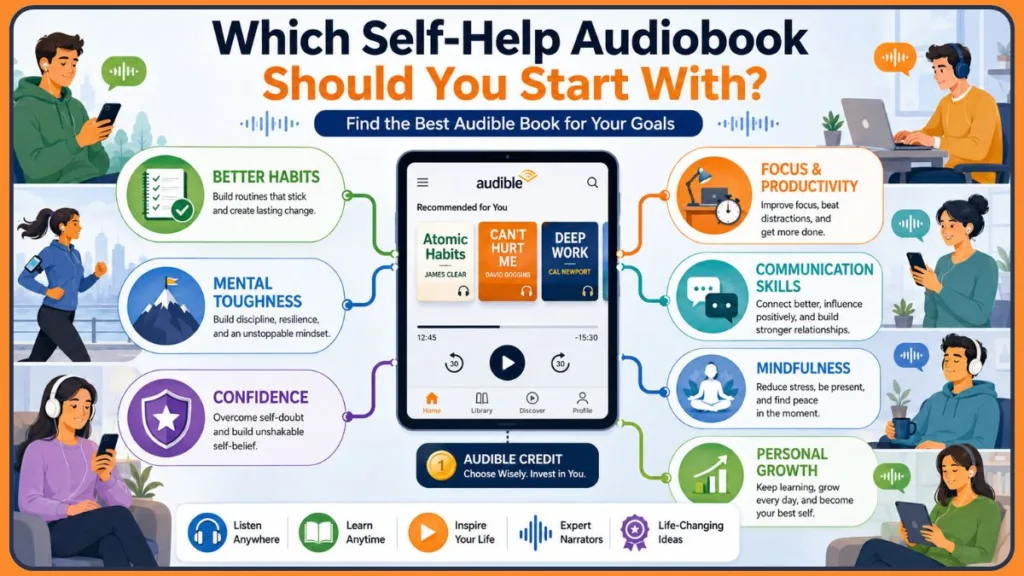
The best first listen depends entirely on the challenge you’re facing right now. Here’s a simple guide:

If you want to build better habits or routines → Start with Atomic Habits. It’s the most immediately actionable book on the list, covers the widest range of goals, and at under six hours it’s completable quickly. This is the safest first credit for almost anyone.
If you need a serious mindset reset or push past mental limits → Start with Can’t Hurt Me. If polite advice hasn’t worked and you need something that cuts through, this is it.
If you keep getting in your own way → Start with The Mountain Is You. If you recognise the pattern of self-sabotage but can’t seem to break it, Wiest gives you language and tools for understanding it at the root.
If you’re exhausted by pressure to always feel positive → Start with The Subtle Art of Not Giving a F*ck. It’s a corrective that makes the rest of life feel more manageable.
If you struggle with anxiety or overthinking → Start with The Power of Now. It won’t fix everything, but it will give you a different relationship with the thoughts that drive the anxiety.
If you want to improve your relationships or communication at work → Start with How to Win Friends and Influence People. It’s the most practically transferable book on this list for day-to-day human interaction.
If you’re a knowledge worker who finishes every day feeling busy but not productive → Start with Deep Work. It will change how you structure your time within weeks of listening.
Frequently Asked Questions
What is the best self-help book on Audible? Atomic Habits by James Clear is the most universally recommended starting point — it’s practical, author-narrated, completable in a weekend of listening, and applicable to almost any goal. However, “best” really depends on what you’re working on. If habits aren’t your main challenge, work through the “Which book should you start with?” section above.
Which self-help audiobook is most recommended by listeners? Atomic Habits leads most charts and community recommendations by a considerable margin, followed closely by Can’t Hurt Me and The Subtle Art of Not Giving a F*ck. The Mountain Is You and Deep Work have both built strong reputations more recently and appear frequently when listeners discussing life-changing self-improvement books ask specifically about titles that produced real behavioural change.
Are self-help audiobooks worth listening to? Yes — with the right books. The format genuinely suits personal development content, particularly when authors narrate their own work. Six of the ten books on this list are author-narrated, which makes a significant difference in how the material lands. The bigger question isn’t the format — it’s whether you apply what you hear. One book listened to and acted on is worth more than ten consumed passively.
Can I keep my Audible books after cancelling? Yes. Any audiobook you redeem with a credit on Audible’s Premium Plus plan is permanently yours — it lives in your library regardless of whether you remain a member. This is one of the most important differences between Audible and streaming-only services, and it makes the free trial genuinely worth using even if you decide not to continue.
Which Audible self-help book should a complete beginner start with? Atomic Habits for most people. It’s accessible without any prior reading in the genre, immediately practical, and gives you a framework — the four laws of behaviour change — that you can apply to whatever goal you’re working toward. From there, your next pick becomes much easier to choose.
What is the best Audible book for confidence? Daring Greatly by Brené Brown addresses confidence at its root — through the lens of vulnerability and shame — rather than offering surface-level tips. If confidence is the specific challenge, this is the most substantive listen on the list for that goal.
Final Thoughts
The best self-help audiobook isn’t the most popular one. It’s the one that speaks directly to the challenge you’re facing right now.
Every title on this list has been credited by real listeners with real change — in how they approach their mornings, their work, their relationships, or their relationship with themselves. That’s not a small thing in a genre where a lot of content promises transformation and delivers motivation that lasts three days.
If you’re choosing one to start with, Atomic Habits remains the most reliable first credit for most people. But if something else on this list speaks more directly to where you are right now, trust that instinct. The best audiobook is always the one you’ll actually finish — and then actually use.
If you haven’t tried Audible yet, the free 30-day trial gives you access to thousands of titles and one credit on any premium audiobook that’s yours to keep. It takes about two minutes to set up and costs nothing to try.
Have you listened to any of these? Drop a comment below and tell us which one made the biggest difference — or which title you think should have made the list.
Visit Our Post Page: Blog Page
Discover more from Izoate
Subscribe to get the latest posts sent to your email.