
Looking for the best affordable smartphone in 2026? We compare Google Pixel, iPhone, Samsung, Motorola, and more—real performance, battery life, cameras, and value explained.
If you’re hunting for the best affordable smartphone in 2026, you already know the drill — endless spec sheets, contradictory reviews, and phone prices that somehow keep climbing even as phones look more and more alike. You want a device that handles your daily life without draining your bank account.
Here’s something worth knowing upfront: the mid-range smartphone market has completely transformed. Phones once considered “budget” are now genuinely capable machines, and you don’t need to spend over $1,000 to get a great experience anymore. The sweet spot in 2026 sits firmly between $199 and $599 — and within that range, there are some genuinely impressive options.
What follows is an honest, plain-English breakdown of the best affordable smartphones available right now, so you can decide what “best” actually means for you.
Best Affordable Smartphones 2026: Quick Verdicts
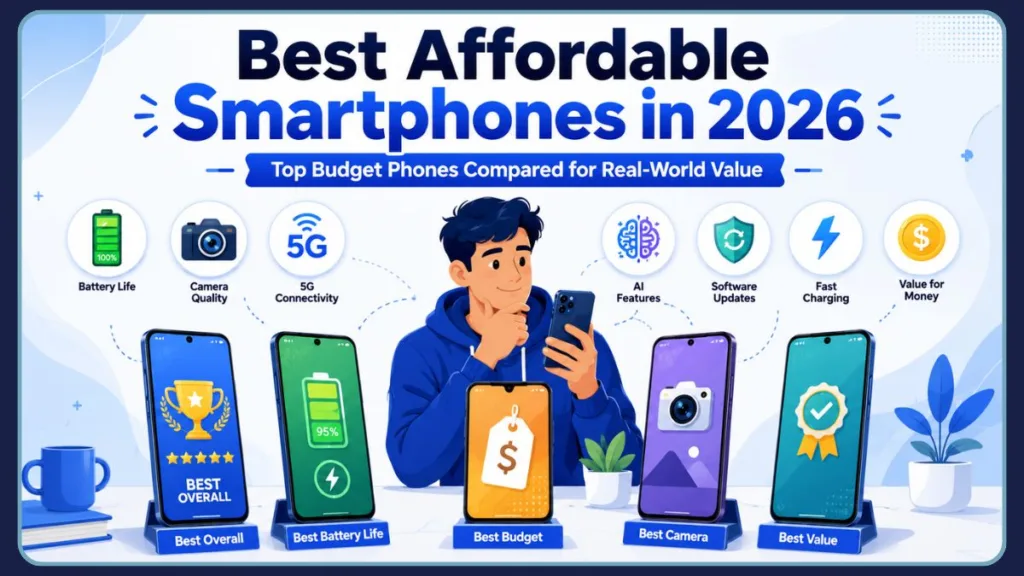
- Best overall: Google Pixel 10a — Tensor G4 chip, 7 years of updates, flagship-level camera under $500
- Best iOS option: Apple iPhone 17e — A19 chip, 256GB base storage, MagSafe support
- Best under $200: Samsung Galaxy A17 5G — OIS camera, 5,200 mAh battery, 6 years of updates
- Best battery life: Motorola Moto G (2026) — 19 hours of real-world screen-on time for $199
- Best design & fast charging: Nothing Phone 4a Pro — 144Hz AMOLED, 50W wired charging, aluminum build
- Best multimedia screen: Samsung Galaxy A57 5G — 6.7-inch Super AMOLED, 6 years of software support
What’s Actually Happening in the 2026 Smartphone Market
Before diving into the phones themselves, it helps to understand why the market looks the way it does this year — because the context genuinely changes how you should shop.
The average smartphone replacement cycle in the US has stretched to a record 3.84 years. People are holding onto their phones longer because manufacturers stopped delivering the kind of year-over-year leaps that made upgrading feel necessary. At the same time, supply chain pressures have pushed up component costs, meaning the bill of materials for mid-range devices has risen by 15–25% compared to recent years.
The result? The segment between $300 and $600 has seen a 27% surge in sales. Buyers who used to expect to spend under $300 are stretching their budgets slightly — not because they want to spend more, but because they’ve learned that spending a bit more upfront buys them a phone that actually lasts. On the flip side, if you’re dealing with inflation-related budget constraints (and 63% of Americans passed on a new phone in the past year due to rising costs), there are still genuinely strong options at the lower end.
The good news is that “affordable” doesn’t mean compromised anymore. It just means being smart about what you’re actually getting.
How We Evaluate Affordable Smartphones in 2026
In 2026, every phone claims to “support 5G” and “take great photos.” Those claims alone mean almost nothing. Here’s what actually matters when you’re shopping in this price range:
Software longevity: A phone that stops receiving security updates in two years is effectively a liability — especially if you’re using it for banking or work. We prioritize update commitments heavily.
Real-world battery life: Manufacturer claims are tested under ideal conditions. We look at actual screen-on time under cellular load because that’s what your day actually looks like.
Primary camera quality: Secondary lenses on budget phones are often marketing padding. What matters is whether the main camera takes photos worth keeping — especially in low light.
Display brightness: If you can’t read your screen outdoors, everything else is moot. Nit counts and real-world visibility are major factors.
Processor efficiency: Not just raw speed — how well the chip manages battery life and heat under sustained load matters far more than benchmark bragging rights.
Carrier flexibility: An unlocked phone that works on your preferred carrier (or MVNO) can save you hundreds annually over a locked contract device.
The Best Affordable Smartphones in 2026: Detailed Picks
Best Overall: Google Pixel 10a (~$499)
If you want the smartest buy in the affordable category right now, the Pixel 10a is it — and it’s not particularly close.
Google’s Tensor G4 chip delivers computational photography that still embarrasses phones costing twice as much. Night photography, action shots, and portrait mode all produce results you’ll actually want to share. Beyond the camera, the display hits up to 2,000–3,000 nits of peak brightness, which means you can actually use it in direct sunlight — a problem that plagued budget phones for years.
The real headline, though, is the update commitment. Google promises seven years of OS and security updates for the Pixel 10a. In a segment where phones historically got abandoned after 24 months, that’s genuinely remarkable. Buying a Pixel 10a today means you’re buying a phone that’ll stay secure and functional until at least 2031.
If you’re also exploring ecosystem options, the Pixel 10a pairs naturally with Google One plans, works seamlessly with Google Fi or any major MVNO, and integrates deeply with Android 16’s latest AI features. It is, without question, the most well-rounded affordable phone you can buy right now.
Recommended buy for most people: Google Pixel 10a: Check latest price & availability
Best iOS Option: Apple iPhone 17e (~$599)
If you’re already in the Apple ecosystem — with an iPad, Mac, AirPods, or Apple Watch — the iPhone 17e makes a lot of sense. Switching to Android would mean leaving behind iMessage, AirDrop, Handoff, and the seamless device continuity that Apple devices share.
The A19 chip inside the 17e is genuinely powerful — faster than most Android mid-range processors and comfortably capable of every AI feature Apple Intelligence offers. Apple has also finally bumped the base storage to 256GB, which removes one of the most common complaints about previous budget iPhones.
The trade-off is real, though: the 17e is stuck at a 60Hz display, which feels noticeably less fluid compared to the 90Hz and 120Hz screens you’ll find on Android phones at similar or lower prices. It also still lacks wireless charging unless you’re using MagSafe accessories. If you’re new to iPhones rather than upgrading within the ecosystem, these limitations might make it harder to justify the $599 price.
If you value long-term software support, tight ecosystem integration, and consistent resale value, the 17e delivers on all three. Apple devices tend to hold their value better than most Android alternatives, which factors into the true cost of ownership over several years.
Apple iPhone 17e: See current deals
Best Under $200: Samsung Galaxy A17 5G (~$199)
At $199, the Galaxy A17 5G is remarkable value — partly because Samsung has made commitments that used to be reserved for flagship devices.
Six years of guaranteed OS and security updates on a $199 phone is genuinely a big deal. It means your Galaxy A17 will stay safe and functional well past the point where most budget phones become security risks. The phone also includes Optical Image Stabilization on the main camera, which dramatically reduces blur in handheld shots and improves low-light performance — a feature you’d rarely find at this price point a couple of years ago.
The 5,200 mAh battery is another highlight, comfortably getting through a full day of use. Sub-6GHz 5G coverage is included, giving you access to modern network speeds without the mmWave hardware that inflates costs. If you’re looking for the safest, most sensible entry-level pick for someone who doesn’t want to think too hard about it, this is the one.
If you’re looking for the safest, most sensible entry-level pick for someone who doesn’t want to think too hard about it, this is the one.
Samsung Galaxy A17 5G: View today’s price
Best Battery Life: Motorola Moto G (2026) (~$199)
If staying connected all day — and into the next day — is your top priority, nothing at this price point comes close to the Moto G 2026.
In continuous web surfing tests at 150 nits, the Moto G consistently clocks over 19 hours of screen-on time. That’s not a typo. For context, that puts it ahead of phones costing two or three times as much. If you’re a heavy user who’s constantly worried about finding a charger, or if your job keeps you on the move without easy access to outlets, this phone is a genuine life-improver.
The compromises are real, though. The MediaTek Dimensity 6300 processor is capable for everyday tasks but won’t impress anyone who pushes it hard. The display is functional but not particularly bright. And while it handles calls, messages, social media, and streaming without issue, it’s not a phone for gaming enthusiasts or photography lovers.
Think of the Moto G as the most honest budget phone available: it’s not trying to be a flagship, it knows exactly what it’s good at, and it excels at that one thing with impressive consistency.
Motorola Moto G (2026): Check price & deals
Best Design & Fast Charging: Nothing Phone 4a Pro (~$499)
If you want a phone that turns heads and doesn’t feel like every other device in the room, the Nothing Phone 4a Pro occupies a category all its own.
The aluminum unibody construction feels premium in a way most phones at this price don’t. The 144Hz AMOLED display is one of the smoothest you’ll find under $500, hitting 1,600 nits of peak brightness. The Glyph Matrix LED lighting system on the back is genuinely functional — it can show charging status, notifications, and call alerts at a glance without turning the screen on.
The 50W wired charging is fast enough to go from nearly empty to a full charge in under an hour. A dedicated 50MP telephoto lens rounds out the camera system, which is an unusual inclusion at this price point. The main caveat worth noting is that Nothing’s long-term software update commitment doesn’t match what Samsung and Google offer, so factor that into your decision if longevity is a priority.
If you’ve looked at budget phones and felt like they all look identical, the Nothing Phone 4a Pro is the antidote.
Nothing Phone 4a Pro: Check availability
Best Multimedia Screen: Samsung Galaxy A57 5G (~$549)
For people who spend a lot of time watching videos, scrolling through social media, or playing mobile games, the Galaxy A57 5G has the screen for it.
The 6.7-inch Super AMOLED display is large, vibrant, and genuinely impressive for the price. Colors pop, contrast is deep, and the refresh rate keeps scrolling smooth. Samsung’s display technology has always been one of its strongest suits, and the A57 continues that tradition in the mid-range tier.
Samsung also offers six years of software updates on the A57, which puts it in the same league as Google’s Pixel lineup for long-term support. The main criticism you’ll see consistently is the processor: the Exynos 1680 can lag behind under sustained load, and reviewers regularly note that it doesn’t handle heavy multitasking as well as Qualcomm-powered competitors. If you’re primarily a media consumer rather than a heavy multitasker or gamer, those limitations will rarely affect your experience.
Samsung Galaxy A57 5G: View latest deals
Quick Comparison: Best Affordable Smartphones 2026
| Phone | Price | Key Strength | Battery | SW Updates | Best For |
|---|---|---|---|---|---|
| Google Pixel 10a | ~$499 | AI photography + 7-yr updates | All-day+ | 7 years | Most people |
| Apple iPhone 17e | ~$599 | A19 chip, ecosystem fit | All-day | 6+ years | iOS users |
| Samsung Galaxy A17 5G | ~$199 | OIS + long updates | All-day+ | 6 years | Budget buyers |
| Motorola Moto G 2026 | ~$199 | 19-hour battery life | 2 days+ | Limited | Power users |
| Nothing Phone 4a Pro | ~$499 | Design + 50W charging | All-day | 3 years | Style seekers |
| Samsung Galaxy A57 5G | ~$549 | 6.7″ Super AMOLED | All-day | 6 years | Media lovers |
What Actually Matters When Buying a Budget Phone in 2026
Software Updates Are the Most Underrated Feature
Here’s a question most buyers don’t ask until it’s too late: how long will this phone keep getting updates? Security patches matter enormously if you’re using your phone for banking, email, or work apps. A phone that stops receiving updates in 18 months is essentially asking you to use banking software on an unsecured device.
Google’s seven-year promise for the Pixel 10a and Samsung’s six-year commitment for the Galaxy A17 and A57 are genuinely differentiating features. Motorola’s update track record, by contrast, is significantly shorter — something worth factoring in if longevity is important to you.
A phone that stops receiving updates in 18 months is essentially asking you to use banking software on an unsecured device. Always check the software support window before you buy.
Battery Life: What the Numbers Actually Mean
When you see a “5,000 mAh battery” in a spec sheet, that number alone tells you very little. What matters is how efficiently the processor uses that power. A phone with an inefficient chip can drain a 5,000 mAh battery faster than a well-optimized phone with a 4,500 mAh battery.
The Motorola Moto G 2026 has become the benchmark for this: its MediaTek Dimensity 6300 chip is remarkably power-efficient, extracting over 19 hours of screen-on time from a standard-sized battery. That’s the real metric worth paying attention to — not the battery size, but how long the phone actually lasts in your hands.
The Camera Gimmick Problem
Budget phones often advertise “quad cameras” or “five-lens systems” that sound impressive until you realize that two or three of those lenses are 2MP macro sensors that produce images you’ll never actually use. They’re marketing filler, not functional photography tools.
What actually matters is the main camera’s sensor quality, whether it includes Optical Image Stabilization (OIS), and how well the software processes images in low light. The Pixel 10a wins the computational photography argument at this price point, consistently, because Google’s image processing algorithms are genuinely better — not because the hardware is more complex.
What actually matters is the main camera’s sensor quality, whether it includes Optical Image Stabilization (OIS), and how well the software processes images in low light.
The eSIM vs. Physical SIM Question
If you travel internationally with any regularity, the eSIM situation is worth understanding before you buy. The iPhone 17e relies heavily on eSIM in the US market, which works perfectly fine domestically but can become expensive and complicated overseas. Many international travelers prefer Android phones that retain a physical dual-SIM tray, letting them simply pop in a local SIM card upon landing rather than paying premium rates through a third-party eSIM app.
The Galaxy A17, Moto G, and Galaxy A57 all retain physical SIM trays. The Nothing Phone 4a Pro and Pixel 10a support both. It’s a small detail with big real-world implications for frequent travelers.
Heads-up for travelers: The iPhone 17e is eSIM-only in the US. If you regularly swap local SIMs abroad, an Android with a physical SIM tray will save you a lot of hassle and money.
The Smarter Way to Shop: Saving Real Money on Your Next Phone
Unlocked Phones + MVNO Plans: The Math That Changes Everything
Here’s something most carrier salespeople would prefer you didn’t calculate: the long-term cost difference between a carrier-locked phone on a postpaid plan versus an unlocked phone on a prepaid MVNO is often enormous.
A $499 Pixel 10a paired with a Mint Mobile plan at roughly $15–$30 per month delivers full 5G coverage on T-Mobile’s network. Compare that to financing the same phone through a carrier on an $80/month postpaid plan over 36 months — you’re paying nearly $2,880 in carrier fees alone, versus roughly $360–$720 on an MVNO. The unlocked route typically wins by hundreds of dollars over the life of the phone.
The unlocked route typically wins by hundreds of dollars over the life of the phone. Pair any of these picks with a prepaid MVNO and you’ll almost always come out ahead.
| Prepaid Carrier | Best Plan | Monthly Cost | Host Network | Best For |
|---|---|---|---|---|
| US Mobile | Light Plan | ~$8/mo | T-Mobile / Verizon / AT&T | Ultra-budget |
| Mint Mobile | 5GB or Unlimited | $15–$30/mo | T-Mobile | Value seekers |
| Tello | 2GB Custom | ~$10/mo | T-Mobile | Flexible budgets |
| Visible | Visible+ Pro | $35–$45/mo | Verizon | Heavy data users |
| Cricket Wireless | Supreme Unlimited | ~$55/mo | AT&T | AT&T coverage area |
Should You Consider a Refurbished Phone?
The refurbished phone market deserves serious consideration — especially since 65% of consumers say they’re now unbothered by cosmetic wear on their devices. A certified refurbished flagship from two years ago can often outperform a brand-new budget phone today, for the same price.
Apple Certified Refurbished, Samsung Certified Renewed, and Amazon Renewed are the safest starting points, offering functional testing guarantees, warranty coverage, and verified clean IMEI numbers. Savings typically range from 20% to 55% off original retail prices. If you’re considering a Pixel 10a or iPhone 17e but want to save a bit more, checking these platforms for a Pixel 9 or iPhone 15 is a smart move that most budget phone guides won’t mention.
A certified refurbished flagship from two years ago can often outperform a brand-new budget phone today, for the same price. Don’t overlook Apple Certified Refurbished, Samsung Certified Renewed, and Amazon Renewed.
Compare prices:
- Apple Certified Refurbished: View current offers
- Amazon Renewed: Check availability
Common Questions Answered
Which budget phone has the best camera under $500?
The Google Pixel 10a is the clear winner here. Its Tensor G4 chip enables computational photography that rivals phones costing $800 or more, particularly in low-light and portrait scenarios. The iPhone 17e is a close second for iOS users, though it lacks the flexibility of Google’s processing algorithms.
How long do budget Android phones actually last?
It depends heavily on the brand and model. A Samsung Galaxy A17 or Google Pixel 10a will receive software updates for six and seven years respectively, meaning they’ll stay secure and usable for that entire window. Budget Motorola phones, while excellent on battery life, typically receive fewer years of update support, which should factor into your decision if longevity is a priority.
Is 5G worth it on a budget phone?
In most cases, yes — but with context. Budget phones support Sub-6GHz 5G (the broader, more common coverage) rather than mmWave 5G (the ultra-fast, short-range version). For everyday use in suburbs and cities, Sub-6GHz 5G delivers noticeably faster speeds than LTE and future-proofs your investment. In rural areas, LTE coverage may still be more consistent, so it’s worth checking your carrier’s 5G map before prioritizing the spec.
Is it better to buy unlocked or through a carrier?
For most people, unlocked beats carrier-locked over a two-to-three-year window. You get carrier flexibility, can switch to MVNOs for dramatically lower monthly bills, and often pay less total over the life of the phone. The main exception is if a carrier is running a genuine promotional deal (like $0 for a mid-range phone with a trade-in) that legitimately beats the unlocked math — in which case, run the numbers carefully before committing.
For most people, unlocked beats carrier-locked over a two-to-three-year window. Run the numbers carefully before locking into a long-term carrier contract.
Are AI features on budget phones worth anything?
Increasingly, yes. The Pixel 10a’s Tensor G4 chip enables on-device AI that works without an internet connection — including live translation, photo magic eraser, and call screening. Samsung’s Galaxy A57 includes a version of their AI camera tools that’s genuinely useful for everyday photography. The iPhone 17e gets the full Apple Intelligence feature set via the A19 chip. Across most budget phones, AI camera enhancements are no longer a gimmick — they’re a real differentiator.
Final Verdict: Which Affordable Smartphone Should You Buy in 2026?
The honest answer is that the right affordable smartphone depends on what you value most — not which phone has the highest spec sheet.
- If you want the best overall value and the longest-lasting investment: buy the Google Pixel 10a. Check latest price & availability
- If you’re already invested in Apple’s ecosystem: the iPhone 17e makes sense despite its limitations. See current deals
- If your budget is firmly under $200: the Samsung Galaxy A17 5G delivers genuinely impressive value for its price. View today’s price
- If battery life is your non-negotiable: nothing touches the Motorola Moto G 2026 at this price. Check price & deals
- If you want a phone that stands out and charges fast: the Nothing Phone 4a Pro earns that premium. Check availability
One thing that consistently matters more than any individual spec: software support. A phone that stays secure, updated, and fast for five or six years is almost always a better investment than a phone that runs slightly faster today but gets abandoned by its manufacturer next year.
Whatever you decide, buying unlocked and pairing it with an MVNO plan is almost always the move that saves you the most money without sacrificing any real-world performance.
Visit Our Post Page: Blog Page
Discover more from Izoate
Subscribe to get the latest posts sent to your email.