
Discover the most powerful power banks in 2026. Compare the highest-capacity portable chargers for laptops, travel, gaming devices, and multi-device fast charging.
If you’ve ever watched your laptop hit 8% battery in an airport lounge with zero outlets in sight, you already know why “most powerful power bank” has become one of the most-searched phrases in tech right now. You’re not just looking for something to top up your phone anymore — you want a battery that can keep a laptop, a tablet, and a phone all running at once, without you having to think about it.
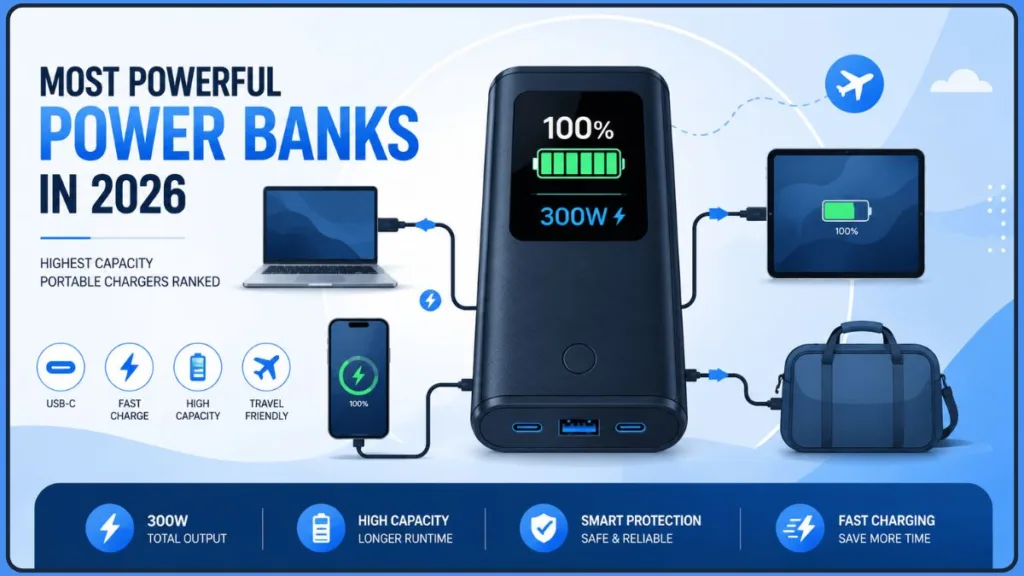
Here’s the good news: the power bank market has changed dramatically. What used to be a 10,000mAh brick that gave your phone one extra charge has evolved into genuine pocket-sized power stations pushing 300 watts — enough to fast-charge a 16-inch MacBook Pro and still have juice left for everything else in your bag.
What Are the Most Powerful Power Banks Right Now
Before we get into the deep-dive picks, here’s the quick version if you’re in a hurry.
Most Powerful Power Banks: Quick Verdicts
- Best overall raw power: Anker Prime 26K (300W) — 26,250mAh capacity, 250–300W total output, recharges to 50% in just 13 minutes
- Best for laptop-heavy travelers: EcoFlow RAPID Pro — 27,650mAh, 300W output, built-in retractable 140W cable
- Most capacity you can buy: Cuktech 30 — a massive 40,000mAh, 300W output, active cooling fan
- Best balance of power and portability: INIU Cougar P64 — 25,000mAh, 140W sustained output, shrunk-down footprint
- Best multi-protocol support: ZMI No.20 — 25,000mAh, 210W combined output across three ports
What’s Actually Driving the “Most Powerful” Power Bank Trend
It helps to understand why the market suddenly cares so much about wattage instead of just capacity, because that context will genuinely change how you shop.
For years, mAh (milliamp-hours) was the only number anyone cared about. Bigger number, better power bank — or so it seemed. But that thinking falls apart the moment you try to charge a modern laptop. The shift now is toward sustained wattage output, largely because USB-C Power Delivery (PD) 3.1 broke through the old 100W ceiling. The new standard supports up to 140W on a single port and combined outputs as high as 300W across multiple ports at once.
This isn’t a random spec bump. It’s driven directly by what people are actually trying to charge. A 16-inch MacBook Pro needs a full 140W input to hit its fastest charging speeds. Handheld gaming devices like the Steam Deck or ASUS ROG Ally need a steady 45–65W just to stay powered during “Turbo Mode” sessions, let alone actually charge while you play. None of that is possible with the power banks from even three or four years ago.
Quick answer: The most powerful power banks in 2026 are defined less by mAh and more by sustained wattage output — anything in the 140W to 300W range is now considered flagship-tier, capable of fast-charging laptops, not just phones.
How We’re Evaluating “Powerful” Here
Since “most powerful” can mean different things depending on what you’re charging, here’s what we weighed for every pick on this list:
- Sustained wattage output, not just peak numbers. A lot of power banks claim a high wattage figure that they can only hold for a few seconds before throttling. We prioritized models that can sustain near-peak output long enough to actually matter — like charging a laptop for more than just a couple of minutes.
- Real capacity vs. advertised capacity. Every power bank loses some energy in the conversion process. We factored in realistic usable capacity rather than taking the mAh number on the box at face value.
- Recharge speed. A 300W power bank that takes four hours to refill itself isn’t actually that useful for a busy travel day. Fast input speeds matter just as much as fast output.
- Thermal management. Pushing 300W through a device small enough to fit in a backpack generates real heat. We looked for active cooling, intelligent thermal monitoring, and proven track records rather than just raw spec sheets.
- Port versatility. The best high-power banks let you charge multiple devices simultaneously without everything slowing to a crawl.
- Airline compliance, where relevant. If a power bank can’t legally travel with you, that’s a real limitation — so we noted which flagship picks stay under the 100Wh threshold and which ones intentionally go bigger for non-flying use cases.
The Most Powerful Power Banks of 2026: Detailed Picks
Best Overall: Anker Prime 26K (300W) — ~26,250mAh
If you want the single most capable power bank you can buy right now, this is it, and it isn’t particularly close.
The Anker Prime 26K packs a 26,250mAh (99.75Wh) battery — deliberately engineered to sit just under the 100Wh airline threshold — while still delivering up to 300W of total output. That’s enough to run two demanding laptops simultaneously at full speed. The unit relies on PowerIQ 4.0, a dynamic power allocation system that continuously reads what’s plugged in and shifts wattage from low-demand ports to high-demand ones in real time, so you’re never stuck manually juggling cables to get the fastest charge.
Because pushing 300W through a compact shell generates serious heat, Anker built in ActiveShield 4.0, a thermal management system running roughly 120 temperature checks per second (over 10 million checks a day) to head off thermal runaway before it becomes a problem.
What really sets this one apart for frequent travelers is recharge speed. With a 250W dual-port input, the Prime 26K can refill to 50% capacity in just 13 minutes — a huge advantage if you’re sprinting between flights and only have a few minutes near an outlet.
Tip: If you regularly charge two laptops at once — say, a personal and a work device — this is the power bank built specifically for that scenario.
Best for: Business travelers and anyone who wants the single most well-rounded, high-power option on the market.
Best for Laptop-Heavy Travel: EcoFlow RAPID Pro — ~27,650mAh
The EcoFlow RAPID Pro goes head-to-head with the Anker Prime on raw specs — a flight-compliant 27,650mAh (99.54Wh) capacity and the same 300W maximum output spread across four ports — but it wins on convenience for a very specific kind of traveler.
Its standout feature is a built-in, retractable 60cm USB-C cable capable of bidirectional 140W fast charging. That solves one of the most annoying parts of carrying a high-power bank: lugging around a separate, heavy-duty PD 3.1-rated cable just to actually use the thing at full speed.
Pair the RAPID Pro with its proprietary magnetic Pogo Pin desktop charging dock, and it can accept up to 320W of input — letting it recharge from 0 to 80% in around 20 minutes, which is about as fast as this category gets right now.
Best for: Anyone who hates carrying extra cables and wants near-instant recharge times between trips.
Most Capacity You Can Buy: Cuktech 30 — 40,000mAh
If your power needs go beyond what’s legal to bring on a plane, the Cuktech 30 pushes the absolute ceiling of portable energy density with a genuinely massive 40,000mAh (141–144Wh) capacity.
This one is built for multi-day, off-grid use rather than airport efficiency. It still delivers a 300W total output and can charge up to five devices simultaneously across two USB-C ports, two USB-A ports, and a 20W wireless charging pad. Sustaining 300W generates a lot of internal heat, so Cuktech equipped this model with an active, gaming-console-grade cooling fan using a PWM (Pulse Width Modulation) adaptive algorithm to keep temperatures in check during heavy use.
Heads-up: At 141Wh+, the Cuktech 30 is well above the 100Wh airline carry-on limit and the 160Wh hard ceiling for approved travel. This is strictly a road-trip, camping, or off-grid power solution — not a flight companion.
Best for: Extended camping trips, film crews, off-grid workers, or anyone who needs serious backup power and isn’t flying with it.
Best Balance of Power and Portability: INIU Cougar P64 — 25,000mAh, 140W
Not everyone needs 300W — and if your priority is one seriously fast-charging port without the bulk of a flagship 300W unit, the INIU Cougar P64 is the strongest option in the 140W class.
It delivers a full 140W of PD 3.1 output from a 25,000mAh battery, and INIU specifically focused on solving the thermal throttling problem that plagues mid-tier power banks. Its Active Temp°Guard system can sustain the full 140W output for up to 15 minutes under load — reportedly five times longer than the industry standard before throttling kicks in.
The Cougar P64 also uses high-density “TinyCell” battery architecture and a “HyperStack” internal layout that shrinks the physical footprint by up to 30% compared to typical 25,000mAh power banks, which makes it a standout pick if you’re trying to minimize bag space without sacrificing charging speed.
Best for: Digital nomads and remote workers who want serious single-port speed in a smaller, easier-to-carry shell.
Best Multi-Protocol Support: ZMI No.20 (International Version) — 25,000mAh, 210W
If your tech ecosystem isn’t strictly Apple or Samsung, the ZMI No.20 is worth a close look. It combines a 25,000mAh capacity with a 210W total output spread across a 100W USB-C port, a 45W USB-C port, and a specialized 100W USB-A port that supports proprietary fast-charging protocols — including Xiaomi’s 120W standard.
That third port is the differentiator here. Most flagship power banks assume you’re charging Apple or Samsung gear, but the ZMI No.20 is built to play nicely across a much wider range of devices and charging standards.
Best for: Users with a mixed device ecosystem who want flexibility beyond the usual USB-C PD setup.
Comparison: Flagship High-Wattage Power Banks
| Model | Total Capacity | Max Output | Max Single-Port Output | Recharge Speed | Standout Feature |
|---|---|---|---|---|---|
| Anker Prime 26K | 26,250mAh (99.75Wh) | 300W | 140W (USB-C) | 250W input (50% in 13 min) | App control, ActiveShield 4.0 thermal monitoring |
| EcoFlow RAPID Pro | 27,650mAh (99.54Wh) | 300W | 140W (USB-C) | 320W input (80% in 20 min) | Built-in 140W retractable cable, magnetic charging dock |
| Cuktech 30 | 40,000mAh (144Wh) | 300W | 140W (USB-C) | 140W input (full charge in 2.5 hrs) | Active cooling fan, 20W wireless pad |
| INIU Cougar P64 | 25,000mAh (92.5Wh) | 140W | 140W (USB-C) | 80W input | Sustains 140W for 15 min, ultra-compact design |
| ZMI No.20 (Intl.) | 25,000mAh (90.7Wh) | 210W | 100W (USB-C or USB-A) | 100W input (full charge in 1.5 hrs) | Proprietary fast-charge support (incl. Xiaomi 120W) |
How Much Power Do You Actually Need?
Before you chase the highest wattage number on the shelf, it’s worth pausing on what you’re actually going to use the power bank for. More power isn’t automatically better if you’re mostly just topping up a phone.
Quick Answer: For phones and small devices, 10,000–20,000mAh with 20–45W output is plenty. For laptops, you’ll want at least 45W (ultrabooks) to 100–140W (gaming laptops or MacBook Pros), paired with 20,000mAh or higher capacity.
If you mainly charge a phone or earbuds: You don’t need anything on this list. A 10,000–15,000mAh power bank with standard USB-C PD will comfortably get you through a long day.
If you charge a laptop occasionally: Look for at least 45W output and 20,000mAh capacity — that combination covers most ultrabooks and gives you a meaningful top-up, even if not a full charge.
If you regularly charge a gaming laptop, MacBook Pro, or multiple devices at once: This is where the 140W–300W tier earns its keep. Anything pulling serious wattage — like a 16-inch MacBook Pro needing 140W for full-speed charging — needs a power bank specifically built for that load, not just a bigger battery.
If you’re prepping for power outages, hurricanes, or off-grid trips: Capacity matters more than portability here. This is where something like the Cuktech 30 (or, for genuinely massive needs, a full portable power station) makes more sense than a flight-friendly flagship.
mAh vs. Watt-Hours: Why the Number on the Box Isn’t the Whole Story
This is one of the most common points of confusion, and it’s worth untangling because it directly affects how much “power” you’re really getting.
Power bank cells store energy at roughly 3.7V internally. But the ports you actually charge from operate at higher voltages — 5V for standard USB-A, and anywhere from 9V up to 28V for USB-C Power Delivery. Moving that energy from the battery’s native voltage up to your device’s charging voltage requires a boost-conversion process, and that process isn’t perfectly efficient. You typically lose somewhere between 15% and 30% of the stored energy to heat during that conversion.
That’s why a 20,000mAh power bank doesn’t actually deliver 20,000mAh to your phone. Here’s roughly what you can expect in real-world terms:
| Advertised Capacity | Total Energy (Wh) | Usable Capacity (Wired, ~85% efficiency) | Usable Capacity (Wireless, ~70% efficiency) |
|---|---|---|---|
| 5,000 mAh | 18.5 Wh | ~3,145 mAh | ~2,590 mAh |
| 10,000 mAh | 37.0 Wh | ~6,290 mAh | ~5,180 mAh |
| 20,000 mAh | 74.0 Wh | ~12,580 mAh | ~10,360 mAh |
| 27,650 mAh | 99.5 Wh | ~17,390 mAh | ~14,320 mAh |
Tip: If you want to estimate how many charges you’ll actually get, don’t just divide the power bank’s mAh by your phone’s battery size. Use the Wh figure instead, and expect to lose roughly 15–30% to conversion efficiency along the way.
Power Bank Airline Rules in 2026: What You Need to Know Before You Fly
If there’s one thing that’s changed more than the hardware itself, it’s the rules around flying with these things. Airlines have tightened power bank regulations significantly throughout 2026, and if you’re shopping for a high-capacity model specifically for travel, this section matters as much as the wattage specs.
The 100Wh “safe zone.”: Batteries rated at or below 100 watt-hours are allowed in carry-on baggage without needing prior airline approval. Since lithium cells run at roughly 3.7V, that works out to approximately 27,000mAh. This is exactly why flagship travel-focused power banks like the Anker Prime 26K (99.75Wh) and EcoFlow RAPID Pro (99.54Wh) are engineered to sit just under that line — it’s not a coincidence, it’s a design target.
The 160Wh hard ceiling: Power banks between 101Wh and 160Wh (roughly 27,500mAh to 43,000mAh) require documented airline approval in advance, and you’re generally limited to two of them per passenger.
Above 160Wh: These are banned outright on passenger aircraft, with very narrow exceptions for essential medical equipment.
Checked baggage is off the table — always: No matter the capacity, power banks and spare lithium-ion batteries are never allowed in checked luggage under any circumstances. If your carry-on gets gate-checked, you’re required to pull the power bank out and carry it into the cabin yourself.
Several major carriers have gone further than the baseline rules recently:
- United Airlines banned storing power banks in overhead bins entirely as of March 1, 2026 — they must now stay on your person, in a seatback pocket, or in a personal item under the seat in front of you. Delta and American followed with similar policies shortly after.
- Lufthansa Group (including Lufthansa, SWISS, Austrian Airlines, Brussels Airlines, Eurowings, and others) went a step further starting January 15, 2026, banning active use of power banks entirely during flights — no charging devices, and no recharging the power bank itself from the seat’s USB port. Power banks must stay powered off and stored under the seat or on your person, capped at two per passenger.
Why it matters: A single thermal runaway incident in October 2025 — where a power bank ignited inside a closed overhead bin on a passenger flight — is widely cited as the catalyst behind this wave of stricter 2026 rules. Lithium-ion cells in thermal runaway can spike to roughly 700°C in seconds, and the danger is significantly worse when the device is out of sight in an overhead bin rather than visible nearby.
Before you fly with any power bank:
- Confirm the Wh rating is clearly and legibly printed on the casing — if security can’t verify it, they can confiscate it.
- Pack it in your carry-on only, never checked luggage.
- Check your specific airline’s policy, since rules now vary more than they used to.
- If you’re under 100Wh, you’re in the clear for nearly every airline worldwide without needing pre-approval.
Power Bank vs. Portable Power Station: Which Do You Actually Need?
As power bank capacities have crept up toward 40,000mAh and beyond, it’s easy to wonder whether you actually need a portable power station instead. Here’s the real distinction.
A power bank is a pure DC device — it stores and delivers power exclusively through USB-A, USB-C, or wireless charging coils. Because it never has to convert DC to AC, the internal hardware stays compact enough to be genuinely pocketable or backpack-friendly.
A portable power station, on the other hand, has a built-in inverter that converts stored DC power into 120V/230V AC — the same kind of power you’d get from a wall outlet. That’s what lets it run things a power bank simply can’t, like mini-fridges, power tools, or medical equipment such as CPAP machines.
| Feature | High-Capacity Power Bank | Portable Power Station |
|---|---|---|
| Typical capacity | 10,000–40,000mAh (37–150Wh) | 200Wh to 5,000+Wh |
| Output type | Pure DC (USB-C, USB-A, wireless) | DC (USB) + AC (wall outlet) |
| Best for | Phones, tablets, laptops, handhelds | Mini-fridges, CPAPs, TVs, power tools |
| Flying with it | Fine under 100Wh | Not allowed on passenger flights |
| Solar charging | Negligible to none | Standard feature on most models |
| Weight | 0.5–1.5 lbs | 10–100+ lbs |
A handful of newer devices blur this line. The UGREEN 300W 48,000mAh power bank, for example, packs a massive 153Wh capacity and a 300W output across five ports — including a built-in LED floodlight and SOS beacon, features you’d normally expect on a power station. But because it still lacks an AC inverter and relies entirely on USB output, it’s technically classified as an ultra-high-capacity power bank. At 153Wh, it falls into the “airline approval required” category, which makes it a poor fit for casual air travel but a genuinely useful option for camping, film production, or extended outdoor work where AC power isn’t necessary.
If you’re trying to decide: Choose a power bank if everything you need to charge plugs in via USB. Choose a portable power station if you need to run anything with a standard wall plug, or if you want solar charging capability for true off-grid use.
What About Safety? The Shift Toward Semi-Solid-State Batteries
As power banks get more powerful, the question of safety naturally comes up — and it’s a fair one, given how much energy is now packed into devices small enough to carry in a jacket pocket.
Traditional lithium-ion and lithium-polymer cells rely on a flammable liquid electrolyte. If the battery is punctured, crushed, or exposed to extreme heat, that liquid can vaporize and ignite. It’s exactly the kind of failure that’s driven the stricter 2026 airline rules covered above.
The industry’s answer has been a quiet but significant shift toward semi-solid-state battery (SSB) technology, which replaces much of that volatile liquid electrolyte with a stable, semi-solid polymer or ceramic matrix. The benefits are meaningful:
- Far better thermal stability. In nail-penetration testing, semi-solid-state cells can be physically pierced without catching fire — a dramatic improvement over traditional liquid cells.
- Thinner designs. Because the cells are inherently more stable, manufacturers can strip away some of the bulky protective layers liquid lithium-ion cells require.
- Longer lifespan. Standard liquid power banks typically retain about 80% capacity after 300–500 charge cycles. Semi-solid-state models can often reach 1,000 cycles before similar degradation — roughly doubling the usable lifespan of the battery.
If long-term safety and longevity matter more to you than raw wattage, it’s worth specifically looking for power banks built on this newer battery chemistry rather than traditional lithium-ion or lithium-polymer cells.
Frequently Asked Questions
What is the most powerful power bank you can buy right now?
In terms of raw, sustained output, the Anker Prime 26K and EcoFlow RAPID Pro are tied at the top, each delivering up to 300W of total output from a flight-compliant, sub-100Wh battery. If you’re not worried about airline limits, the Cuktech 30 offers significantly more raw capacity (40,000mAh) at the same 300W output ceiling.
What mAh power bank is allowed on a plane in 2026?
Power banks at or below 100Wh — roughly 27,000mAh — are allowed in carry-on baggage on virtually every major airline without needing prior approval. Between 100Wh and 160Wh (about 27,500mAh to 43,000mAh), you’ll need airline sign-off in advance and are typically limited to two units. Anything above 160Wh is banned outright on passenger flights.
How many watts do I need to charge a laptop with a power bank?
It depends on the laptop. Smaller ultrabooks typically need 45–65W, while larger or gaming laptops usually require 65–100W, and some high-performance models need the full 140W that PD 3.1 now supports. Check the wattage printed on your laptop’s original charger, and choose a power bank that matches or exceeds that figure.
Can a power bank really charge a laptop?
Yes, as long as it supports USB-C Power Delivery and outputs enough wattage to match your laptop’s requirements. A power bank with high mAh capacity but low wattage output won’t charge a laptop effectively, even if the battery itself is large — wattage, not just capacity, is what determines whether the charge actually happens.
Is a higher mAh power bank more dangerous?
Not inherently. Higher-capacity power banks do carry more stored energy, which means poor design or inadequate cooling poses a bigger risk if something goes wrong. But a well-built high-capacity model with quality cells, active thermal management, and proper protection circuitry can be just as safe as a smaller one. This is exactly why features like Anker’s ActiveShield or INIU’s thermal guard systems matter as much as the capacity number itself.
What’s the difference between mAh and Wh, and why does it matter?
mAh measures how much charge a battery can store, while Wh (watt-hours) measures the actual energy stored, accounting for voltage. Since power banks run at roughly 3.7V internally but charge your devices at higher voltages, a portion of that stored energy is lost in conversion. Wh is the more accurate number for understanding real-world charging capacity, especially for airline compliance.
Final Verdict: Which Powerful Power Bank Should You Buy?
The honest answer depends on what you’re actually trying to power, not just which spec sheet looks the most impressive.
- If you want the single most capable, well-rounded option: Go with the Anker Prime 26K. It hits the airline-friendly capacity sweet spot while still delivering genuine 300W performance.
- If you’re tired of carrying separate charging cables: The EcoFlow RAPID Pro’s built-in retractable cable solves a problem most power banks ignore.
- If you need the most raw capacity and aren’t flying with it: The Cuktech 30’s 40,000mAh and active cooling make it the strongest off-grid option here.
- If portability matters as much as power: The INIU Cougar P64 gives you 140W in a noticeably smaller footprint.
- If your devices don’t all play by the same charging rules: The ZMI No.20’s multi-protocol support covers more ground than most flagship competitors.
Whatever you land on, match the wattage to what you’re actually charging, double-check the Wh rating if you’re planning to fly with it, and don’t assume bigger mAh automatically means more usable power. Got a specific laptop or travel setup you’re trying to plan around? Drop it in the comments and we’ll help you figure out exactly what you need.
Visit Our Post Page: Blog Page
Discover more from Izoate
Subscribe to get the latest posts sent to your email.