
What is the Best Bleed Weapon in Elden Ring in 2026? Explore 10 top Bleed weapons from the base game and DLC to find the right weapon for your build.
Few things in Elden Ring feel as satisfying as triggering Hemorrhage during a boss fight and watching a huge chunk of the enemy’s health disappear. With the right weapon and build, you can turn consecutive attacks, powerful weapon skills, and charged Heavy Attacks into devastating Bleed damage.
But which weapon should you use to create the strongest Bleed build in Elden Ring?
Bloodfiend’s Arm is our top recommendation for a heavy Bleed build in 2026, particularly if you prefer a Strength/Arcane setup. Its powerful charged Heavy Attacks build up Blood Loss while its Colossal Weapon moveset lets you interrupt enemies and deal substantial stance damage.
Our top pick: Choose Bloodfiend’s Arm for heavy attacks, powerful physical damage, and substantial Bleed buildup. For faster attacks and weapon-skill combos, consider Rivers of Blood, Eleonora’s Poleblade, or Godskin Peeler.
However, the best bleed weapon in Elden Ring isn’t necessarily the same for every character. Your ideal choice depends on your preferred combat style, character attributes, weapon skills, and access to the Shadow of the Erdtree DLC.
Here are the key factors to consider when choosing your weapon:
- Fast Blood Loss buildup: Weapons such as Reduvia, Eleonora’s Poleblade, and Godskin Peeler can build Bleed through consecutive attacks and multi-hit combos.
- Powerful weapon skills: Mohgwyn’s Sacred Spear, Rivers of Blood, and Bloody Helice offer distinctive skills for dealing damage, building Bleed, and creating openings.
- Charged Heavy Attacks: Bloodfiend’s Arm combines heavy physical damage with Blood Loss buildup and stagger potential.
- Dual-wield combinations: Scavenger’s Curved Swords and Backhand Blades offer fast attack patterns for an Elden Ring dual wield Bleed build.
- Character attributes: Your Strength, Dexterity, and Arcane investment influences which weapon and affinity will suit your build.
- DLC access: Weapons such as Bloodfiend’s Arm, Bloodfiend’s Sacred Spear, and Backhand Blade provide additional options if you own Shadow of the Erdtree.
In this guide, you’ll discover the Elden Ring best Bleed weapons ranked, early-game and DLC recommendations, Strength and Arcane weapon choices, the difference between Blood and Occult affinities, the best Ashes of War, and equipment to improve your Bleed build.

Whether you’re trying to discover which weapon does the most Bleed in Elden Ring, how much Arcane you need for a Bleed build, or the fastest way to trigger Hemorrhage, you’ll find recommendations to help you create a setup that fits your playstyle.
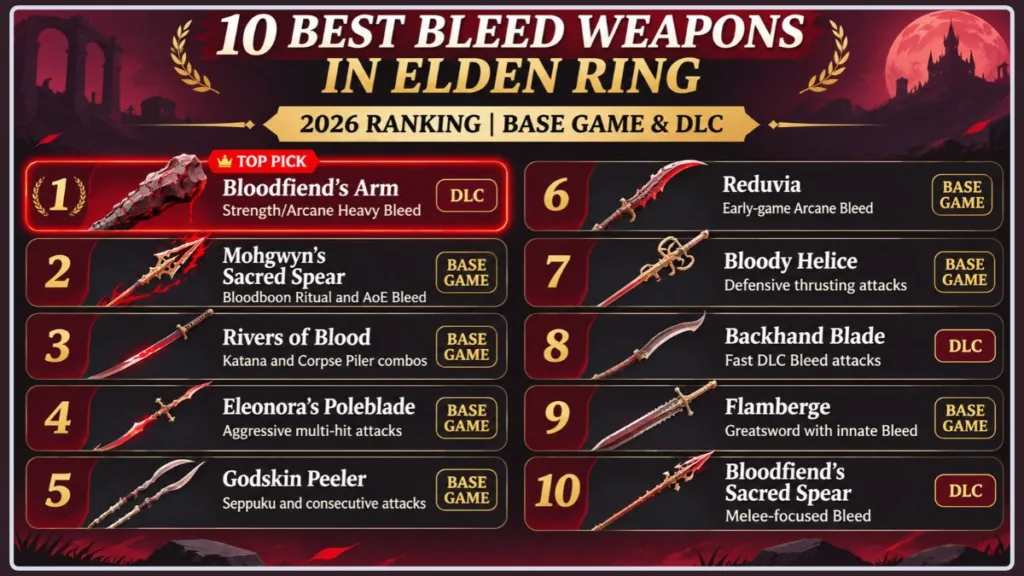
10 Best Bleed Weapons in Elden Ring, Ranked
Not every Bleed weapon works the same way. Some are designed for fast consecutive attacks, while others deliver powerful weapon skills or combine physical damage with substantial Blood Loss buildup.
The following ranking considers each weapon’s Bleed potential, attack pattern, weapon skills, physical damage, build compatibility, and accessibility. It includes powerful base-game options and weapons available through Shadow of the Erdtree.
| Rank | Weapon | Best use |
|---|---|---|
| 1 | Bloodfiend’s Arm | Strength/Arcane heavy Bleed |
| 2 | Mohgwyn’s Sacred Spear | Bloodboon Ritual and area-wide Bleed |
| 3 | Rivers of Blood | Katana and Corpse Piler combos |
| 4 | Eleonora’s Poleblade | Aggressive multi-hit Twinblade attacks |
| 5 | Godskin Peeler | Seppuku and consecutive attacks |
| 6 | Reduvia | Early-game Arcane Bleed |
| 7 | Bloody Helice | Defensive thrusting attacks |
| 8 | Backhand Blade | Fast DLC Bleed attacks |
| 9 | Flamberge | Greatsword with innate Bleed |
| 10 | Bloodfiend’s Sacred Spear | Melee-focused Bleed |
1. Bloodfiend’s Arm – Best Heavy Bleed Weapon for Strength/Arcane Builds
Best for: Strength/Arcane Bleed builds
Weapon type: Colossal Weapon
Availability: Shadow of the Erdtree DLC
Want to turn a single heavy attack into a devastating opening against your enemy? Bloodfiend’s Arm is an excellent choice if you prefer a heavy weapon that combines powerful physical damage with substantial Blood Loss buildup.
Unlike traditional Bleed katanas that depend on repeated light attacks, this Colossal Weapon can build up Bleed through its charged Heavy Attacks. This lets you combine heavy physical hits with status damage rather than relying entirely on fast attack combinations.
Its biggest advantage is the combination of Blood Loss buildup and stagger potential. You can interrupt enemy attacks with heavy hits while dealing stance damage, making it useful against enemies that are difficult to approach with faster weapons.
Repeatedly landing charged Heavy Attacks can trigger Bleed while also dealing considerable physical damage. This makes the weapon particularly attractive for Strength/Arcane builds.
If you’re looking for the best Strength Bleed weapon in Elden Ring or a powerful heavy weapon for your Bleed build, Bloodfiend’s Arm deserves a place near the top of your list.
Build recommendation: Choose Bloodfiend’s Arm if you prefer heavy attacks and want a powerful Bleed weapon that can punish enemies while building up Hemorrhage.
2. Mohgwyn’s Sacred Spear – Best Weapon for Bloodboon Ritual and AoE Bleed
Best for: Arcane builds and area-wide Bleed damage
Weapon type: Great Spear
Availability: Base game
If you want to surround enemies with Bloodflame and build up Bleed across multiple targets, Mohgwyn’s Sacred Spear is an excellent choice.
Its unique weapon skill, Bloodboon Ritual, releases Bloodflame around you and creates a wide area of damage. This makes the spear particularly useful when enemies surround you or when you’re fighting larger opponents that can take multiple hits from the skill.
Repeated Bloodboon Ritual attacks can build up substantial Blood Loss, and a complete skill sequence can trigger Bleed multiple times when enough attacks connect.
The spear also has passive Blood Loss buildup, so you don’t have to depend entirely on its weapon skill to trigger Hemorrhage. You can use regular attacks against individual enemies and activate Bloodboon Ritual when you need wider coverage.
Bloodboon Ritual’s main advantages:
- Creates a wide area of Bloodflame damage.
- Repeated skill hits build up Blood Loss.
- Can trigger Bleed multiple times when the full sequence connects.
- Particularly useful against groups of enemies.
- Suits Arcane-focused characters.
Build recommendation: Choose Mohgwyn’s Sacred Spear if you want powerful Bleed potential combined with an effective area-damage skill. It is one of the strongest options for an Arcane-focused build that relies on Bloodboon Ritual.
3. Rivers of Blood – Best Bleed Katana for Corpse Piler Combos
Best for: Dexterity/Arcane katana builds
Weapon type: Katana
Availability: Base game
Rivers of Blood remains one of the most recognizable Bleed weapons in Elden Ring. Its combination of physical damage, Fire damage, and innate Blood Loss buildup makes it an excellent option if you prefer fast katana attacks.
Its unique weapon skill, Corpse Piler, is the main reason to use this weapon. It performs a series of slashing attacks that extend beyond the weapon’s normal reach, allowing you to strike enemies from a safer distance while building up Blood Loss.
Corpse Piler is particularly effective when you can land multiple hits on a boss or larger enemy. Its attacks also deal Fire damage, giving the weapon an additional damage component. The skill’s relatively low FP cost also makes it useful for repeated combat encounters.
Rivers of Blood works well with Dexterity and Arcane investment, making it a natural choice if you want a dedicated katana Bleed build.
Corpse Piler’s main advantages:
- Delivers multiple slashing attacks.
- Builds up Blood Loss through repeated hits.
- Combines physical and Fire damage.
- Extends your attack reach through its weapon skill.
- Suits Dexterity/Arcane builds.
Build recommendation: Choose Rivers of Blood if you enjoy aggressive katana combat and want a weapon skill that combines extended slashing attacks with Blood Loss buildup.
4. Eleonora’s Poleblade – Best Twinblade for Aggressive Bleed Combos
Best for: Fast attacks and aggressive Bleed combos
Weapon type: Twinblade
Availability: Base game
If you prefer staying on the offensive rather than waiting for openings to land heavy attacks, Eleonora’s Poleblade is an excellent alternative.
Its Bloodflame-themed attacks combine physical damage, Fire damage, and Blood Loss buildup. The Twinblade moveset also gives you access to repeated attacks, helping you maintain pressure against enemies vulnerable to Hemorrhage.
Its unique weapon skill, Bloodblade Dance, performs a series of spinning attacks that hit enemies multiple times. You can also use its follow-up input to continue the attack sequence while moving away from danger.
This makes Eleonora’s Poleblade particularly useful when you want to maintain pressure without relying entirely on stationary attacks.
Rivers of Blood vs Eleonora’s Poleblade: Which Should You Choose?
Both weapons are excellent for aggressive Bleed combat, but their movesets offer different advantages:
- Rivers of Blood: Better suited to katana combat and the extended slashing attacks of Corpse Piler.
- Eleonora’s Poleblade: Better suited to a mobile Twinblade playstyle with multi-hit attacks and a follow-up movement option.
Build recommendation: Choose Eleonora’s Poleblade if you prefer a mobile Twinblade playstyle and want a weapon skill that combines multiple attacks with movement. Pick Rivers of Blood if you prefer katana reach and Corpse Piler combos.
5. Godskin Peeler – Best Twinblade for Seppuku and Multi-Hit Attacks
Best for: Seppuku and multi-hit Bleed builds
Weapon type: Twinblade
Availability: Base game
Godskin Peeler is a strong choice if you want to build up Blood Loss through repeated attacks. Its Twinblade moveset provides multiple hits, making it useful for aggressive Bleed-focused combat.
You can apply Blood affinity and use Seppuku to improve its Bleed-focused performance. One particularly useful attack is its two-handed running Heavy Attack, which can land four hits in quick succession.
This attack pattern makes Godskin Peeler an interesting alternative to traditional dual-wield setups. You can take advantage of its multi-hit attack without requiring two separate weapons.
If you’re searching for the best weapons to use with Seppuku Ash of War, Godskin Peeler is worth considering. However, Seppuku requires a compatible weapon and cannot be applied to every Twinblade configuration or unique weapon.
Build recommendation: Choose Godskin Peeler if you prefer a two-handed Twinblade setup and want to build up Blood Loss through consecutive attacks. Its compatibility with Seppuku makes it an excellent option for aggressive Bleed builds.
6. Reduvia – Best Early-Game Bleed Weapon with Ranged Attacks
Best for: Early-game Bleed builds
Weapon type: Dagger
Availability: Base game
You don’t need to wait until the later stages of Elden Ring to start building a powerful Bleed character. Reduvia is one of the earliest useful Bleed weapons you can obtain, making it an excellent choice if you want to start an Arcane-focused build early.
Reduvia has 50 Blood Loss buildup and requires 5 Strength, 13 Dexterity, and 13 Arcane.
Its unique weapon skill, Reduvia Blood Blade, launches a ranged Blood attack that can build up Blood Loss while allowing you to maintain some distance from enemies. Its innate Blood Loss buildup and Arcane scaling also make it useful if you want to invest in status damage early.
You can obtain Reduvia by defeating Bloody Finger Nerijus, an invading NPC encountered in the ravine leading toward Murkwater Catacombs in Limgrave.
Early-game recommendation: Choose Reduvia if you want an effective early-game Bleed weapon with Arcane scaling, innate Blood Loss buildup, and a ranged weapon skill.
7. Bloody Helice – Best Bleed Weapon for Evasive Counterattacks
Best for: Defensive Bleed combat
Weapon type: Heavy Thrusting Sword
Availability: Base game
Not every Bleed build needs to rely on relentless attacks. Bloody Helice offers a more defensive approach by combining thrusting attacks with an evasive weapon skill.
Its unique skill, Dynast’s Finesse, allows you to evade an incoming attack before following up with a powerful thrust. The skill provides long invincibility frames, giving you an opportunity to avoid enemy attacks and create openings for counterattacks.
Its Pierce damage and thrusting moveset also provide useful reach and stance damage, making it a good alternative to katanas and Twinblades. Bloody Helice works well with Dexterity and Arcane investment, giving you a different approach to an Elden Ring Bleed build.
Combat recommendation: Choose Bloody Helice if you prefer a defensive playstyle that combines dodging, counterattacks, and Blood Loss buildup.
8. Backhand Blade – Best DLC Weapon for Fast Bleed Attacks
Best for: Fast DLC Bleed attacks
Weapon type: Backhand Blades
Availability: Shadow of the Erdtree DLC
Looking for a fast weapon that can overwhelm enemies with consecutive attacks? Backhand Blade is an excellent DLC option if you prefer aggressive combat and a quick dual-wield moveset.
It requires 10 Strength and 13 Dexterity. Unlike some dedicated Bleed weapons, it does not automatically provide innate Blood Loss buildup. Instead, you can apply Blood affinity to make it suitable for an Arcane-focused Bleed build.
With Blood affinity, its Blood Loss buildup can reach approximately 100, depending on your Arcane level. Its two-handed moveset allows you to use a second Backhand Blade in your off-hand, giving you a fast dual-wield attack pattern.
The weapon also has access to Blind Spot, an Ash of War that lets you move into an enemy’s blind spot and attack from the side. You can further support its successive attacks with equipment such as White Mask, Lord of Blood’s Exultation, and Rotten Winged Sword Insignia.
You can find Backhand Blade in Gravesite Plain, near the Scorched Ruins, in the Shadow of the Erdtree DLC.
DLC recommendation: Choose Backhand Blade if you own Shadow of the Erdtree and prefer fast, repeated attacks over slower heavy hits.
9. Flamberge – Best Greatsword with Innate Bleed and Customizable Skills
Best for: Flexible Greatsword Bleed builds
Weapon type: Greatsword
Availability: Base game
Flamberge is a useful option if you want a Greatsword with innate Blood Loss buildup rather than relying on a unique weapon skill. It is accessible in Caelid near Redmane Castle and has relatively low attribute requirements.
Its main advantage is flexibility. You can experiment with different Ashes of War to suit your preferred combat approach, including Impaling Thrust, Piercing Fang, and Storm Blade.
This makes Flamberge worth considering if you want to build around a standard weapon rather than committing to a unique armament. You can customize its weapon skill to complement your preferred combat style.
Build recommendation: Choose Flamberge if you want a flexible Greatsword with innate Bleed and the freedom to experiment with different weapon skills.
10. Bloodfiend’s Sacred Spear – Best for Melee-Focused Bleed Builds
Best for: Melee-focused Bleed builds
Weapon type: Spear
Availability: Shadow of the Erdtree DLC
Bloodfiend’s Sacred Spear is another DLC option worth considering if you want to focus on direct melee combat. It offers higher passive Blood Loss buildup than Mohgwyn’s Sacred Spear and is more focused on regular melee attacks.
This gives you an alternative if you want to build up Bleed through your weapon’s normal attacks rather than relying primarily on a wide-area skill.
Build recommendation: Choose Bloodfiend’s Sacred Spear if you prefer melee-focused attacks and higher passive Blood Loss buildup. Pick Mohgwyn’s Sacred Spear when area-wide Bloodboon Ritual attacks are more important to your build.
What Are the Other Bleed Weapons Worth Considering in Elden Ring?
The ten weapons above cover several different combat styles, but you aren’t limited to those options. Other weapons offer useful Blood Loss buildup, distinctive skills, and different attribute requirements. Consider these alternatives if their movesets better match your character.
Bloodhound’s Fang – Best Early-Game Curved Greatsword Alternative
Bloodhound’s Fang is a strong alternative if you want a heavier weapon with a mobile weapon skill. It has 55 Blood Loss buildup and requires 18 Strength and 17 Dexterity.
Its unique skill, Bloodhound’s Finesse, lets you somersault backward to evade an attack before following up with a stepping strike. The skill cannot be changed.
You can obtain the weapon by defeating Bloodhound Knight Darriwil at the Forlorn Hound Evergaol in Limgrave.
Consider Bloodhound’s Fang if you want a weapon that combines a curved Greatsword moveset, early-game accessibility, and evasive attacks.
Scavenger’s Curved Sword – Best for Dual-Wield Bleed Builds
Scavenger’s Curved Sword is a popular choice if you want to create an Elden Ring dual-wield Bleed build. Its fast curved sword moveset allows you to land multiple attacks through running, jumping, and regular combos.
It also has innate Blood Loss buildup, making it particularly useful for Occult affinity builds that take advantage of Arcane scaling.
Using two Scavenger’s Curved Swords gives you access to powerstanced attacks that can hit multiple times. This helps you build up Blood Loss while maintaining physical damage.
A dual Scavenger Curved Sword build is worth considering if you prefer repeated attacks over the slower swings of heavy weapons. You can also compare this setup with Bandit’s Curved Swords, which offer another option for fast dual-wield attacks.
Dual-wield recommendation: Choose two Scavenger’s Curved Swords if you prefer rapid powerstanced attacks and want to take advantage of their innate Bleed and Occult affinity compatibility.
Great Stars – Best Heavy Alternative for Strength-Based Bleed Builds
Great Stars is a strong alternative if you want a heavy weapon that combines physical damage, Blood Loss buildup, and health recovery.
Unlike lighter Bleed weapons, Great Stars allows you to stagger enemies while dealing considerable physical damage. Its innate Blood Loss buildup also makes it suitable for Blood or Occult affinity setups.
You can experiment with Wild Strikes to deliver repeated attacks and build up Blood Loss. Another option is using Occult affinity to benefit from Arcane scaling while retaining the weapon’s innate Bleed.
Consider a Great Stars Bleed build if you want a Strength-focused setup without depending on katanas or Twinblades.
Hoslow’s Petal Whip – Best Customizable Whip for Bleed Builds
Hoslow’s Petal Whip is an interesting option if you prefer a whip-based moveset. It has 55 Blood Loss buildup, 110 base physical attack, and requires 10 Strength and 20 Dexterity.
Its weapon skill is Kick, which can be changed. The whip also accepts compatible Ashes of War, giving you more customization than a fixed-skill unique weapon.
You can obtain it by killing Diallos after visiting Roundtable Hold or by completing the final Volcano Manor contract. Completing both routes allows you to acquire two whips and create a dual-wield setup.
Choose Hoslow’s Petal Whip if you want a customizable Bleed weapon with the reach of whip attacks.
Varré’s Bouquet – Best for Blood Tax and Repeated Thrusts
Varré’s Bouquet is a distinctive Bleed weapon with 65 Blood Loss buildup. It requires 8 Strength, 16 Dexterity, and 24 Arcane.
Its unique weapon skill, Blood Tax, performs a multi-thrust attack and restores a small amount of health when its strikes connect. The skill cannot be changed.
Although its physical damage is relatively low, its Blood Loss buildup and multi-hit skill make it an option worth considering for status-focused builds.
You can obtain Varré’s Bouquet by completing White Mask Varré’s questline and invading him before reaching the Dynasty Mausoleum Midpoint in Mohgwyn Palace.
Consider Varré’s Bouquet if you value its high Blood Loss buildup and health recovery from successful Blood Tax strikes.
Hand of Malenia – Best Dexterity Katana for Waterfowl Dance
Hand of Malenia is a katana for characters with substantial Dexterity investment. It has 50 Blood Loss buildup and requires 16 Strength and 48 Dexterity.
Its unique skill, Waterfowl Dance, delivers a multi-hit combo. This gives the weapon an aggressive attack pattern, although its high Dexterity requirement makes it less accessible for early-game Bleed builds.
You can obtain it from Enia at Roundtable Hold by exchanging the Remembrance of the Rot Goddess, earned by defeating Malenia.
Choose Hand of Malenia if you already have a high-Dexterity character and want a katana with a distinctive multi-hit skill.
Uchigatana – Best Starting Katana for an Early Bleed Build
Uchigatana is a straightforward option if you want to start building Blood Loss without waiting for a later weapon. It has 45 Blood Loss buildup, requires 11 Strength and 15 Dexterity, and provides 115 base physical attack.
Its weapon skill, Unsheathe, offers a quick attack option and can be changed. The Uchigatana is available as the Samurai starting weapon or can be found inside Deathtouched Catacombs in Stormhill.
Choose Uchigatana if you want an accessible early-game katana with innate Blood Loss buildup and a customizable weapon setup.
Thorned Whip – Best Lightweight Whip with Innate Bleed
Thorned Whip is another option if you prefer whip attacks. It has 50 Blood Loss buildup, 102 physical damage, and requires 8 Strength and 16 Dexterity.
It comes with Kick, which can be changed, and drops from Fire Prelates found north of the Giant-Conquering Hero’s Grave.
Its low Strength requirement makes it accessible to a range of characters, while its whip moveset provides a different combat option from katanas and heavy weapons.
Consider Thorned Whip if you want a lightweight Bleed weapon with a relatively low Strength requirement.
Moonveil – Best Intelligence Katana with Secondary Bleed
Moonveil is primarily an Intelligence-focused katana rather than a dedicated Bleed weapon. It has 50 Blood Loss buildup and requires 12 Strength, 18 Dexterity, and 23 Intelligence.
Its unique weapon skill, Transient Moonlight, releases a wave of light when you unsheathe the blade. Moonveil combines physical and magic damage, so its Bleed effect is a secondary part of its overall combat potential.
You can obtain it by defeating the Magma Wyrm in Gael Tunnel.
Moonveil is worth considering if you’re already building around Intelligence and want a katana that combines magic damage with some Blood Loss buildup. It is better treated as an Intelligence weapon with secondary Bleed potential than as a conventional Arcane Bleed weapon.
Meteoric Ore Blade – Best Katana for Physical and Magic Damage
Meteoric Ore Blade is another katana that combines physical and magic damage with innate Blood Loss buildup. It has 50 Blood Loss buildup and requires 15 Strength, 14 Dexterity, and 18 Intelligence.
Its unique skill, Gravitas, pulls enemies toward you. It also offers strong base physical damage and can build up Bleed more effectively at higher scaling levels.
You can find the weapon in a treasure chest near Caelid Waypoint Ruins, south of Caelem Ruins.
Consider Meteoric Ore Blade if you want a katana that combines physical and magic damage with Bleed as an additional status effect.
Other Weapons for Specialized Bleed Builds
You can also experiment with other weapons if you want a different balance of attack speed, reach, physical damage, and weapon skills:
- Bandit’s Curved Swords: A useful alternative for fast dual-wield Bleed attacks and consecutive combos.
- Star Fist: Worth considering for a Star Fist Bleed build built around fast, close-range attacks.
- Nagakiba: A long katana that you can experiment with using Bloodflame Blade and Spinning Slash.
- Great Omenkiller Cleaver: A heavy weapon option for players who prefer powerful physical attacks alongside Bleed.
- Great Katana: A DLC option for players who prefer a heavier katana moveset.
- Raptor Talons: An alternative for close-range, repeated attacks.
- Warped Axe: Another option to explore for Strength-focused Bleed combinations.
- Morgott’s Cursed Sword: A curved Greatsword with a distinctive weapon skill and Bleed-focused combat potential.
How to Optimize Your Elden Ring Bleed Build
Choosing one of the best Bleed weapons in Elden Ring is only the beginning. If you want to trigger Hemorrhage more frequently and deal devastating damage to bosses, you also need the right weapon affinity, Ashes of War, talismans, and character attributes.
A well-optimized Elden Ring Bleed build combines reliable Blood Loss buildup with enough physical damage to remain effective even when enemies resist or are immune to Bleed.
Here’s how to configure your weapon and character for better performance.
Blood Affinity vs Occult Affinity Elden Ring: Which Is Better for Bleed?
Choosing between Blood affinity and Occult affinity in Elden Ring is one of the most important decisions when creating an Arcane-focused Bleed build. Both affinities can improve Blood Loss buildup, but they work differently and suit different weapons.
Blood affinity adds Blood Loss buildup to compatible weapons that don’t naturally inflict Bleed. It also introduces Arcane scaling, allowing your Arcane investment to improve the weapon’s physical damage and status buildup.
This makes Blood affinity particularly useful when you want to turn an ordinary weapon into a Bleed weapon. For example, you can apply it to compatible weapons such as Godskin Peeler and build up Blood Loss through consecutive attacks.
However, Blood affinity changes your weapon’s scaling and reduces some of its other damage-scaling potential. You may gain additional Bleed buildup at the expense of some physical damage.
Occult affinity takes a different approach. Instead of adding Bleed to a weapon that doesn’t have it, Occult introduces Arcane scaling to its physical damage and existing innate status buildup.
This makes it particularly effective on weapons that already have innate Blood Loss, such as:
- Uchigatana: Combines innate Bleed with Arcane scaling when given Occult affinity.
- Nagakiba: Offers extended katana reach alongside innate Blood Loss.
- Scavenger’s Curved Sword: Combines innate Bleed with a fast curved sword moveset.
- Great Stars: Provides a heavier option with innate Blood Loss and physical damage.
Which Is Better for Bleed: Blood or Occult Affinity?
The better affinity depends on your weapon and whether you prioritize faster Hemorrhage procs or a balance between physical damage and status buildup.
| Feature | Blood affinity | Occult affinity |
|---|---|---|
| Adds Bleed to compatible weapons | Yes | No |
| Scales with Arcane | Yes | Yes |
| Improves existing innate Bleed | Yes | Yes |
| Physical damage scaling | Changes weapon scaling | Strongly favors Arcane |
| Best suited for | Weapons without innate Bleed | Weapons with innate Bleed |
Affinity recommendation: Choose Blood affinity when your weapon doesn’t naturally inflict Bleed or when you want to prioritize Blood Loss buildup. Choose Occult affinity when your weapon already has innate Bleed and you want to combine physical damage with Arcane-scaled status buildup.
You can unlock Blood and Occult affinities by obtaining the Black Whetblade in Nokron, Eternal City. Once available, you can choose these affinities when applying a compatible Ash of War.
What Are the Best Ashes of War for Bleed Builds in Elden Ring?
The right Ashes of War for Bleed can transform an ordinary weapon into a powerful status-focused weapon. Some skills directly improve Blood Loss buildup, while others help you land consecutive attacks, break through enemy defenses, or maintain pressure during boss fights.
Seppuku – Best Ash of War for Increasing Bleed Buildup
Seppuku is one of the strongest choices for a dedicated Bleed build because it temporarily coats your weapon in blood, increasing its physical attack power and Blood Loss buildup.
When activated, Seppuku inflicts Blood Loss on you in exchange for a temporary weapon buff. The effect lasts 60 seconds and adds 30 base Blood Loss buildup and 30 physical attack power to the weapon. Its additional buildup can scale with Arcane when your weapon has the appropriate affinity and scaling.
This makes Seppuku particularly effective when you combine it with fast weapons that can land multiple attacks before the buff expires.
Can you put Seppuku on a weapon that already has Bleed?
Yes. You can apply Seppuku to compatible weapons that already have innate Blood Loss buildup. Its additional buildup stacks with the weapon’s existing Bleed rather than replacing it.
Good weapon choices include:
- Uchigatana: Combines innate Bleed with Seppuku and can use Blood or Occult affinity.
- Nagakiba: Provides greater reach and can benefit from additional Blood Loss buildup.
- Scavenger’s Curved Sword: Combines innate Bleed with fast consecutive attacks.
- Godskin Peeler: Works well with Blood affinity and its multi-hit Twinblade attacks.
Seppuku is not compatible with every weapon. It can be applied to compatible infusable swords, thrust-capable polearms, and thrusting shields, but it cannot be applied to Daggers, Throwing Blades, Backhand Blades, or Colossal Swords.
Seppuku tip: Activate Seppuku before engaging an enemy to take advantage of its temporary weapon buff. Remember that the skill also costs HP, so avoid activating it carelessly when you’re already low on health.
Impaling Thrust – Best for Breaking Enemy Guards
Impaling Thrust is a useful Ash of War if you want a direct forward attack that can overcome enemy shields and create openings for additional strikes.
It lets you build power before lunging forward with a strong thrust that pierces an enemy’s guard. This makes it particularly useful against shielded opponents and enemies that frequently block your attacks.
You can pair Impaling Thrust with Blood affinity on compatible weapons to add Bleed buildup while retaining its guard-piercing attack.
Its relatively low FP cost also makes it a practical option when you want to use your weapon skill frequently without spending too much FP.
Best suited for: Thrust-capable weapons that benefit from Blood affinity and a reliable forward attack.
Piercing Fang – Best for Powerful Guard-Piercing Attacks
Piercing Fang is another excellent option if you want to punish enemies that rely on blocking.
Unlike a regular thrust, this skill delivers a powerful forward lunge that cannot be blocked by an enemy’s guard. It also has greater reach and damage than Impaling Thrust, although it costs more FP.
You can use Piercing Fang on compatible thrusting weapons and select Blood affinity when you want to combine its powerful attack with Blood Loss buildup.
The skill comes pre-equipped on the Nagakiba, making it a particularly useful option if you prefer a long-reach katana.
Best suited for: Nagakiba and other compatible thrusting weapons when you want to punish blocking enemies with a powerful attack.
Blind Spot – Best Ash of War for Backhand Blade Bleed Builds
Blind Spot is an excellent option if you’re using the Backhand Blade for an aggressive DLC Bleed build.
This weapon skill lets you move into an enemy’s blind spot and attack from the side, helping you slip past their guard while maintaining offensive pressure.
Unlike Seppuku, Blind Spot doesn’t directly add Blood Loss buildup. Its main advantage is its movement and positioning, which can help you land attacks against defensive enemies without approaching them directly.
You can combine Blind Spot with Blood affinity to give your Backhand Blade Blood Loss buildup and improve its suitability for an Arcane-focused setup.
Best suited for: Backhand Blade users who prefer fast movement, evasive attacks, and aggressive combat.
Bloodflame Blade – Best Incantation for Adding Extra Blood Loss
Bloodflame Blade is worth considering if you prefer using a weapon buff instead of changing your weapon’s affinity.
This incantation coats your right-hand weapon in Bloodflame, adding Fire damage and a lingering Blood Loss effect. Each successful hit applies an additional 40 Blood Loss buildup over two seconds, helping you build Bleed through repeated attacks.
Bloodflame Blade is particularly useful on compatible weapons that already have innate Bleed, such as the Uchigatana and Nagakiba.
However, remember that Bloodflame Blade is a temporary weapon buff. It cannot be applied to weapons with Blood or Occult affinity because those affinities prevent ordinary weapon buffs.
Weapon-buff recommendation: Use Bloodflame Blade with a compatible, buffable weapon that already has innate Bleed. It provides additional Blood Loss without requiring you to change the weapon to Blood affinity.
Best Bleed Talismans Elden Ring: Boost Your Damage
Your weapon and Ashes of War determine how effectively you build up Blood Loss, but the right equipment can increase your damage even further.
The best Bleed talismans in Elden Ring reward you for triggering Blood Loss and landing consecutive attacks. These options are particularly useful for builds that rely on fast weapons, Twinblades, curved swords, and repeated weapon-skill combos.
Lord of Blood’s Exultation – Best Talisman for Bleed Damage
Lord of Blood’s Exultation is one of the most important talismans for a dedicated Bleed build.
It increases your attack power by 20% for 20 seconds whenever Blood Loss occurs nearby. This effect can activate when you trigger Hemorrhage on an enemy or suffer Blood Loss yourself.
This makes the talisman particularly effective when you’re using weapons that trigger Bleed frequently. You can also activate its effect with Seppuku before entering combat.
It works with both physical attacks and spell damage, making it useful for a variety of Arcane-focused builds.
Rotten Winged Sword Insignia – Best for Consecutive Attacks
Rotten Winged Sword Insignia increases your attack power as you land successive attacks, making it a strong option for fast Bleed weapons.
It provides three successive attack bonuses:
- 6% attack power: Initial successive-hit bonus.
- 8% attack power: Increased bonus as you continue attacking.
- 13% attack power: Highest bonus after maintaining consecutive hits.
This talisman works particularly well with Eleonora’s Poleblade, Godskin Peeler, Scavenger’s Curved Swords, and Backhand Blade because their attack patterns make it easier to maintain consecutive hits.
Unlike Lord of Blood’s Exultation, Rotten Winged Sword Insignia doesn’t require you to trigger Hemorrhage. It rewards repeated attacks directly.
White Mask – Best Armor Piece for Bleed Damage
Although it isn’t a talisman, the White Mask is one of the most useful armor pieces for an Elden Ring Bleed build.
This helmet increases your attack power by 10% for 20 seconds when Blood Loss occurs nearby. Its effect stacks with Lord of Blood’s Exultation, allowing you to combine both bonuses for a substantial damage increase.
The White Mask is particularly useful for aggressive Bleed builds because you can trigger its bonus by inflicting Hemorrhage on enemies.
You can obtain it by defeating one of the Nameless White Mask invaders in the blood-filled lake area of Mohgwyn Dynasty Mausoleum. Make sure you obtain it before defeating Mohg, Lord of Blood, because the invaders disappear afterward.
Recommended equipment combination: Use Lord of Blood’s Exultation and White Mask for damage bonuses triggered by Blood Loss. Add Rotten Winged Sword Insignia when your weapon relies on fast, consecutive attacks.
Stat Allocation: How Much Arcane Do You Need for a Bleed Build?
Arcane is one of the most important attributes for an Elden Ring Bleed build, but the amount you should invest depends on your weapon, affinity, and overall damage goals.
Arcane can improve Blood Loss buildup when your weapon has compatible Arcane scaling. It also contributes to the physical damage of weapons with Arcane scaling, particularly those using Blood or Occult affinity.
However, increasing Arcane does not automatically improve the Bleed buildup of every weapon. You should check your weapon’s attribute scaling before investing heavily in this stat.
Recommended Arcane Levels for Bleed Builds
A useful Arcane target depends on whether you prioritize faster Blood Loss buildup or physical damage.
| Arcane investment | Main benefit | Recommendation |
|---|---|---|
| 20–30 Arcane | Early investment in Arcane-scaling weapons | Suitable for developing Bleed builds |
| 45 Arcane | Major status-buildup soft cap | Practical target when prioritizing Blood Loss |
| 60 Arcane | Additional weapon damage and status scaling | Useful for more developed Arcane builds |
| 80 Arcane | Major Occult weapon-damage soft cap | High-level target for Arcane-focused Occult builds |
The 45 Arcane soft cap for status buildup is a useful stopping point when your primary goal is to trigger Bleed more efficiently. You can still gain additional benefits beyond this level, but the returns become less significant.
The 80 Arcane soft cap for Occult weapon scaling is more relevant when you want to maximize the physical damage of an Occult-infused weapon. It is a major damage-scaling breakpoint rather than a requirement for every Bleed character.
Should You Prioritize Arcane or Other Attributes?
Your weapon’s requirements and damage scaling should determine how you distribute your attributes.
- Vigor: Maintain enough health to survive boss attacks, especially when using Seppuku.
- Mind: Invest in FP if you frequently rely on weapon skills such as Corpse Piler or Bloodboon Ritual.
- Endurance: Provides the stamina and equipment load needed for repeated attacks and your preferred armor.
- Strength: Important for heavy weapons such as Bloodfiend’s Arm and Great Stars.
- Dexterity: Useful for katanas, Twinblades, curved swords, and other Dexterity-focused weapons.
- Arcane: Improves Blood Loss buildup and physical damage when your weapon’s scaling supports it.
Stat recommendation: Aim for approximately 45 Arcane when your main priority is Blood Loss buildup. Consider investing toward 80 Arcane if you’re using an Occult weapon and want to prioritize its physical damage scaling. Don’t sacrifice Vigor or your weapon’s required attributes just to reach a higher Arcane level.
The most effective Bleed build is not simply the one with the highest status buildup. You also need enough physical damage, survivability, and stamina to keep attacking.
Final Verdict: Which Bleed Weapon Should You Choose?
The best bleed weapon in Elden Ring ultimately depends on how you want to fight. If you prefer heavy attacks that combine physical damage, stagger potential, and Blood Loss buildup, Bloodfiend’s Arm is our top recommendation for a Strength/Arcane build.
For other combat styles, consider these options:
- Mohgwyn’s Sacred Spear: Choose it for powerful Bloodboon Ritual attacks and area-wide Bleed damage.
- Rivers of Blood: Use it if you prefer katana combat and Corpse Piler combos.
- Eleonora’s Poleblade: Choose it for aggressive Twinblade attacks and mobile weapon skills.
- Godskin Peeler: Use it with Seppuku for a multi-hit Bleed setup.
- Reduvia: Choose it if you want an accessible early-game weapon with Arcane scaling and ranged attacks.
- Scavenger’s Curved Swords: Consider them for fast dual-wield attacks and an Occult-focused build.
- Backhand Blade: Use it if you own Shadow of the Erdtree and prefer fast consecutive attacks.
Remember that your weapon is only one part of a successful Bleed setup. Choosing the right Blood or Occult affinity, equipping powerful talismans, using suitable Ashes of War, and investing in Arcane can make a significant difference.
Build around your preferred moveset, maintain enough Vigor to survive difficult encounters, and focus on landing consecutive attacks when enemies are vulnerable.
The goal isn’t simply to build up Bleed as quickly as possible. It’s to create a weapon setup that consistently triggers Hemorrhage while dealing enough physical damage to defeat even the toughest enemies in the Lands Between.
Visit Our Post Post: Blog Page
Discover more from Izoate
Subscribe to get the latest posts sent to your email.