
Ever been hooked by a cliffhanger on your phone? Learn how micro-dramas work, where to watch short series, and how to avoid surprise episode charges.
It’s late evening, and you’re scrolling through a feed with no plan. A clip pops up: a woman reads a message on her phone, goes pale, and the video cuts off before she says a word. You check the caption and realize it’s “Episode 7” of a series you’ve never heard of.
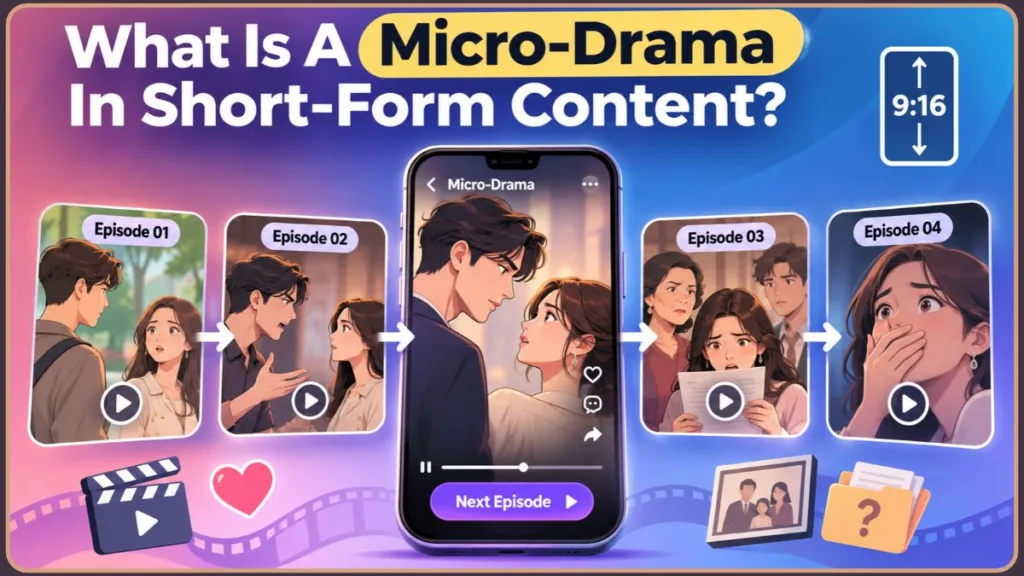
What Is a Micro-Drama, Exactly?
A micro-drama is a scripted story told in a string of very short video episodes, usually shot for your phone screen. The characters stay the same, the plot keeps moving, and each episode picks up where the last one stopped.
Think of a TV drama that has been chopped into tiny pieces. Instead of one 45-minute episode, you get dozens of one- or two-minute chapters. You still get actors, dialogue, conflict and a growing storyline. You just get them in small bites.
Here’s a quick example. Two strangers are forced into an arranged marriage. Episode one sets up the deal. Episode two shows their awkward first dinner. By episode ten, a family secret has shaken everything. Each chapter is short, but together they add up to a full story.
Key Insight: A micro-drama is defined by its continuing story, not just its length. A short dramatic video that stands alone is only a clip. A short episode that depends on what happened before it is a micro-drama.
How to Spot a Micro-Drama in 30 Seconds
You don’t need a definition to recognize one. Ask yourself these questions:
- Does it have an episode number? Series are usually labelled “Ep. 12” or similar.
- Do the same characters return? You should see familiar faces and recurring relationships.
- Does it make sense without the earlier episodes? If the answer is “not really,” it’s probably a micro-drama.
- Is the frame vertical? Most are filmed in a tall 9:16 shape that fills a phone screen.
- Does it end on a question? A secret, a decision or a surprise reaction is the usual giveaway.
Episodes commonly run one to three minutes. Chinese duanju series often go shorter, around 60 to 90 seconds. These are habits, not rules, and runtimes and episode counts change from one app to the next.
Micro-Dramas vs Reels, Shorts and Web Series
Micro-dramas borrow the same phone-first habits that made Instagram Reels, YouTube Shorts and TikTok popular. The difference is what you’re asked to follow.
| Everyday short videos | Micro-dramas | Web series | |
|---|---|---|---|
| Story | Usually one idea per clip | One story across many episodes | One story across episodes |
| Characters | Different every time | Same cast throughout | Same cast throughout |
| Episode length | Seconds to a minute or so | Roughly 1 to 3 minutes | Anything from minutes to an hour |
| Screen shape | Mostly vertical | Mostly vertical | Often widescreen |
| Do you need earlier episodes? | Rarely | Usually | Usually |
| Built for | Scrolling | Following a plot on a phone | Watching online in general |
A funny Reel works even if you’ve never seen the creator before. A micro-drama cliffhanger only lands if you know who the characters are and what they stand to lose. That’s why watching one feels more like binging a show than scrolling a feed.
Why You Can’t Stop Tapping “Next Episode”
There’s a bit of psychology behind the pull, and knowing it helps you stay in control of your time and your wallet.
- Unfinished stories nag at you. Psychologists have long noted that people tend to remember interrupted tasks better than completed ones. A cliffhanger works the same way. Your brain wants closure.
- The commitment feels tiny. Two minutes seems harmless, so it’s easy to say yes. Ten “harmless” episodes later, you’ve spent twenty minutes.
- The stakes are easy to grasp. Betrayal, romance, secrets and revenge need almost no explanation, so you’re emotionally invested within seconds.
- There’s always a next step. The “Next episode” button sits right where your thumb already is.
None of this is sinister, since good storytelling has always worked this way. But it does explain why a free preview can quietly turn into a paid binge. When you notice yourself reaching for a purchase, pause and decide whether you really want to finish this story.
How a Whole Story Fits Into a Few Minutes
Short episodes leave little room for slow build-ups, so writers rely on a few reliable habits.
A quick opening
Many episodes begin mid-conflict: a confrontation, a surprise arrival, a phone call that changes everything. The goal is to give you a question to chase right away, such as who sent the message or what the family is hiding.
A simple shape for each episode
A typical short episode often follows this rhythm:
- Set the scene. Who is here and what do they want?
- Add pressure. A secret, misunderstanding or outside force complicates things.
- Move the story. Someone makes a choice or learns something new.
- Leave a question open. The episode stops before the answer.
This is a handy pattern, not a formula every series follows.
Filming for a phone
A tall frame changes how scenes are shot. Close-ups, reactions and facial expressions carry most of the emotion because there’s little room for wide shots. Directors place characters carefully so the important action stays visible on a small screen. Vertical framing alone doesn’t make a story good, though. The writing still has to explain who’s speaking and why the moment matters.
Cliffhangers, used wisely
Cliffhangers create a curiosity gap: you know enough to care but not enough to rest. They work best when used selectively. If every single episode ends on a shocking twist, the trick gets predictable fast. The better series mix in real progress, like a changed relationship, a revealing conversation or a hard decision.
Where Micro-Dramas Came From
The modern commercial version took off in China, where short dramas are called duanju (短剧). The format grew alongside smartphones and short-video platforms. Producers realized they could release a story in tiny chapters, and apps could deliver those chapters straight to viewers who paid to unlock more.
Chinese series often run for dozens of episodes, and some stretch into the hundreds. Free previews let you sample a story first, then decide whether to pay.
The money involved explains why the rest of the world noticed. A piece in the Yale Journal of International Affairs reported that China’s domestic short-drama market passed 50 billion yuan, roughly US$7 billion, in consumer spending during 2024. That number describes spending inside China, so don’t read it as worldwide revenue.
The format is also moving into mainstream entertainment. In April 2026, TikTok announced a partnership with HOORAE, the production company founded by Issa Rae, to develop original micro-series for TikTok and PineDrama. The first announced title, Screen Time, was described as a free, ad-supported thriller. According to the official announcement, it follows a double-date movie night that goes wrong when a mysterious figure threatens to expose the couples’ secrets.
It’s a useful sign: an established production company is now making scripted stories specifically for short-form viewing.
Story Types You’ll See Most Often
Micro-drama is a format, not a genre. Still, certain stories fit it especially well because the conflict is clear and every episode can reveal something new.
- Romance: Arranged marriages, secret relationships, enemies who slowly fall in love, and second chances after a breakup.
- Revenge and family conflict: Betrayal, hidden identities, inheritance fights and someone returning to settle a score.
- Fantasy: Magical powers, mythical worlds and characters with unusual abilities, with short episodes revealing the rules bit by bit.
- Mystery: A missing explanation drives the plot, and each episode adds a clue or overturns an earlier guess.
- Comedy and workplace stories: Awkward conversations, office rivalries and misunderstandings that stretch across episodes.
Chinese micro-dramas lean heavily on soap-opera favorites such as secret marriages, wealthy families, hidden identities and second chances. Even so, a series only works if its characters can carry more than a single twist.
Where to Watch Micro-Dramas
You can find short dramas on dedicated apps, official channels and social accounts. Catalogues, languages, free previews and prices differ by service and country, so treat this list as a starting point and not a promise that everything is available where you live.
| App | What you’ll typically find |
|---|---|
| ReelShort | Vertical romance, thrillers and scripted series |
| DramaBox | Short dramas across many genres |
| GoodShort | Romantic, family and dramatic stories |
| ShortMax | Mobile-first fictional series |
| FlickReels | Short-drama content for phone viewing |
| PineDrama | A dedicated short-drama app; availability varies by region |
Five Ways to Watch Without Paying for Every Episode
- Use the free episodes as a test. Judge the acting, writing and subtitles before you spend anything. A free preview is a sample, not a promise that the whole series is free.
- Look for rewarded ads. Some apps let you unlock an episode or earn coins by watching an ad. Check the limits, because there may be daily caps or waiting periods.
- Read the daily-reward rules. Login rewards can expire, and streaks may reset if you miss a day.
- Search the publisher’s official YouTube channel. Some producers upload trailers, selected episodes or full series. Make sure it’s the real channel, and remember a trailer isn’t the whole story.
- Follow verified creators and publishers. Instagram and Facebook are good for discovery, but many clips are teasers or reposts. Check who uploaded the video and look for an official link.
Key Insight: A clip in your feed is often an advert for the series, not the series itself. Before you assume the next episode is one tap away, find the official place to watch it.
How to Tell Whether a Micro-Drama App Is Safe
“Micro-drama” is a type of entertainment, not one company. Every app has its own developer, billing rules and privacy policy, so judge each one on its own.
Before you install:
- Download from an official app store where possible.
- Check the developer name, update history, ratings and recent reviews.
- Be wary of anyone offering a modified file or an install outside the normal store.
- Look for repeated complaints about surprise charges, missing episodes or trouble cancelling.
Before you pay:
- Work out what one episode costs in real money, not just coins.
- Find out whether purchased coins and promotional coins follow different rules.
- Check whether a subscription covers every show or only some.
- See whether the plan renews automatically and how to cancel it.
- Read the refund policy.
- Check whether rewards expire.
The number that matters isn’t the price of one episode. It’s the likely cost of finishing the series you actually want.
Permissions and privacy: Read the privacy policy, look at what the app asks to access, and skip permissions that have nothing to do with watching. Use a strong, unique password if you create an account.
Content ratings: Short episodes can still include mature romance, violence or intense scenes. Check the age rating, especially if a child shares your device. Parental controls help, but they don’t replace checking the content yourself.
Avoid unofficial APK files, pirated streaming sites and websites promising unlimited free coins. They can put your device, account and payment details at risk.
How AI Is Changing Micro-Drama Production
Micro-drama describes the storytelling format, not the technology behind it. A series can be filmed with actors and a crew, built partly with AI, or made with a mix of both.
AI can help at several stages:
- Story development: Brainstorming premises, outlining episodes or testing dialogue. A human still has to fix continuity and make the characters’ choices believable.
- Visuals: Generating backgrounds, character designs or selected scenes. Creators need to check that people and places look the same from shot to shot.
- Voice and language: Synthetic voices, translation and dubbing. Timing, emotion and lip-sync still need review.
- Editing: Subtitles, rough cuts and visual effects can go faster with AI help, though creative decisions stay with people.
AI-Made vs Live-Action Micro-Dramas
| AI-generated or AI-assisted | Live-action | |
|---|---|---|
| What’s used | AI for some or most visuals or audio | Real performers in real or built sets |
| Production needs | Can reduce some filming and post-production work | Actors, crew, locations and shooting time |
| Strength | Easy to experiment with imagined settings | Captures human performance |
| Watch out for | Inconsistent faces, voices or details | Continuity across scenes, costumes and locations |
| Still required | A strong story and creative direction | A strong story and creative direction |
Neither approach guarantees a good show. A beautiful AI clip can still have a confusing plot, and a well-acted live-action scene can still be badly written. The real test for you as a viewer is simple: can you follow the characters and do you care what happens next?
What Creators Are Saying
Online reactions are mixed. In a thread on r/FacelessVideos, one person described a relative enjoying AI-generated micro-dramas, while another saw AI as a way to try out new plots and endings. A discussion on r/Filmmakers raised a different worry: what happens to actors and crews if more live-action work is replaced? One participant described losing regular work after a company moved toward AI-generated methods.
These are individual opinions, not research or proof of an industry-wide trend. They do show the questions creators are wrestling with, including cost, creative control, audience acceptance and the role of human performers.
How Micro-Drama Apps and Creators Make Money
Understanding the business model explains why some episodes are free and others aren’t. Many apps use a freemium approach: the opening episodes cost nothing, and the rest are unlocked through payment, ads or a subscription.
- Coins and paid unlocks: You buy virtual coins and spend them on locked episodes. It’s flexible, but small purchases add up fast across a series of dozens of episodes.
- Subscriptions: Weekly, monthly or quarterly plans may remove some ads or open a catalogue. They don’t always unlock every title, so read the details.
- Ads and rewarded viewing: Some apps show ads between episodes, while others give you coins or an unlocked episode for watching one.
- Sponsorships and brand deals: A company can fund a series or place a product inside the story itself.
How the People Behind the Series Get Paid
Writers, producers and studios may earn through:
- Licensing and distribution deals.
- Platform commissions or production contracts.
- Revenue-sharing agreements.
- Sponsorships and brand partnerships.
- Owning a series and licensing it later.
A popular series isn’t automatically a profitable one. Earnings depend on production and marketing costs, how many viewers finish the story, platform terms, and who owns the rights.
What a Series Costs to Make
There’s no single price. A dialogue-heavy story filmed in a few locations is far cheaper than a fantasy series with stunts and special effects. A production budget may cover scriptwriting, cast and crew, locations and costumes, sound and editing, subtitles, dubbing, trailers and distribution. Short episodes mean less to watch at once, but a full season can still involve a lot of footage. AI may trim some tasks, but it doesn’t remove the need for a coherent script, careful editing and quality checks.
Branded Micro-Dramas: When Companies Tell Stories
A branded micro-drama is a scripted series made or funded by a company, with its product or identity built into the plot. Instead of a direct sales pitch, you’re invited to follow characters. It only works when the brand has a natural place in the story. If every scene exists to show off a product, you’ll notice the advert before you care about the people.
Case Study 1: Crocs and Charmed to Meet You
Crocs teamed up with ReelShort on a romantic micro-drama inspired by a real story from a Crocs employee. The plot uses Jibbitz charms, the little accessories people clip onto their shoes, as the reason two neighbors connect.
According to the Shorty Awards case study, the series passed 4.5 million views within a week and later reached nearly eight million views on ReelShort. You can find the title on its ReelShort page. The takeaway is that the product mattered to the plot. The charms weren’t just visible; they helped bring the characters together.
Case Study 2: P&G and Albertsons with Rico’s Tacos
Procter & Gamble worked with Albertsons Media Collective on a scripted series about a family starting a taco business. Products from participating P&G brands appear naturally in the story and setting. Episodes run roughly one to two minutes and were designed for Albertsons’ YouTube, social and in-store channels. The eMarketer report explains how shopper insights shaped the project, showing how a retailer can use its own media channels to support episodic content.
Case Study 3: JCPenney and Spanish-Language Storytelling
JCPenney partnered with TelevisaUnivision on a five-part Spanish-language microdrama, El amigo de mi novio es millonario (“My Boyfriend’s Friend Is a Millionaire”). Marketing Dive reported more than 16 million impressions and 5.6 million video views. It shows how language and familiar story conventions can help a brand reach a specific audience.
What Makes a Branded Micro-Drama Work
If you run a business or manage marketing, keep three things in mind:
- Tell a story people would watch anyway. The characters and conflict should hold attention without the product.
- Give the brand a believable job. It should fit the setting or move the plot forward.
- Plan where it will appear and what success means. Decide whether you want awareness, product discovery or sales.
Marketing Dive also warns that brands risk treating the format as a passing trend or stuffing stories with product promotion. Entertainment has to come first.
Accessibility Tip: Make Short Dramas Easier to Watch
Fast-paced, phone-sized stories can be tiring to follow, so adjust what you can:
- Turn on subtitles or captions if the app offers them, and check their quality before you pay for a series.
- Increase your phone’s text size and display zoom so subtitles are readable.
- Use headphones in noisy places so you don’t miss dialogue.
- Try a tablet or larger screen if small vertical frames are hard on your eyes.
- Take breaks. Short episodes make it easy to watch far longer than you planned.
Subtitle quality varies a lot between series, so treat it as part of your free-preview test.
Tools and Habits for Smarter Viewing
- A notes app or screenshot: Jot down the series name and where you found it, so you can return to the official source.
- A spending limit: Decide your coin budget before you start.
- A calendar reminder: If you start a free trial or subscription, set a reminder to cancel before it renews.
- Your app store’s subscription page: Check it regularly to see what you’re paying for.
Will Micro-Dramas Replace TV?
Probably not. Films and long-form series meet a different need. If you want a feature-length story or a richly built TV episode, those formats will still be around. Micro-dramas suit moments when you want a continuing story in short sessions on your phone.
The format does open doors for writers, actors, independent producers, platforms and advertisers. It also brings real challenges: repeated plots, payment systems that frustrate viewers, and questions about AI and production jobs. Another challenge is the stories themselves. If every episode is only a cliffhanger, viewers may keep tapping without getting enough character growth or payoff.
In the long run, its value will depend on whether the writing, performances, distribution and payment experience give you a reason to keep coming back.
Frequently Asked Questions
What is a micro-drama in simple words?
It’s a scripted fictional series split into short video episodes. The same characters and storyline continue from one episode to the next, usually in a format made for phones.
How long is a micro-drama episode?
Many last about one to three minutes. Chinese duanju series often run closer to 60 to 90 seconds, though it varies by platform.
How many episodes does a micro-drama have?
There’s no fixed number. Some run a few dozen episodes, others far more, depending on the story and the platform.
Is a micro-drama the same as a TikTok video?
No. A TikTok can be a standalone clip. A micro-drama is a connected fictional series with recurring characters. TikTok can host micro-dramas, but the format isn’t tied to one platform.
Can you watch micro-dramas for free?
Often partly. Some apps give free preview episodes, rewarded-ad unlocks or selected episodes on official YouTube and social channels. Other episodes may need coins or a subscription, so check the full cost first.
Are all micro-dramas made with AI?
No. Many use real actors and crews. Others use AI for backgrounds, voices, editing or video generation, and some mix both.
How do micro-drama apps make money?
Through paid unlocks, virtual coins, subscriptions and advertising. Creators and production companies may earn through licensing, contracts, distribution deals, sponsorships and revenue-sharing.
What is a branded micro-drama?
A fictional series that includes a company’s product or identity in the story, designed to entertain while building awareness or interest.
Where did micro-dramas start?
The modern commercial format became especially successful in China, where it’s known as duanju, and has since spread to other markets.
How is a micro-drama different from a web series?
A web series can use any episode length or screen shape. Micro-dramas are generally built around very short episodes and phone-first viewing, often in a vertical frame.
Final Tip: Sample First, Pay Later
If you’re curious about micro-dramas, start with the free episodes, find the official place to watch the full series, and work out the total cost before you unlock anything. Treat a cliffhanger as an invitation, not a bill.
Micro-dramas bring serialized storytelling into the short-video world. The episodes are small, but what keeps you watching is the same as in any good drama: characters you care about, conflicts that develop and episodes that give you more than another abrupt ending.
Have you watched a micro-drama yet, and did you finish it or stop at the paywall? Tell us which apps or series you’ve tried in the comments. Your experience might save another reader some coins.
Visit Our Post Page: Blog Page
Discover more from Izoate
Subscribe to get the latest posts sent to your email.