
Curious about what Amazon thinks about you? Learn how to see Amazon About You in 2026, find your profile, check its insights, and edit incorrect information.
Amazon has a new way to show you something it has been doing for years: building a picture of your shopping interests and preferences from your activity.
The difference is that Amazon now gives you a place to look at some of those assumptions.
That is what Amazon About You does.
You can open the feature from the Amazon Shopping app, mobile web, or desktop, then review personal details and preferences Amazon associates with your account. You can also provide feedback, update certain information, or remove details you do not want used for personalization.
And yes, some of the observations can be surprisingly specific.
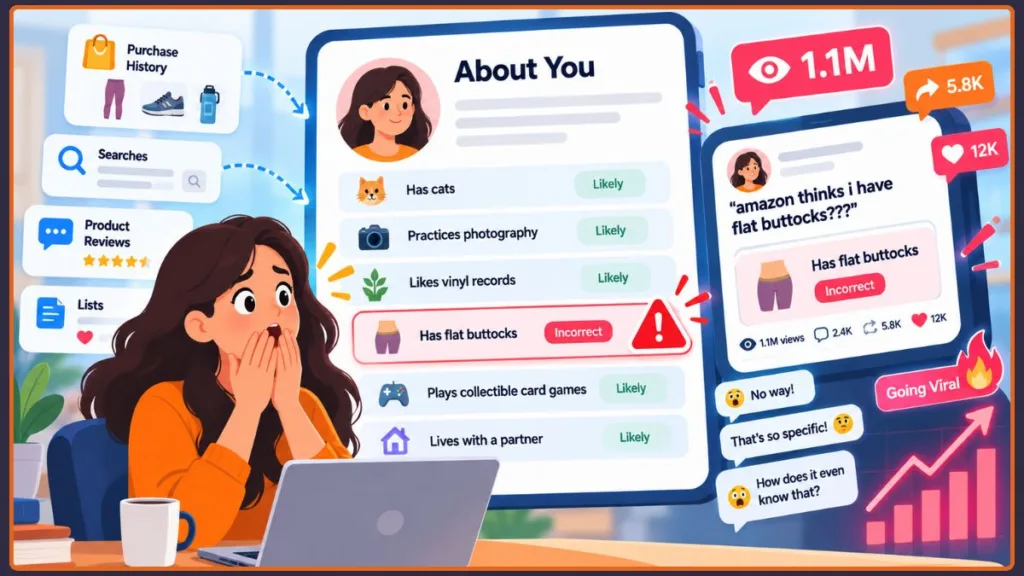
Recent users have reported profiles containing everything from ordinary interests such as having cats, practicing photography, collecting vinyl records, or preferring comfortable clothing to much stranger conclusions, including the viral “has flat buttocks” observation that attracted more than one million views on Threads in less than a day.
So, how do you see what Amazon thinks about you?
Here is where to find it and what the information actually means.
What Is Amazon About You and What Does It Show?
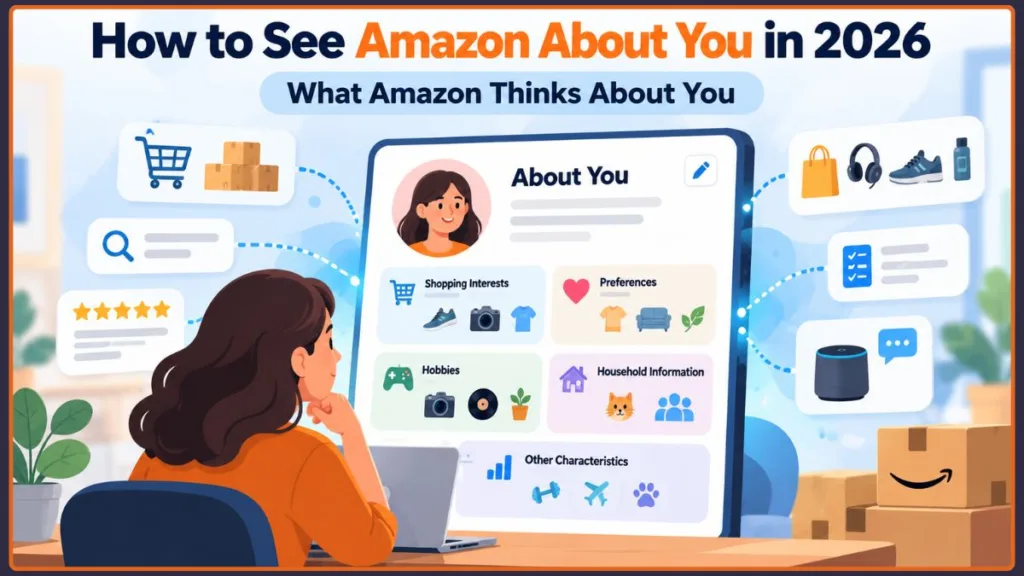
Amazon About You is a view of personal details and preferences that Amazon uses to personalize your shopping experience.
Amazon says the information behind personalization can include your purchase history, searches, Lists, product reviews, and conversations with Alexa for Shopping. Amazon About You gives customers a central place to view and update some of those preferences.
That makes About You different from your normal Amazon recommendations.
Recommendations simply appear as products Amazon thinks you might want. About You gives you a more direct look at some of the information and assumptions behind that personalization.
It does not mean Amazon has created a definitive biography of you. The observations are better understood as inferences based on signals from your activity.
For example, buying cat litter regularly may make it reasonable for Amazon to infer that you have a cat. Repeatedly shopping for photography equipment could contribute to an inference that you practice photography.
Sometimes the inference may be right.
Sometimes it may be very wrong.
And sometimes it may be oddly specific.
Tip: Think of About You as a window into Amazon’s assumptions, not a perfect record of who you are.
Amazon About You vs. Your Regular Recommendations
Amazon has personalized recommendations for years.
What makes About You different is visibility.
Normally, Amazon can use signals from your activity behind the scenes to decide which products, categories, or suggestions to show you. About You turns some of those conclusions into something you can actually inspect.
That means the interesting part is not necessarily that Amazon has started making these kinds of inferences.
It is that Amazon is now showing you some of them directly.
How to Find Your Amazon About You Profile
Amazon’s About You feature can be accessed through the Amazon Shopping app, mobile web, or desktop, although the exact navigation labels can vary as Amazon updates its interface.
Find Amazon About You in the Shopping App
- Open the Amazon Shopping app.
- Go to the Me tab.
- Tap your name.
- Select About You.
Recent reporting has also found the feature under Account → Shopping preferences → About you, so the exact menu wording may differ between app versions or interfaces.
Practical tip: If you do not see About You immediately, check Account → Shopping preferences as well. Amazon’s navigation can vary between versions.
Find Amazon About You on Desktop
- Open Amazon and sign in.
- Hover over your name in the upper-right corner.
- Click your name or select your profile through Who’s shopping?
- Select About You.
Older versions of Amazon’s navigation have exposed the same information through Account → Ordering and shopping preferences → Your Shopping preferences → Manage your information. That path may still appear for some accounts or interface versions.
What You Should See in Your About You Profile
Once you reach About You, Amazon can present a list of personal details, preferences, interests, household information, or other characteristics associated with your shopping behavior.
This is the part many people find interesting.
You may recognize yourself immediately—or wonder how Amazon arrived at a particular conclusion.
What Information Does Amazon About You Show?
The observations can cover ordinary shopping preferences and interests, but they can also extend into broader characteristics Amazon has inferred from patterns in your activity.
Shopping Interests and Preferences
Some observations are relatively straightforward, such as:
- Has cats
- Cares for a cat
- Consistently invests in cat care
- Prefers clothing that prioritizes comfort
- Shops for particular product categories
- Has particular dietary or shopping preferences
These types of observations are easier to understand because there is often an obvious connection between repeated shopping activity and the conclusion.
Hobbies, Products, and Lifestyle Inferences
Other observations can go beyond individual purchases and describe broader interests or habits.
Reported examples have included:
- Practices photography
- Plays collectible card games
- Is invested in the Apple ecosystem
- Reads diverse non-fiction
- Likes vinyl records
- Likes ceramics
- Prefers natural materials in home décor
- Probably owns a Shark robot vacuum
- Uses a phone in the shower to read Kindle books
- Does not trust people easily
Some users have also reported more personal observations such as:
- Has a husband
- Husband has skinny legs
- Has a bad father
- Treats cats as biological children
These examples come from independent reporting and user-submitted experiences, rather than an Amazon-published master list of every possible category. They therefore show the kinds of observations people have encountered, not a definitive list of everything Amazon can infer.
Why Some Amazon Inferences Can Be Surprisingly Specific
The most widely discussed example was a Threads user’s discovery that Amazon believed she “has flat buttocks.”
The post went viral, gathering more than one million views in less than a day.
The user speculated that the conclusion could have come from buying “butt scrunch leggings.” That may be possible, but it was her hypothesis, not something Amazon publicly confirmed.
Important: We know the observation appeared. We do not necessarily know the exact purchase, search, model, or rule that generated it.
Other reported examples have included Amazon concluding that a user did not know what truffle was supposed to taste like, or identifying characteristics of a person’s household and shopping habits.
The unusual examples are memorable, but the larger point is straightforward:
Amazon can turn patterns in everyday shopping activity into surprisingly specific assumptions about a customer.
How Does Amazon Create Your About You Profile?
Amazon describes personalization as a process that can use different types of customer activity to make shopping recommendations more relevant.
At a high level, the process looks like this:
Activity → patterns → inferred preferences → personalization
The Signals Amazon Uses
Amazon says personalization can use information such as:
- Purchase history
- Searches
- Orders
- Lists
- Product reviews
- Conversations with Alexa for Shopping
Amazon can combine these signals rather than relying on a single purchase or search.
For example, one unusual order may not say much about you. A repeated pattern of related purchases, searches, saved items, and conversations can provide much more context.
From Shopping Activity to Personal Inferences
Imagine that you repeatedly search for gardening tools, save seeds to a List, and purchase gardening supplies.
Amazon does not necessarily need you to explicitly tell it, “I am interested in gardening.”
The collection of those actions can become evidence of that preference.
The same basic logic can explain many of the observations users have reported.
Amazon itself gives examples of this type of personalization, including using conversations about pets, Lists containing gardening products, and repeated purchases of non-dairy milk to make related recommendations.
But there is an important limitation: Amazon has not publicly explained the exact technical logic behind every individual About You observation.
Warning: Be careful with claims that a specific purchase or search definitely caused a specific About You observation unless Amazon has confirmed that connection.
Amazon’s broader advertising documentation also describes rules-based and model-based profiling techniques for creating audiences around shopping and entertainment interests.
That provides useful context about Amazon’s wider personalization and advertising systems, but it should not be treated as a complete technical explanation of how every About You entry is generated.
Amazon has also continued expanding AI-powered shopping through Rufus and Alexa for Shopping, bringing more personalized assistance into the buying process.
The broader direction is clear: more shopping context is being turned into personalized recommendations and assistance.
What If Amazon Gets Something About You Wrong?
Amazon may know that you:
- searched for something
- bought something
- reviewed something
- saved something to a List
- discussed something with Alexa
But that does not necessarily tell Amazon why you did it.
You could have bought a product as a gift, searched for something you were only researching, purchased something for another person, shared an Amazon household, temporarily developed an interest, or simply made an unusual purchase once.
The system sees behavior.
It may not know the complete context behind that behavior.
Why Amazon’s Inferences Can Be Incorrect
That is why an About You observation should be treated as an inference rather than a verified fact.
Independent reporting has already found mixed results. Some observations were surprisingly accurate, while others were incorrect or difficult to explain.
A profile might correctly identify an interest in photography while getting another personal detail completely wrong.
Another user might see an inference that seems obvious from years of purchases, while a very specific observation may appear to come from nowhere.
The important distinction is:
Amazon observed a signal.
Amazon interpreted that signal.
The interpretation may or may not be correct.
How to Edit or Remove an About You Detail
Amazon says About You is editable.
Customers can provide feedback, update information, or remove information they do not want used for personalization.
That makes the feature more useful than simply being a curiosity page.
Preferences change. Searches become irrelevant. Household circumstances change. Something you purchased last year may have nothing to do with what you want today.
When you open an observation, review the available controls and use the options Amazon provides to correct or remove information where possible.
Practical advice: Review surprising or outdated observations rather than assuming they are permanent. About You is something you can review, not something you have to accept as fact.
Amazon also says customers can ask Alexa for Shopping, “What do you know about me?”, to learn more about their personalized shopping information and update preferences.
Why Can’t I Find Amazon About You?
If you cannot see the feature, the problem may be the interface rather than the feature itself.
Check the Correct Amazon Account
Make sure you are signed into the same Amazon account you normally use for shopping.
This matters particularly if you use multiple Amazon accounts, household profiles, or different sign-in methods.
Try the App and Desktop Versions
Check both the Amazon Shopping app and the desktop site.
Amazon’s menu structure can differ between platforms, and current and older interfaces have surfaced About You through different paths.
Look for variations such as:
Me → Your name → About You
or:
Account → Shopping preferences → About you
On desktop, you may also encounter the older:
Your Shopping preferences → Manage your information
route.
What to Do If About You Still Doesn’t Appear
Update the Amazon Shopping app and check your account again.
Also remember that Amazon can change account navigation and feature availability over time. An option that appears for one customer may not be presented in exactly the same place for another.
Tip: A missing About You option does not automatically mean Amazon has no personalized information about your account. It may simply mean the feature is being surfaced differently in your current interface.
Is Amazon About You the Same as Your Amazon Profile?
Not exactly.
The phrase Amazon profile can refer broadly to information associated with your Amazon account, while About You is specifically focused on details and preferences used to personalize your shopping experience.
That is why About You is interesting.
Your normal Amazon activity might tell Amazon what you bought.
About You can show you what Amazon thinks that activity says about you.
What Makes About You Different?
About You is less like a traditional public-facing social profile and more like a customer-facing view of inferred shopping information.
It gives you a way to inspect some of the assumptions that would otherwise remain hidden inside a personalized shopping system.
What Does Amazon About You Mean for Your Privacy?
The privacy question is not simply whether Amazon knows that you buy cat litter or photography equipment.
The larger issue is how much can be inferred when many individual signals are combined.
Amazon’s Broader Use of Customer Profiling
Amazon explicitly says personalization can draw on shopping history, searches, Lists, product reviews, and Alexa interactions.
Separately, Amazon’s advertising documentation describes profiling systems that can group customers according to shopping and entertainment interests using rules-based and model-based techniques.
That does not mean every About You observation is used for advertising.
It also does not mean Amazon’s advertising documentation provides a complete technical blueprint for About You.
It does show, however, that Amazon’s broader ecosystem can use behavioral patterns to understand what kinds of products, services, and interests may be relevant to a customer.
Amazon has also faced regulatory scrutiny over other forms of customer data handling. In 2023, the FTC and Department of Justice alleged that Amazon retained children’s Alexa voice recordings and geolocation information in violation of children’s privacy law, including information connected to deletion requests. Amazon agreed to a $25 million settlement and changes to its privacy practices.
That case involved Alexa and children’s data, not About You, so it should not be presented as evidence that About You itself violated privacy law.
Why Seeing Your Inferences Matters
About You makes the relationship between behavior and profiling more visible.
Instead of only seeing a recommendation for a product, you can sometimes see the assumption Amazon has associated with your behavior.
That visibility can be useful.
It can also be uncomfortable.
The important thing is understanding what you are looking at: a personalization system’s interpretation of your activity, not necessarily a complete or perfectly accurate description of you.
Is Amazon About You Accurate?
Sometimes. Not necessarily always.
Amazon’s personalization system is built from signals about customer activity and preferences. That makes the resulting profile useful, but it also makes it dependent on the quality and context of those signals.
Independent reporting has found both accurate and inaccurate observations.
Some inferences can feel almost obvious because they are supported by years of consistent shopping behavior.
Others can be surprisingly specific without an obvious explanation.
The safest way to interpret an About You entry is:
“Amazon inferred this from my activity.”
Not:
“Amazon has verified this as a fact about me.”
That distinction becomes especially important when the observation concerns something personal.
What Amazon About You Really Tells You
For years, personalized recommendations have worked quietly in the background.
About You makes some of that personalization visible.
That is the real change.
You can now see how Amazon connects your shopping behavior with interests, preferences, household details, and other characteristics—and, when an observation is outdated or wrong, Amazon gives you tools to provide feedback or remove information.
So the answer to “How do I see what Amazon thinks about me?” is straightforward: open About You from your Amazon account and review the information associated with your shopping experience.
Just remember what you are looking at.
It is not a secret biography.
It is a collection of Amazon’s interpretations of your behavior.
And sometimes, apparently, those interpretations are much more specific than anyone expected.
Visit Our Post Page: Blog Page
Discover more from Izoate
Subscribe to get the latest posts sent to your email.